

This physics problem tests your understanding of fundamental physical laws and their applications. The step-by-step solution below breaks down the problem using relevant equations and physical reasoning.
ScanSolve AI Answer
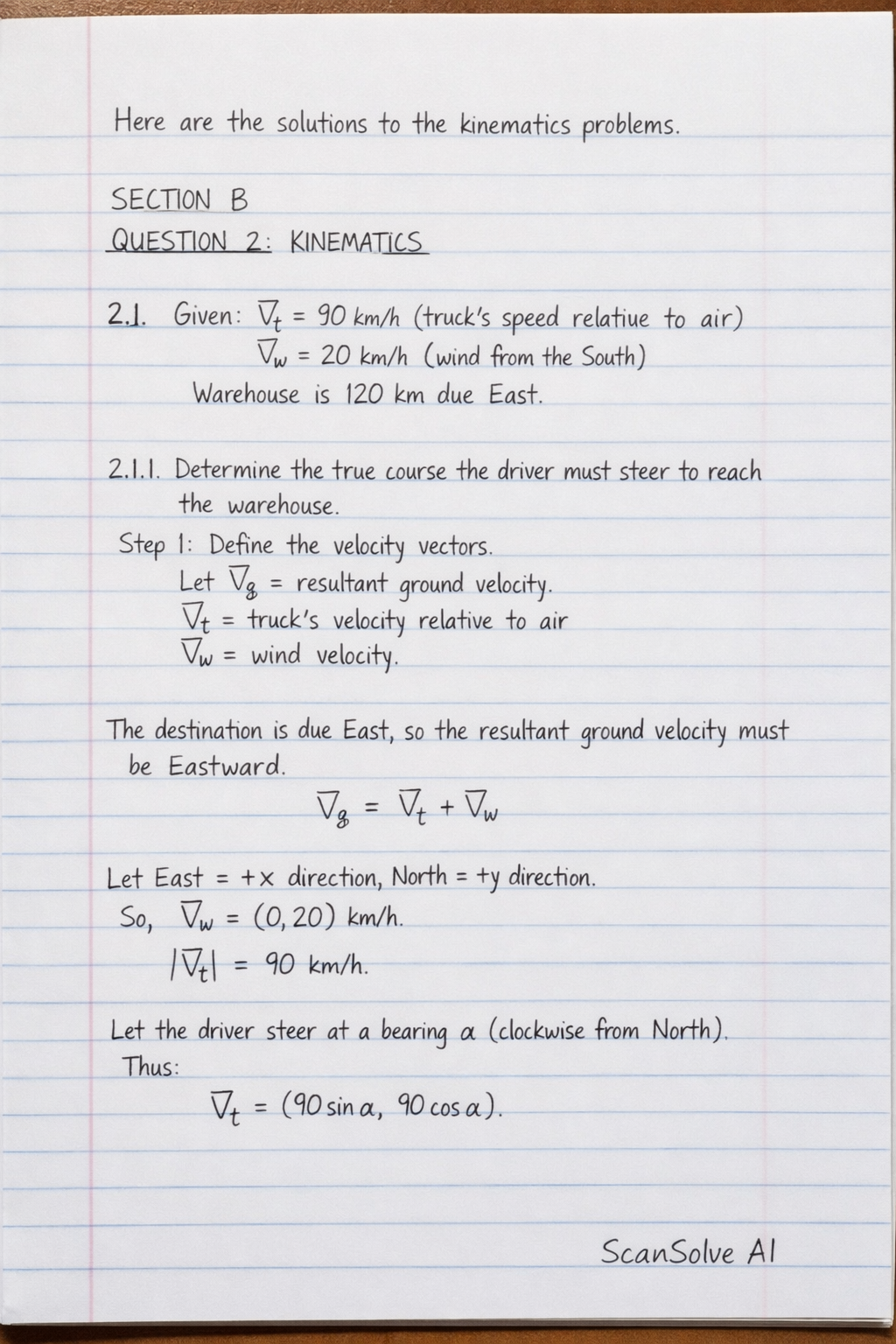
Here are the solutions to the kinematics problems. SECTION B QUESTION 2: KINEMATICS 2.1 Given: Truck's speed relative to air V_t = 90 km/h. Wind velocity V_w = 20 km/h from the South (i.e., blowing North). Warehouse is 120 km due East. 2.1.1 Determine the true course the driver must steer to reach the warehouse. Step 1: Define the velocity vectors. Let the resultant ground velocity be V_g, the truck's velocity relative to air be V_t, and the wind velocity be V_w. The destination is due East, so the resultant ground velocity must be purely in the East direction. The wind blows North. We have the vector equation: V_g = V_t + V_w Let East be the positive x-direction and North be the positive y-direction. The wind velocity is V_w = (0, 20) km/h. The magnitude of the truck's velocity relative to air is |V_t| = 90 km/h. Let the driver steer at a bearing (clockwise from North). So, V_t = (90 , 90 ). The resultant ground velocity is V_g = (V_gx, 0), where V_gx is the ground speed towards East. Step 2: Set up and solve the component equations. Substituting the components into the vector equation: (V_gx, 0) = (90 , 90 ) + (0, 20) Equating the y-components: 0 = 90 + 20 90 = -20 = -(20)/(90) = -(2)/(9) Step 3: Calculate the bearing. = (-(2)/(9)) ≈ 102.89^ The driver must steer at a bearing of 102.89^ true. The true course the driver must steer is 102.89^ true. 2.1.2 Calculate how long the journey will take. Step 1: Calculate the magnitude of the resultant ground velocity. From the x-components: V_gx = 90 Using = -(2)/(9), we can find . Since is in the second quadrant (102.89^), is positive. = sqrt(1 - ^2) = sqrt(1 - (-(2)/(9))^2) = sqrt(1 - (4)/(81)) = sqrt((77)/(81)) = sqrt(77)9 V_gx = 90 × sqrt(77)9 = 10sqrt(77) km/h V_gx ≈ 10 × 8.775 ≈ 87.75 km/h Step 2: Calculate the time taken for the journey. The distance to the warehouse is D = 120 km. Time = DistanceSpeed T = 120 km87.75 km/h T ≈ 1.3675 hours Converting to minutes: T ≈ 1.3675 × 60 minutes ≈ 82.05 minutes The journey will take approximately 82.05 minutes. 2.2 Given: Initial height h_0 = 48 m. Initial velocity u = 18 m/s. Angle = 25^ above horizontal. Acceleration due to gravity g = 9.8 m/s^2 (downwards). Step 1: Resolve initial velocity into components. u_x = u = 18 (25^) ≈ 18 × 0.9063 = 16.313 m/s u_y = u = 18 (25^) ≈ 18 × 0.4226 = 7.607 m/s 2.2.1 The maximum height above the ground reached by the ball. Step 2: Calculate the vertical displacement from the projection point to the maximum height. At maximum height, the vertical velocity v_y = 0. Using the kinematic equation v_y^2 = u_y^2 + 2a_y y: 0^2 = (7.607)^2 + 2(-9.8) H_rel 0 = 57.866 - 19.6 H_rel H_rel = (57.866)/(19.6) ≈ 2.952 m Step 3: Calculate the maximum height above the ground. H_max = h_0 + H_rel = 48 m + 2.952 m = 50.952 m The maximum height above the ground reached by the ball is 50.95 m. 2.2.2 The horizontal distance from the foot of the building where the ball hits the ground. Step 1: Calculate the total time of flight. The ball starts at y_0 = 48 m and hits the ground at y = 0 m. Using the kinematic equation y = y_0 + u_y t + (1)/(2) a_y t^2: 0 = 48 + 7.607 t + (1)/(2)(-9.8) t^2 0 = 48 + 7.607 t - 4.9 t^2 Rearranging into a quadratic equation: 4.9 t^2 - 7.607 t - 48 = 0 Using the quadratic formula t = -b ± sqrt(b^2 - 4ac)2a: t = -(-7.607) ± sqrt((-7.607)^2 - 4(4.9)(-48))2(4.9) t = 7.607 ± sqrt(57.866 + 940.8)9.8 t = 7.607 ± sqrt(998.666)9.8 t = (7.607 ± 31.602)/(9.8) We take the positive root for time: t = (7.607 + 31.602)/(9.8) = (39.209)/(9.8) ≈ 4.001 s Step 2: Calculate the horizontal distance. The horizontal distance x is given by x = u_x t: x = 16.313 m/s × 4.001 s ≈ 65.268 m The horizontal distance from the foot of the building where the ball hits the ground is 65.27 m. 2.2.3 The time taken for the ball to hit the ground. The time taken for the ball to hit the ground was calculated in 2.2.2. t ≈ 4.001 s The time taken for the ball to hit the ground is 4.00 s. 2.3 Given: Phase 1: Accelerates from rest (u_1 = 0) to v_1 = 72 km/h in t_1 = 45 s. Phase 2: Travels at constant speed (v_2 = 72 km/h) for t_2 = 3 minutes. Phase 3: Brakes uniformly to rest (v_3 = 0) in t_3 = 60 s. Step 1: Convert velocities to SI units. 72 km/h = 72 × 1000 m3600 s = 20 m/s Convert time for Phase 2 to seconds: t_2 = 3 minutes = 3 × 60 s = 180 s 2.3.1 Calculate the acceleration of the train. Step 2: Calculate acceleration during Phase 1. Using the kinematic equation v_1 = u_1 + a t_1: 20 m/s = 0 + a (45 s) a = (20)/(45) m/s^2 = (4)/(9) m/s^2 a ≈ 0.444 m/s^2 The acceleration of the train is 0.444 m/s^2. 2.3.2 Determine the total distance travelled by the train from the start until it comes to rest. Step 1: Calculate distance for Phase 1 (acceleration). Using s_1 = u_1 t_1 + (1)/(2) a t_1^2: s_1 = (0)(45) + (1)/(2) ((4)/(9)) (45)^2 s_1 = (2)/(9) × 2025 = 2 × 225 = 450 m Step 2: Calculate distance for Phase 2 (constant speed). s_2 = v_2 t_2 = (20 m/s)(180 s) = 3600 m Step 3: Calculate distance for Phase 3 (deceleration). First, find the deceleration a_3. Using v_3 = u_3 + a_3 t_3: 0 = 20 + a_3 (60) a_3 = -(20)/(60) = -(1)/(3) m/s^2 Now, calculate the distance s_3 using s_3 = u_3 t_3 + (1)/(2) a_3 t_3^2: s_3 = (20)(60) + (1)/(2) (-(1)/(3)) (60)^2 s_3 = 1200 - (1)/(6) (3600) = 1200 - 600 = 600 m Step 4: Calculate the total distance. S_total = s_1 + s_2 + s_3 = 450 m + 3600 m + 600 m S_total = 4650 m The total distance travelled by the train is 4650 m. Send me the next one 📸