
We read your photo as:
Calculate for the total energy required when the old bonds are broken. Show full working out
ScanSolve AI Answer
Answer
Step-by-step solution
3 stepsTo calculate the total energy required when old bonds are broken, we need to know the specific chemical reaction taking place. Since the reaction is not provided, we will assume a common addition reaction involving an alkene and hydrogen iodide (HI), as the bond energies for , , and are given in the table.
Let's assume the reaction is the addition of hydrogen iodide to an alkene, for example:
In this reaction, the "old bonds" that are broken are one bond and one bond.
Identify the bonds to be broken.
Based on the assumed reaction, the bonds broken are:
- One bond
- One bond
Retrieve the bond energy values from the provided table.
- Energy of bond =
- Energy of bond =
Calculate the total energy required to break these bonds.
The total energy required to break the old bonds is the sum of the energies of the bond and the bond.
The total energy required when the old bonds are broken is .
Try one yourself
A new problem that tests the same skill.
Still stuck on this one?
Ask a follow-up, and the answer starts from this question.
More Physics Questions
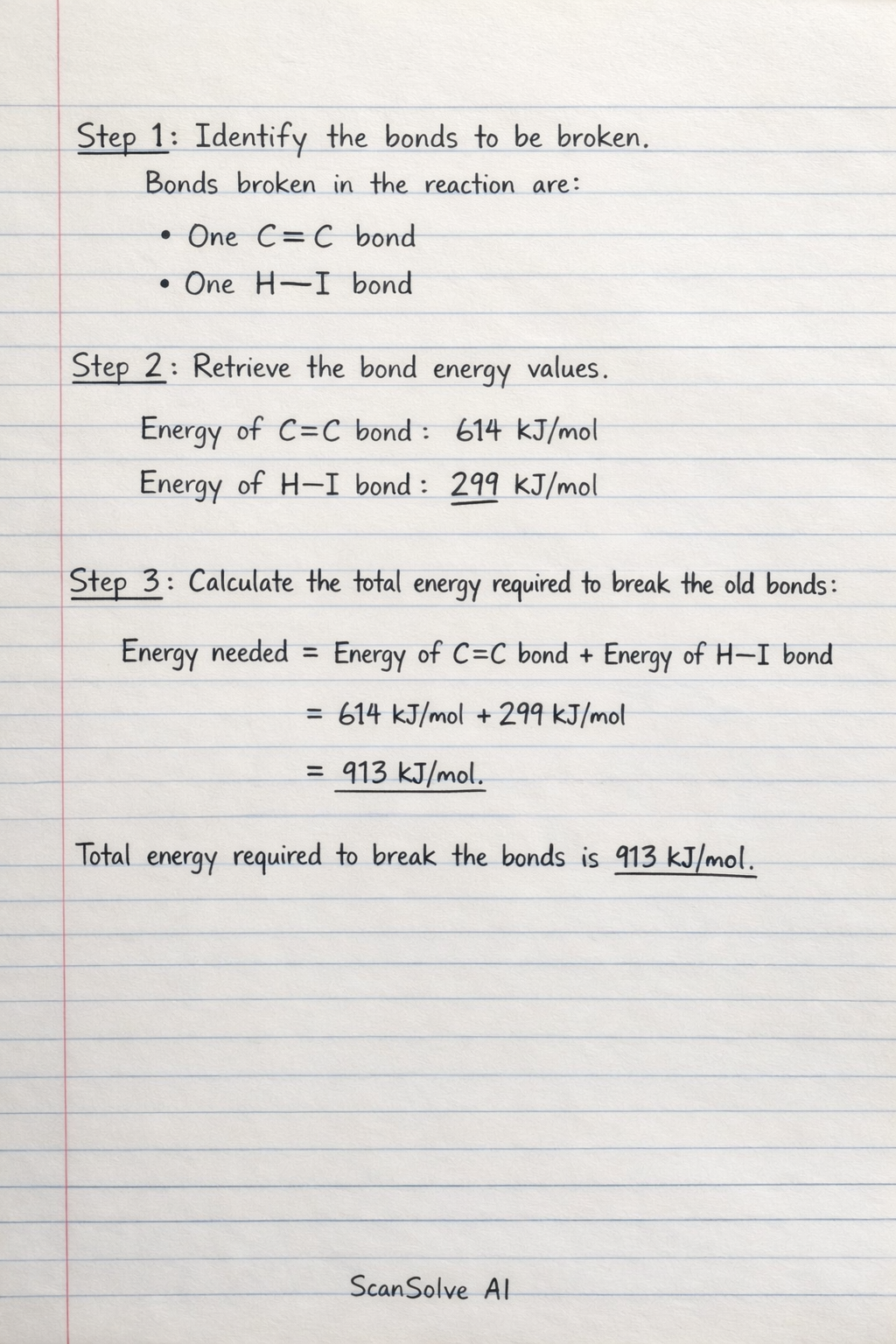
Handwritten Step-by-Step Solution
Get this as a handwritten image on WhatsApp — like a tutor wrote it for you.
Try on WhatsApp