
Force and Newtons laws
ScanSolve AI Answer
Here are the important points about Force and Newton's Laws:
-
Force Definition: A force is a push or a pull that can cause an object with mass to change its velocity (i.e., to accelerate). It is a vector quantity, having both magnitude and direction. The SI unit of force is the Newton ().
-
Newton's First Law (Law of Inertia): An object at rest stays at rest, and an object in motion stays in motion with the same speed and in the same direction unless acted upon by an unbalanced external force. This law defines inertia, which is an object's resistance to changes in its state of motion.
-
Newton's Second Law (Law of Acceleration): The acceleration of an object is directly proportional to the net force acting on it and inversely proportional to its mass. The direction of the acceleration is in the direction of the net force. Mathematically, this is expressed as:
where is the net force, is the mass, and is the acceleration.
-
Newton's Third Law (Law of Action-Reaction): For every action, there is an equal and opposite reaction. This means that if object A exerts a force on object B, then object B simultaneously exerts an equal and opposite force on object A. These forces act on different objects and are always equal in magnitude and opposite in direction.
Still stuck on this one?
Ask a follow-up, and the answer starts from this question.
More Physics Questions
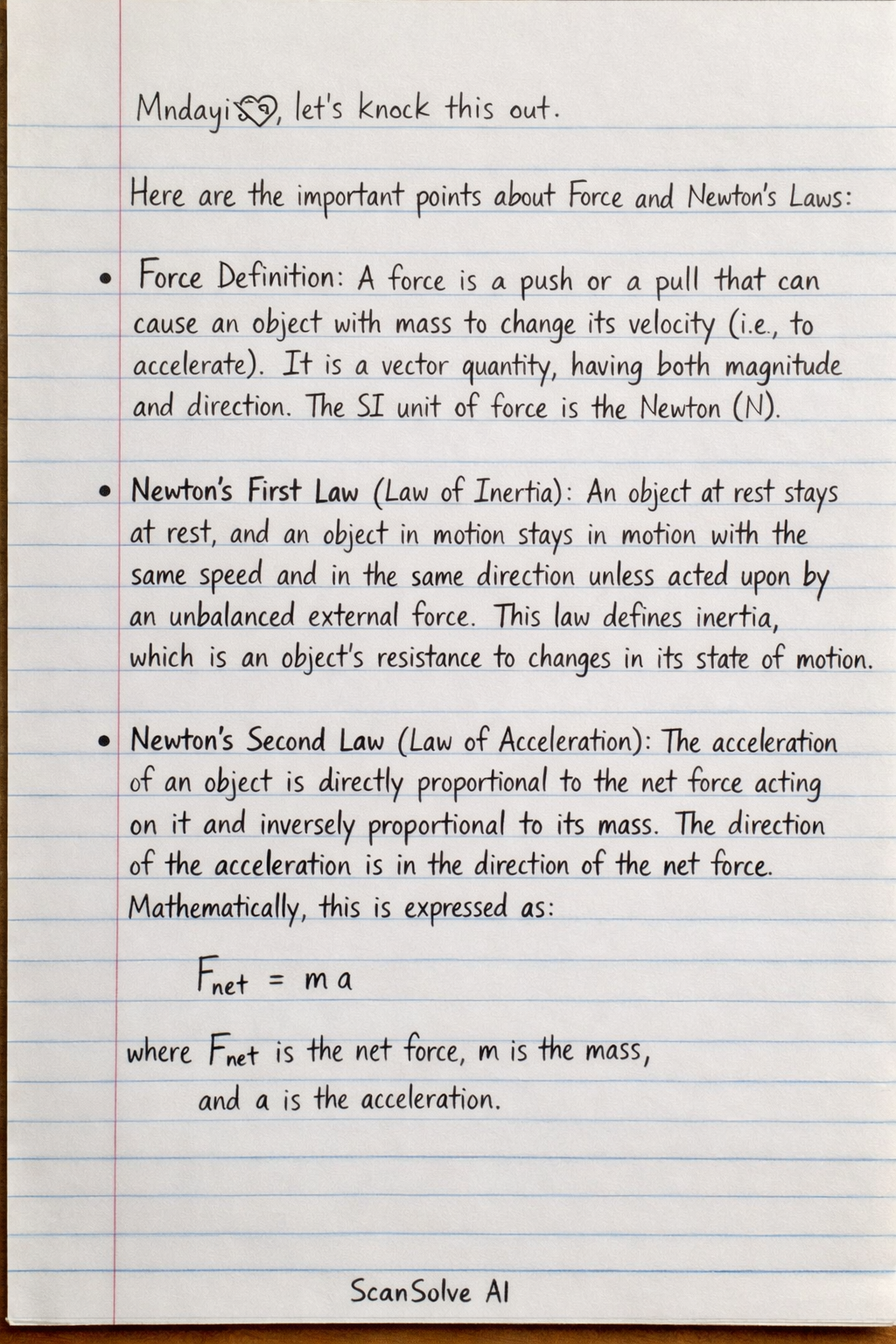
Handwritten Step-by-Step Solution
Get this as a handwritten image on WhatsApp — like a tutor wrote it for you.
Try on WhatsApp