
State and explain Newton's three law of motion
Physics
ScanSolve AI Answer
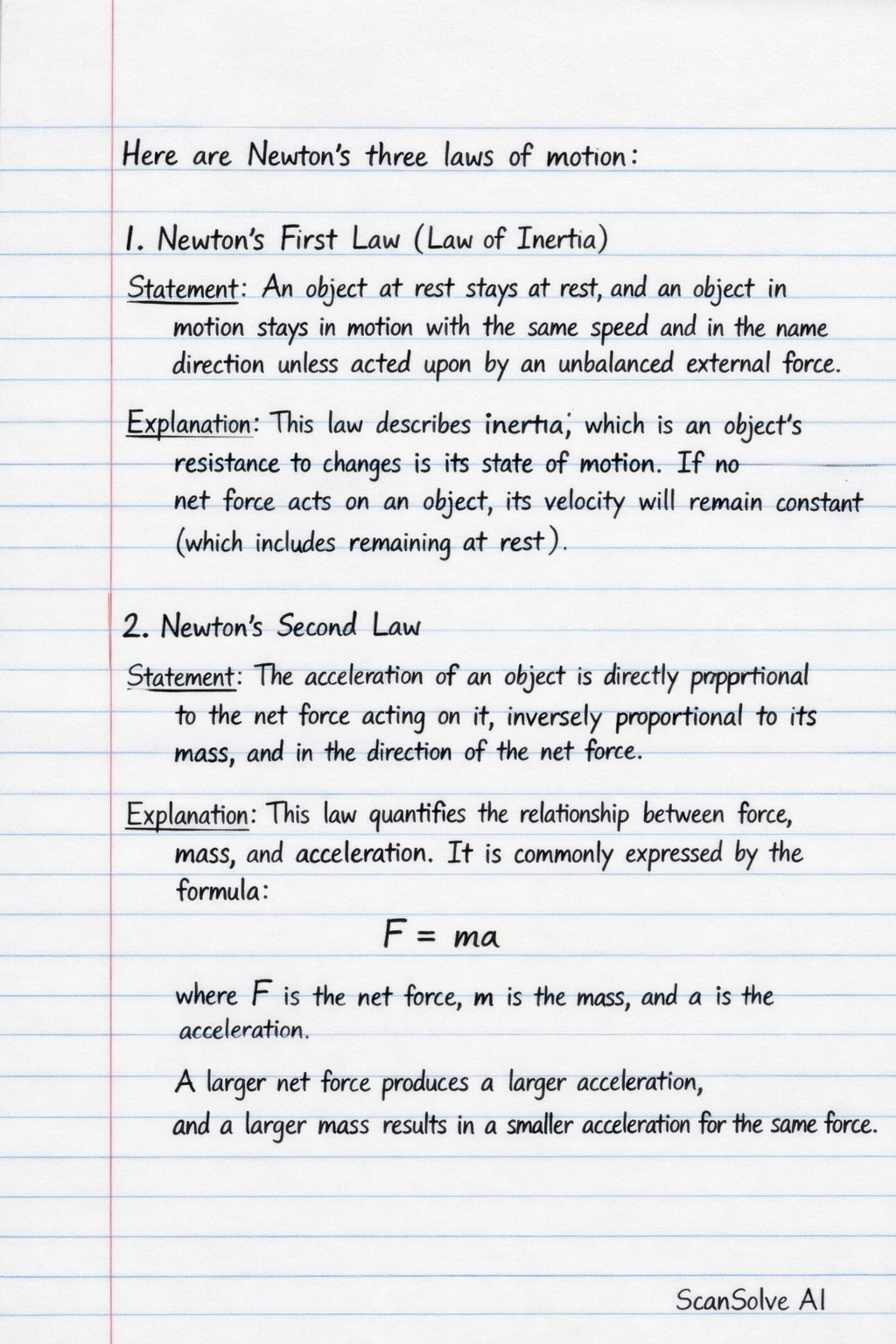
Here are Newton's three laws of motion:
1. Newton's First Law (Law of Inertia)
- Statement: An object at rest stays at rest, and an object in motion stays in motion with the same speed and in the same direction unless acted upon by an unbalanced external force.
- Explanation: This law describes inertia, which is an object's resistance to changes in its state of motion. If no net force acts on an object, its velocity will remain constant (which includes remaining at rest).
2. Newton's Second Law
- Statement: The acceleration of an object is directly proportional to the net force acting on it, inversely proportional to its mass, and in the direction of the net force.
- Explanation: This law quantifies the relationship between force, mass, and acceleration. It is commonly expressed by the formula , where is the net force, is the mass, and is the acceleration. A larger net force produces a larger acceleration, and a larger mass results in a smaller acceleration for the same force.
3. Newton's Third Law
- Statement: For every action, there is an equal and opposite reaction.
- Explanation: This law states that forces always occur in pairs. When one object exerts a force on a second object, the second object simultaneously exerts an equal and opposite force back on the first object. These forces act on different objects and therefore do not cancel each other out.
Was this helpful?
Still stuck on this one?
Ask a follow-up, and the answer starts from this question.
Got a different question?Ask your own question
More Physics Questions
QState the two versions of Newton's Second Law of Motion.QWhat is newton's first law of motionQState and explain pascal's lawQExplain Newton's second law of motion in one sentence.
Browse by topic:Mechanics
Handwritten Step-by-Step Solution
Get this as a handwritten image on WhatsApp — like a tutor wrote it for you.
Try on WhatsApp