
Force and Newton's laws formula sheet
ScanSolve AI Answer
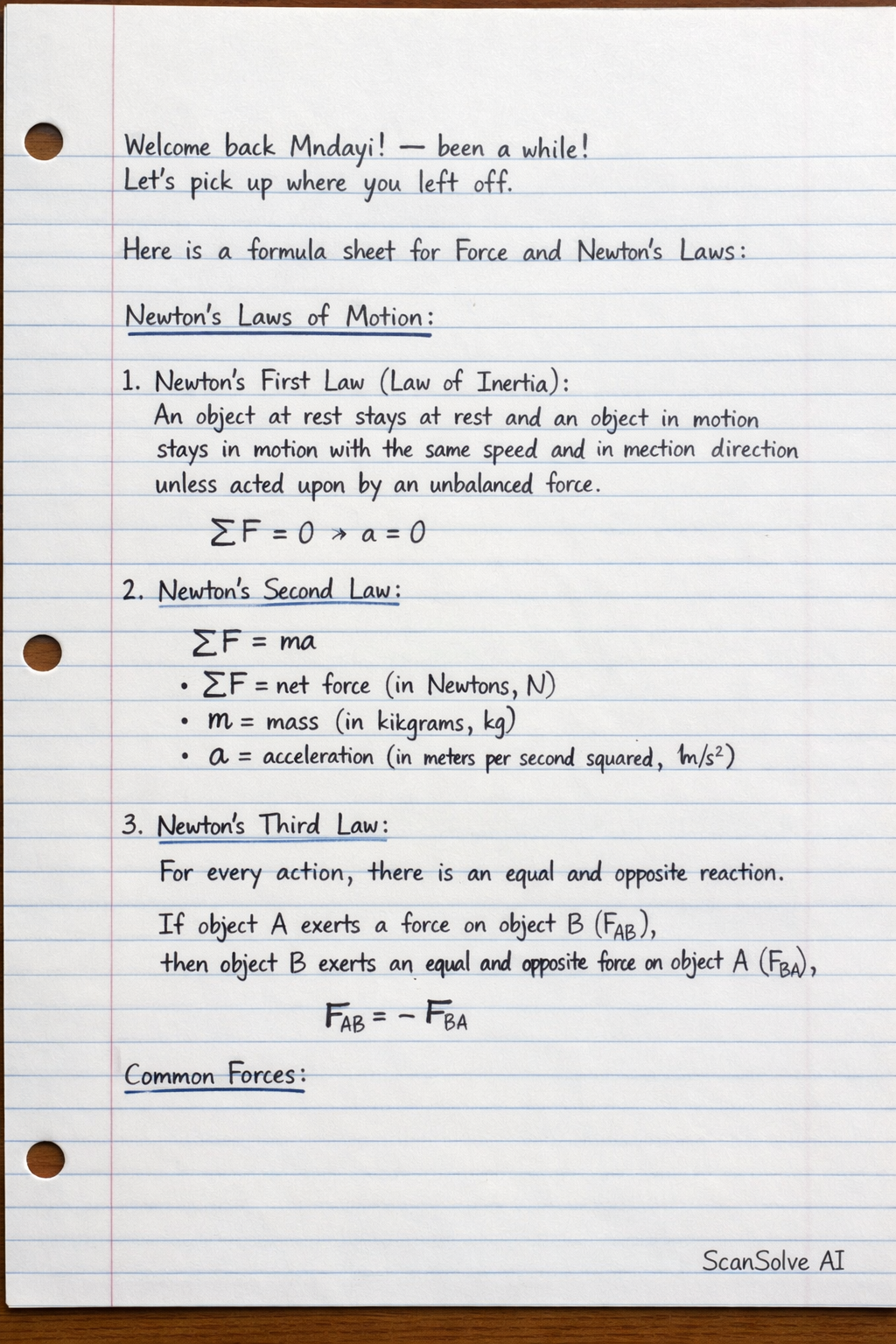
Here is a formula sheet for Force and Newton's Laws:
Newton's Laws of Motion:
-
Newton's First Law (Law of Inertia): An object at rest stays at rest and an object in motion stays in motion with the same speed and in the same direction unless acted upon by an unbalanced force.
- Mathematically, this is often expressed as:
-
Newton's Second Law: The acceleration of an object is directly proportional to the net force acting on it and inversely proportional to its mass.
- Formula:
- is the net force (in Newtons, N)
- is the mass (in kilograms, kg)
- is the acceleration (in meters per second squared, m/s²)
- Formula:
-
Newton's Third Law: For every action, there is an equal and opposite reaction.
- If object A exerts a force on object B (), then object B exerts an equal and opposite force on object A ().
Common Forces:
-
Weight (Force due to gravity):
- Formula:
- is weight (in Newtons, N)
- is mass (in kilograms, kg)
- is the acceleration due to gravity (approximately on Earth)
- Formula:
-
Friction Force:
- Static Friction (): The force that opposes the initiation of motion. It can vary up to a maximum value.
-
- is the coefficient of static friction
- is the normal force
-
- Kinetic Friction (): The force that opposes motion when an object is sliding.
-
- is the coefficient of kinetic friction
- is the normal force
-
- Static Friction (): The force that opposes the initiation of motion. It can vary up to a maximum value.
-
Normal Force (): The force exerted by a surface perpendicular to the surface, supporting an object.
-
Tension (): The force transmitted through a string, rope, cable, or similar object when it is pulled tight by forces acting from opposite ends.
Still stuck on this one?
Ask a follow-up, and the answer starts from this question.
More Physics Questions
Handwritten Step-by-Step Solution
Get this as a handwritten image on WhatsApp — like a tutor wrote it for you.
Try on WhatsApp