
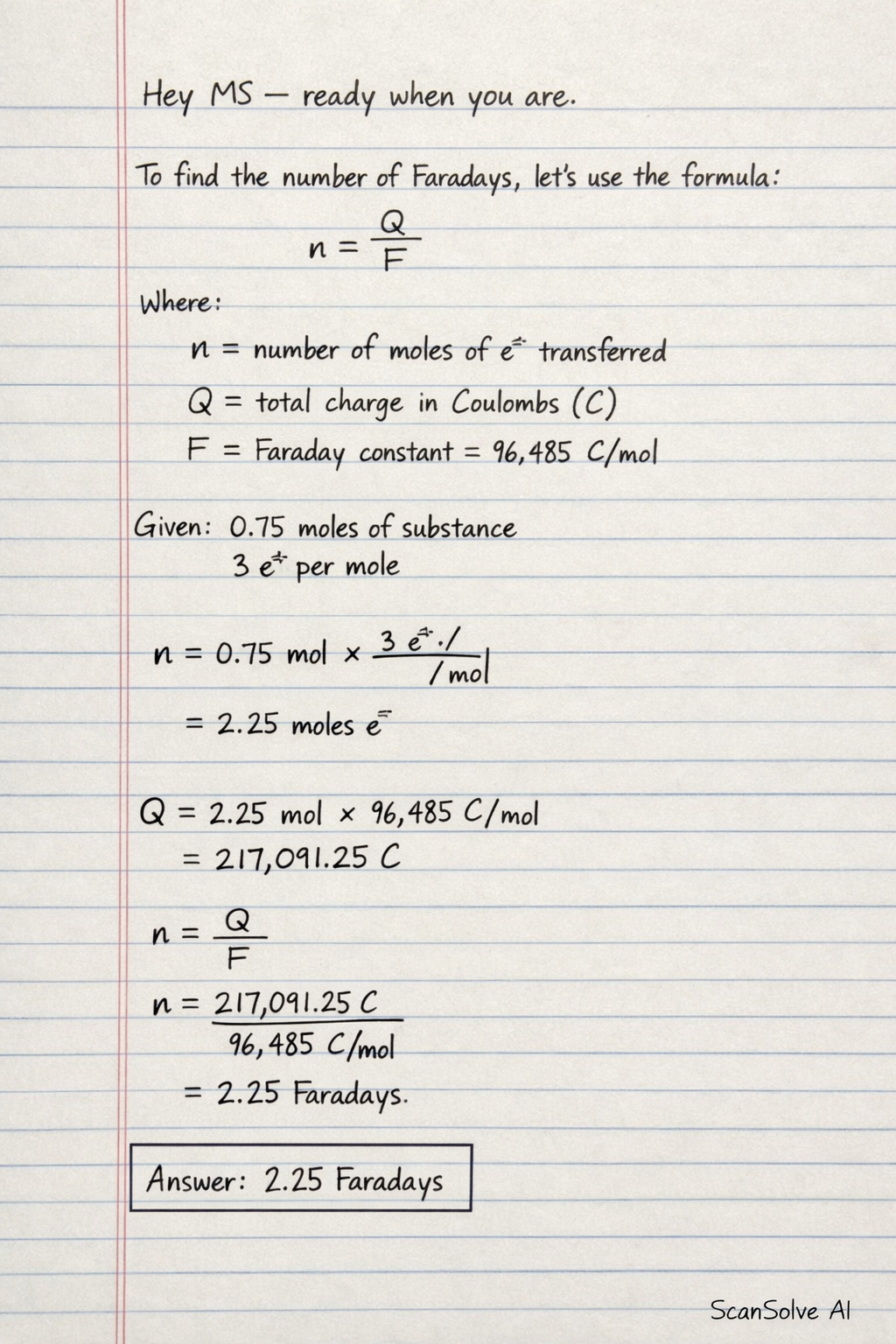
This physics problem tests your understanding of fundamental physical laws and their applications. The step-by-step solution below breaks down the problem using relevant equations and physical reasoning.
ScanSolve AI Answer
Hey MS — ready when you are. To find the number of Faradays, you can use the following formula: n = (Q)/(F) Where: n is the number of moles of electrons transferred. Q is the total charge in Coulombs (C). F is the Faraday constant, which is approximately 96,485 \, C/mol. If you have the amount of substance in moles and the number of electrons transferred per mole of substance, you can also use: n = moles of substance × electrons per mole of substance This gives you the number of moles of electrons, which is equivalent to the number of Faradays. Send me the next one 📸