
Derive the formula for length of a simple pendulum
ScanSolve AI Answer
Answer
Step-by-step solution
5 stepshere is the derivation for the period of a simple pendulum:
Set up the equation of motion.
Consider a pendulum of mass and length , displaced by an angle from the vertical. The restoring force acting tangentially to the arc is the component of gravity, . According to Newton's second law, , where is the tangential acceleration.
Simplify the equation.
Divide both sides by and rearrange the terms.
Apply the small angle approximation.
For small angles of oscillation (typically ), we can approximate (where is in radians). This simplifies the differential equation.
Identify the simple harmonic motion (SHM) equation.
This equation is in the standard form for simple harmonic motion, , where is the angular frequency. By comparing, we find the angular frequency squared.
Derive the period formula.
The period of simple harmonic motion is related to the angular frequency by the formula . Substitute the expression for .
Try one yourself
A new problem that tests the same skill.
Still stuck on this one?
Ask a follow-up, and the answer starts from this question.
More Physics Questions
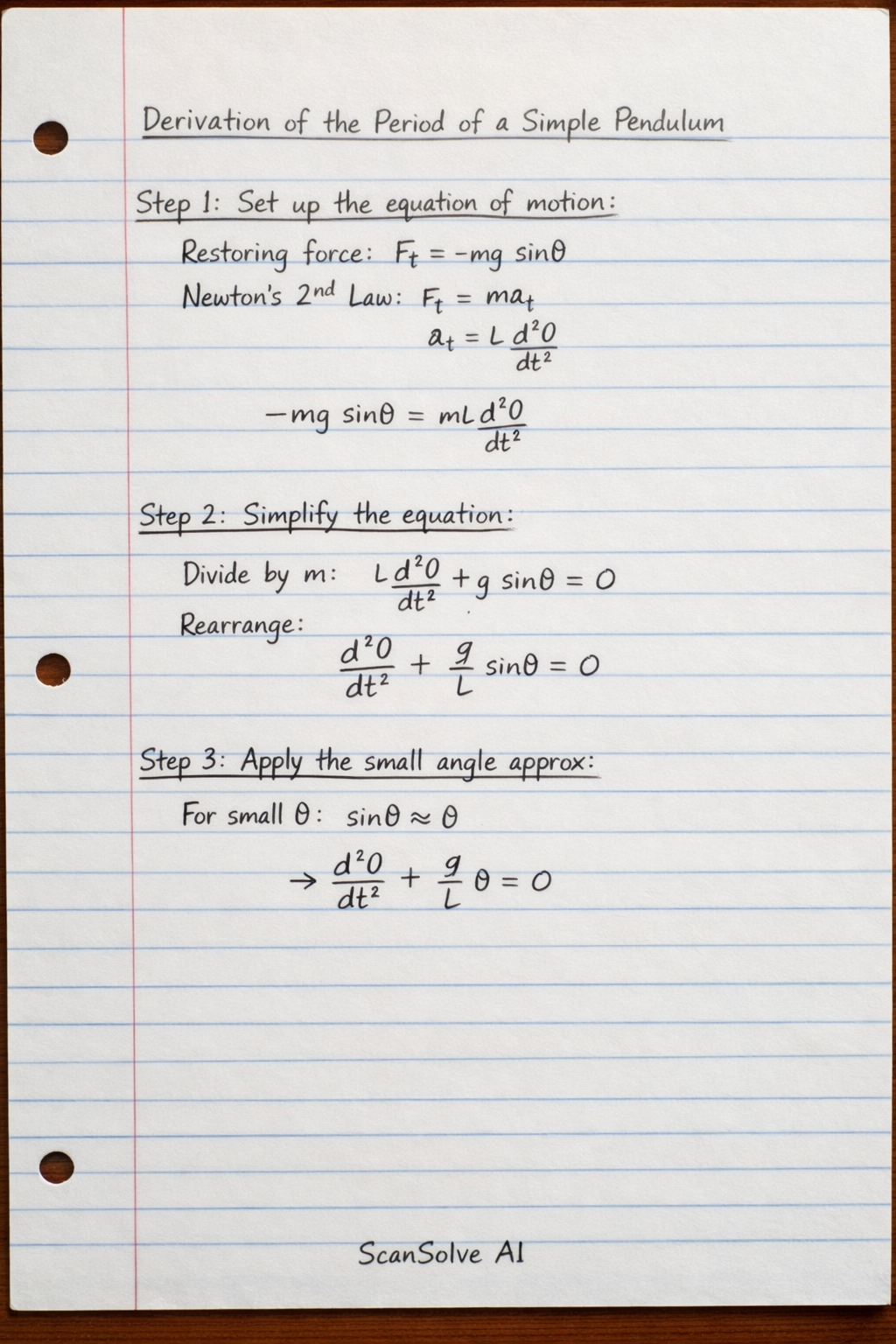
Handwritten Step-by-Step Solution
Get this as a handwritten image on WhatsApp — like a tutor wrote it for you.
Try on WhatsApp