
We read your photo as:
Derive the formula for the energy stored in a capacitor, showing at least two forms.
ScanSolve AI Answer
Answer
Step-by-step solution
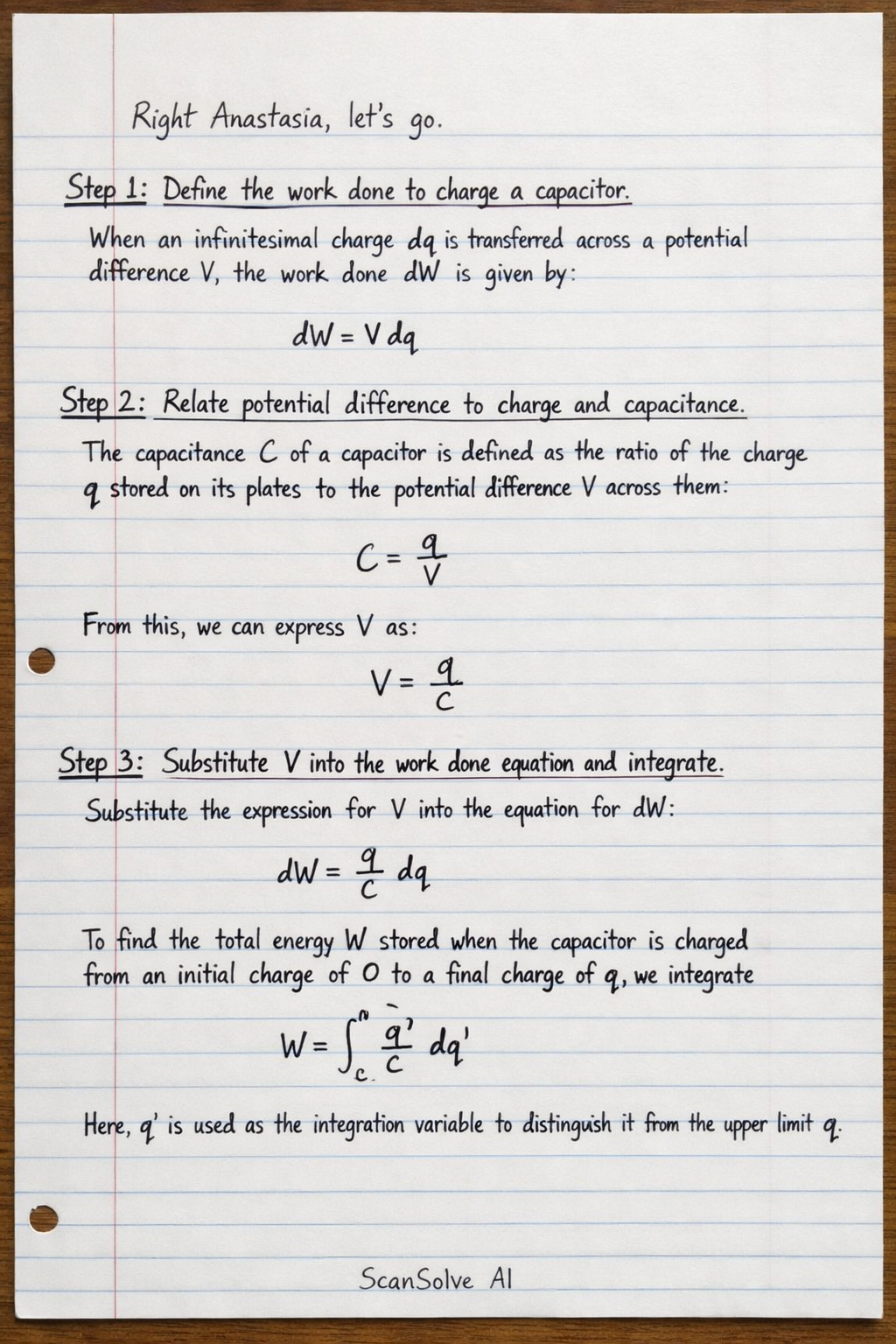
5 stepsDefine the work done to charge a capacitor.
When an infinitesimal charge is transferred across a potential difference , the work done is given by:
Relate potential difference to charge and capacitance.
The capacitance of a capacitor is defined as the ratio of the charge stored on its plates to the potential difference across them:
From this, we can express as:
Substitute into the work done equation and integrate.
Substitute the expression for into the equation for :
To find the total energy stored when the capacitor is charged from an initial charge of 0 to a final charge of , we integrate :
Here, is used as the integration variable to distinguish it from the upper limit .
Perform the integration.
This is the first form of the energy stored.
Derive the other forms using the capacitance definition.
We know that . Substitute this into the expression :
This is the second form of the energy stored.
Now, substitute into the expression :
This is the third form of the energy stored.
Thus, the electrical energy stored in a capacitor can be expressed in three equivalent forms:
Try one yourself
A new problem that tests the same skill.
Still stuck on this one?
Ask a follow-up, and the answer starts from this question.
More Physics Questions
Handwritten Step-by-Step Solution
Get this as a handwritten image on WhatsApp — like a tutor wrote it for you.
Try on WhatsApp