
We read your photo as:
Given final velocity v = 0 m/s (at rest at the highest point), time t = 4 s, and acceleration due to gravity a = -g = -10 m/s2 (taking upward as positive). We use the ki
ScanSolve AI Answer
Step-by-step solution
8 stepsHere are the solutions to the questions:
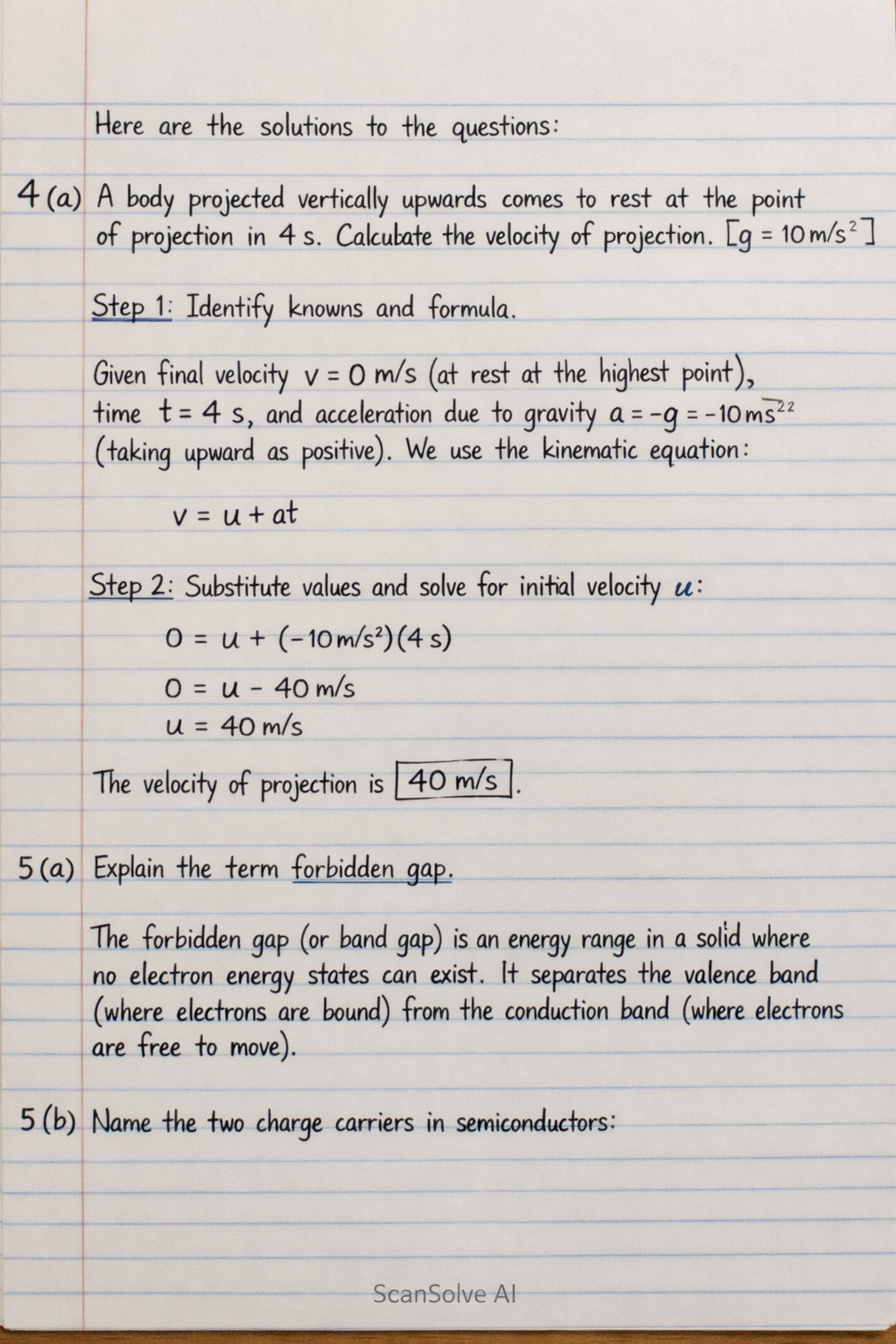
4 (a)
A body projected vertically upwards comes to rest at the point of projection in . Calculate the velocity of projection. []
Identify knowns and formula.
Given final velocity (at rest at the highest point), time , and acceleration due to gravity (taking upward as positive). We use the kinematic equation .
Substitute values and solve for initial velocity .
The velocity of projection is .
5 (a)
Explain the term forbidden gap.The forbidden gap (or band gap) is an energy range in a solid where no electron energy states can exist. It separates the valence band (where electrons are bound) from the conduction band (where electrons are free to move).
5 (b)
Name the two charge carriers in semiconductors.The two charge carriers in semiconductors are electrons and holes.
6 (a)
An electron of mass has a velocity of . Determine the de-Broglie wavelength of the electron. []State the de-Broglie wavelength formula.
The de-Broglie wavelength is given by , where is Planck's constant, is mass, and is velocity.
Substitute the given values.
Calculate the wavelength.
The de-Broglie wavelength of the electron is .
7 (a)
What is a magnetic material?A magnetic material is a substance that can be magnetized or is strongly attracted to a magnet. These materials contain magnetic domains that can align in the presence of an external magnetic field.
7 (b)
Describe two ways of demagnetizing a magnet.Two ways to demagnetize a magnet are:
- Heating: Heating the magnet above its Curie temperature causes the random thermal motion of atoms to disrupt the alignment of magnetic domains.
- Hammering/Mechanical shock: Repeatedly dropping or striking the magnet can disorient the magnetic domains, causing them to lose their organized alignment.
8 (a) (i)
Define work.Work in physics is done when a force causes a displacement of an object in the direction of the force. It is a scalar quantity, calculated as the product of the force and the distance moved in the direction of the force.
8 (a) (ii)
A force F acts on a body of mass m, causing the body to accelerate at a m s⁻². The body travels through a distance s m in time t s in the direction of the force. Show that the work done is equal to change in the kinetic energy of the body.Define work done and force.
Work done . From Newton's second law, .
So, .Use a kinematic equation to express displacement.
For constant acceleration, the kinematic equation relating final velocity (), initial velocity (), acceleration (), and displacement () is .
Rearranging for : .Substitute into the work equation and simplify.
Since is the final kinetic energy () and is the initial kinetic energy (), we have:
This shows that the work done on the body is equal to the change in its kinetic energy.
8 (b) (i)
Define kinetic friction.Kinetic friction is the force that opposes the relative motion between two surfaces that are sliding against each other. It acts parallel to the surfaces and in the direction opposite to the motion.
8 (b) (ii)
State two factors which affect kinetic friction.Two factors that affect kinetic friction are:
- The nature of the surfaces in contact (e.g., their roughness or smoothness).
- The normal force pressing the two surfaces together.
Still stuck on this one?
Ask a follow-up, and the answer starts from this question.
More Physics Questions
Handwritten Step-by-Step Solution
Get this as a handwritten image on WhatsApp — like a tutor wrote it for you.
Try on WhatsApp