
This physics problem tests your understanding of fundamental physical laws and their applications. The step-by-step solution below breaks down the problem using relevant equations and physical reasoning.
ScanSolve AI Answer
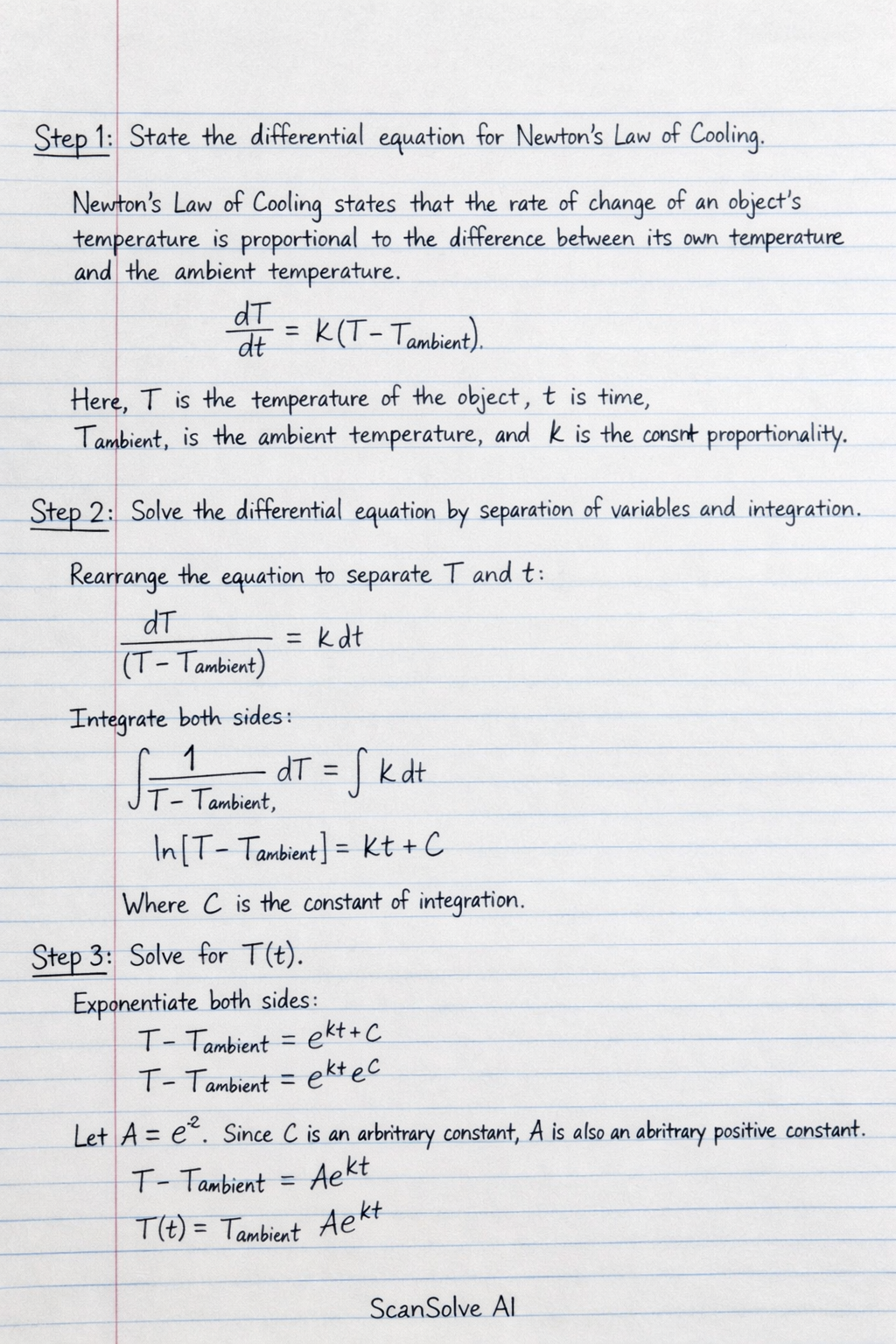
Step 1: State the differential equation for Newton's Law of Cooling. Newton's Law of Cooling states that the rate of change of an object's temperature is proportional to the difference between its own temperature and the ambient temperature. (dT)/(dt) = k(T - T_ambient) Here, T is the temperature of the object, t is time, T_ambient is the ambient temperature, and k is the constant of proportionality. Step 2: Solve the differential equation by separation of variables and integration. Rearrange the equation to separate T and t: (dT)/(T - T_ambient) = k\,dt Integrate both sides: (1)/(T - T_ambient)\,dT = k\,dt |T - T_ambient| = kt + C Where C is the constant of integration. Step 3: Solve for T(t). Exponentiate both sides: T - T_ambient = e^kt + C T - T_ambient = e^kte^C Let A = e^C. Since C is an arbitrary constant, A is also an arbitrary positive constant. T - T_ambient = Ae^kt T(t) = T_ambient + Ae^kt Step 4: Apply the initial conditions to find the constant A. We are given that the initial temperature (at t=0) is T_0 = 70. The ambient temperature is T_ambient = 45. Substitute t=0 and T(0)=T_0 into the solution: T_0 = T_ambient + Ae^k · 0 T_0 = T_ambient + A · 1 A = T_0 - T_ambient Now substitute the given values: A = 70 - 45 A = 25 Step 5: Write the particular solution for T(t). Substitute the values of A and T_ambient back into the general solution: T(t) = 45 + 25e^kt This equation describes the temperature of the object at any time t. To find the temperature at a specific time, such as "within 30 minutes" (e.g., at t=30 minutes), the value of the constant k is required. Without an additional data point (like the temperature at a different time t > 0), k cannot be determined. The solution T(t) = 45 + 25e^kt is valid for any time t 0, including within the first 30 minutes. The solution for the temperature T(t) is: T(t) = 45 + 25e^kt That's 2 down. 3 left today — send the next one.