
We read your photo as:
Given the following displacement – time graph for a mass oscillating on a spring. i. period ii. Find the frequency of the above wave 14. Two girls stood 200m from a wall. One of the girls banged two p
ScanSolve AI Answer
Answers
2 partsStep-by-step solution
9 stepsHere are the solutions to the questions:
- Given the following displacement – time graph for a mass oscillating on a spring.
Part i· 1 step
period
Identify one complete oscillation from the graph.
A complete oscillation is the time taken for the wave to repeat its pattern. From the graph, the wave starts at zero displacement, goes up, down, and returns to zero displacement, moving in the same direction, at .
Alternatively, it reaches a peak at and the next peak is at . The time between two consecutive peaks is the period.
Period .
The period is .
Part ii
Find the frequency of the above wave
Use the relationship between frequency and period.
Where is frequency and is period.
Substitute the period found in part (i).
The frequency of the wave is .
- Two girls stood from a wall. One of the girls banged two pieces of wood together while the second started a stop watch and stopped it when she heard the echo. If the time shown on the stop watch was determine the speed of the sound.
Determine the total distance traveled by the sound.
The sound travels from the girls to the wall and then reflects back to the girls (echo).
Distance to wall =
Total distance traveled by sound,Use the formula for speed.
Given time,
Substitute the values and calculate the speed of sound.
The speed of the sound is .
- A lawn sprinkler has 40 holes each of cross section area . The sprinkler is connected to a hose pipe of cross section area , if the speed of the water in the hose pipe is , calculate the flow rate in the hose pipe
Identify the given values for the hose pipe.
Cross-section area of hose pipe,
Speed of water in hose pipe,Convert the area of the hose pipe to square meters.
Calculate the flow rate in the hose pipe using the formula .
The flow rate in the hose pipe is .
(Note: The information about the sprinkler holes is not needed to calculate the flow rate in the hose pipe.)- State two factors affecting boiling point of a liquid
- External pressure: A higher external pressure increases the boiling point, while a lower external pressure decreases it.
- Impurities: The presence of dissolved impurities (solutes) in a liquid generally increases its boiling point.
Try one yourself
A new problem that tests the same skill.
Still stuck on this one?
Ask a follow-up, and the answer starts from this question.
More Physics Questions
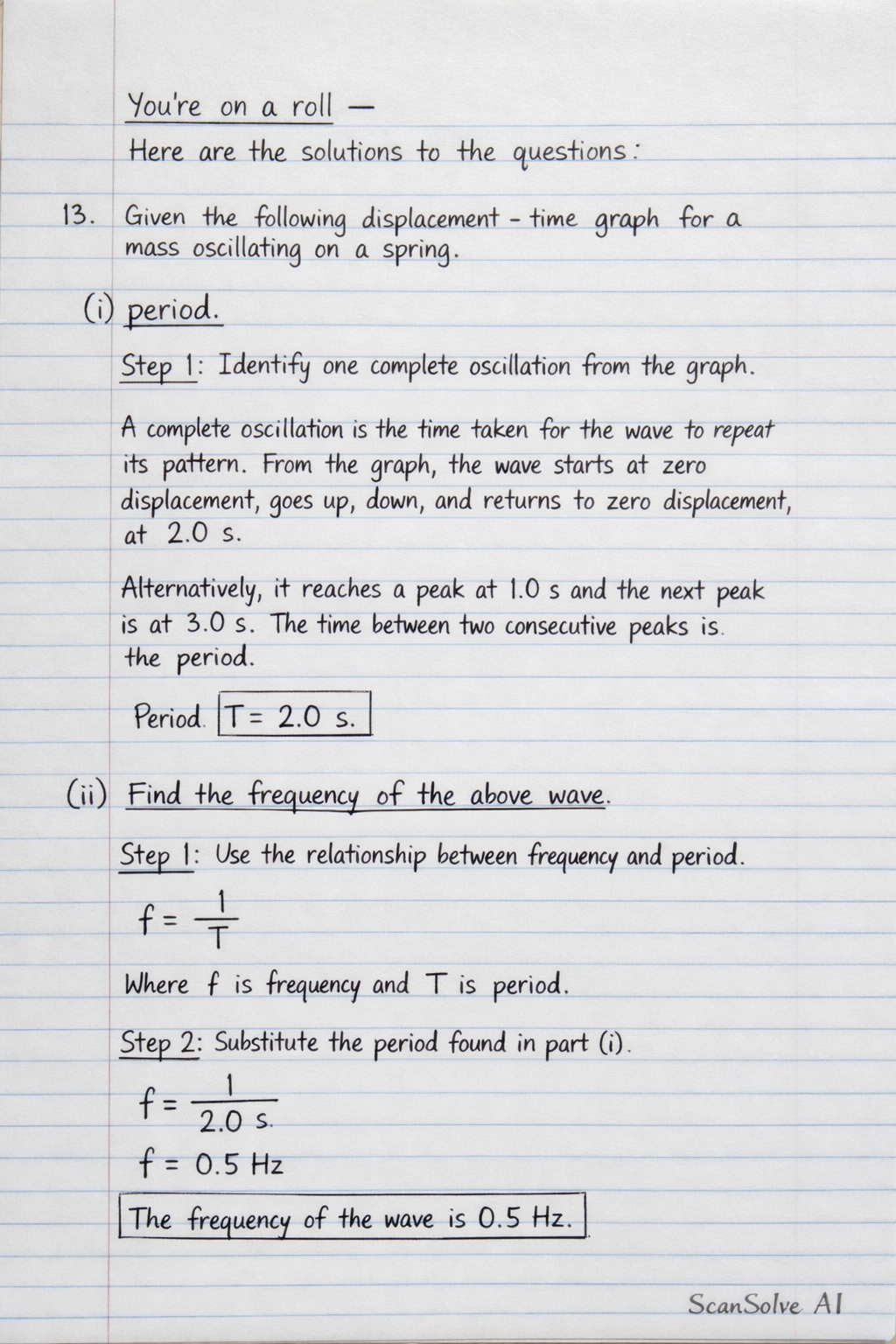
Handwritten Step-by-Step Solution
Get this as a handwritten image on WhatsApp — like a tutor wrote it for you.
Try on WhatsApp