
We read your photo as:
Given the volume of water and its density, we can find the mass.
Physics
ScanSolve AI Answer
Answer
Step-by-step solution
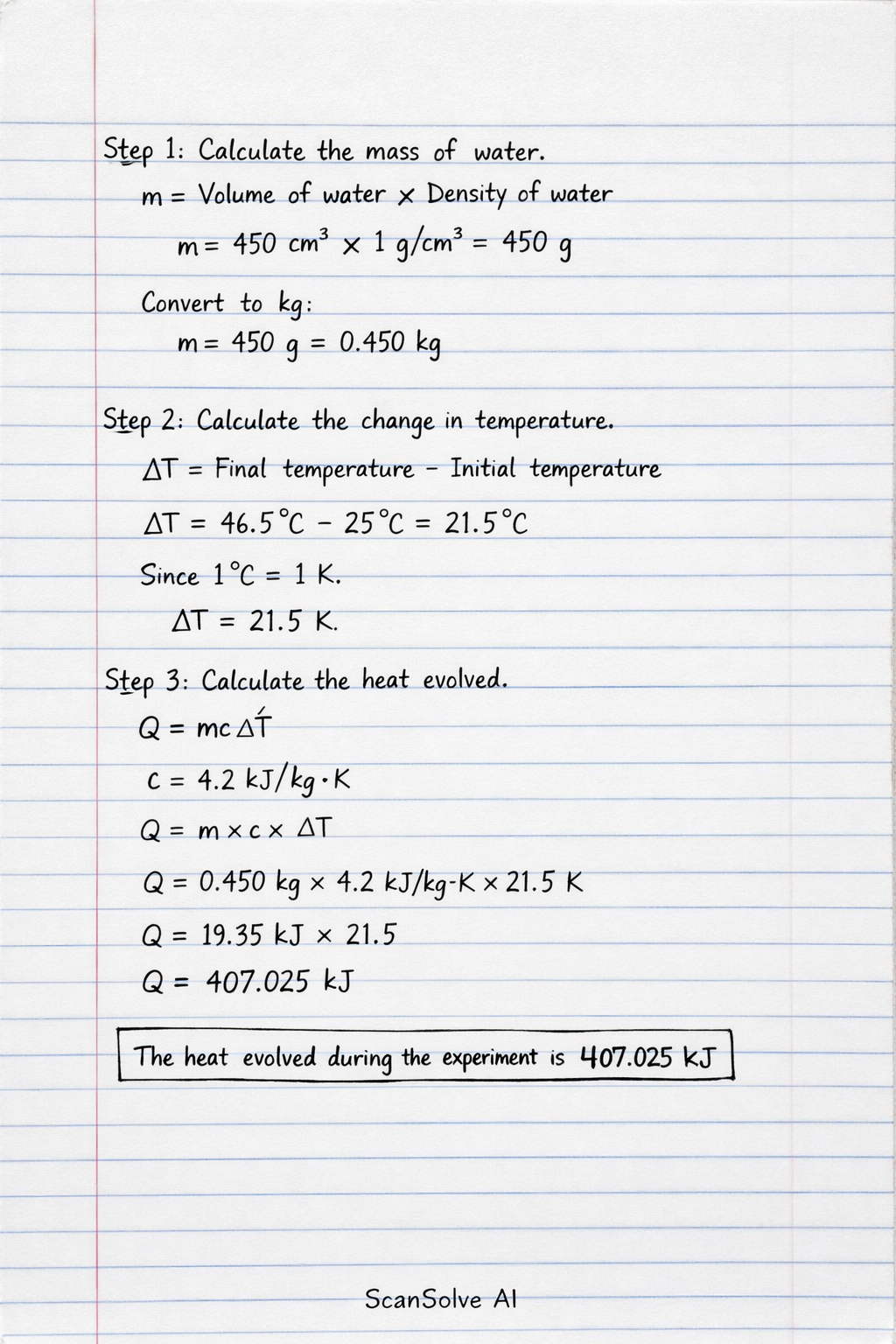
3 stepsCalculate the mass of water.
Given the volume of water and its density, we can find the mass.
Convert the mass from grams to kilograms:
Calculate the change in temperature of the water.
Since a change of is equivalent to a change of ,
Calculate the heat evolved using the formula .
Given specific heat capacity of water .
The heat evolved during the experiment is .
Was this helpful?
Try one yourself
A new problem that tests the same skill.
Still stuck on this one?
Ask a follow-up, and the answer starts from this question.
Got a different question?Ask your own question
More Physics Questions
QA mass of 120g half immersed in water displaced a volume of 20cm³. Calculate the density of the…QTo calculate the density of the sand, we need its mass and its volume.QWhat is the ratio of the mass of water to that of material at equal volumes?QPlot a graph of water mass versus water volume and draw the best fit line. Calculate the slope. What…QGiven density of water = 1000 kgm⁻³.
Handwritten Step-by-Step Solution
Get this as a handwritten image on WhatsApp — like a tutor wrote it for you.
Try on WhatsApp