
We read your photo as:
To calculate the density of the sand, we need its mass and its volume.
ScanSolve AI Answer
Answer
Step-by-step solution
5 stepsHere's the solution to 9(a):
- (a) To calculate the density of the sand, we need its mass and its volume.
Determine the mass of the water that fills the bottle.
Mass of water = (Mass of bottle + water) - (Mass of empty bottle)
Mass of water =Determine the volume of the bottle.
Assuming the density of water is .
Volume of bottle = Volume of water that fills the bottleDetermine the mass of the sand.
Mass of sand = (Mass of bottle + some sand) - (Mass of empty bottle)
Mass of sand =Determine the volume of the sand.
The line "Mass of bottle + sand + water on top of the sand = 80g" tells us the total mass when the bottle is filled with sand and then water is added to fill the remaining space.
Mass of (sand + water) in the bottle = (Mass of bottle + sand + water) - (Mass of empty bottle)
Mass of (sand + water) =Now, subtract the mass of the sand (from Step 3) to find the mass of the water added on top of the sand.
Mass of water added = Mass of (sand + water) - Mass of sand
Mass of water added =Using the density of water (), find the volume of the water added.
Volume of water added =The volume of the sand is the total volume of the bottle minus the volume of the water added.
Volume of sand = Volume of bottle - Volume of water added
Volume of sand =Calculate the density of the sand.
Density of sand =
The density of the sand is .
Try one yourself
A new problem that tests the same skill.
Still stuck on this one?
Ask a follow-up, and the answer starts from this question.
More Physics Questions
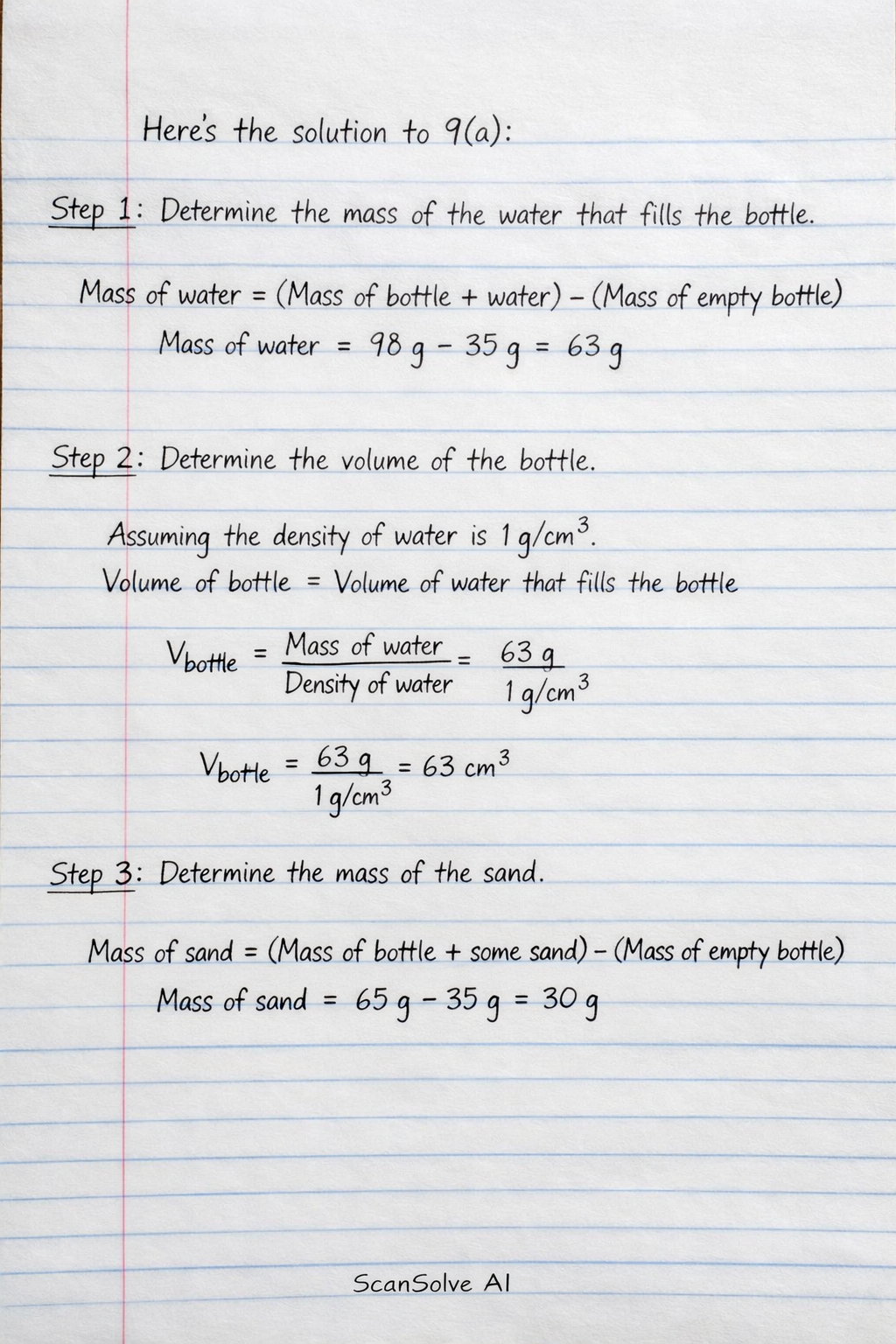
Handwritten Step-by-Step Solution
Get this as a handwritten image on WhatsApp — like a tutor wrote it for you.
Try on WhatsApp