
This physics problem tests your understanding of fundamental physical laws and their applications. The step-by-step solution below breaks down the problem using relevant equations and physical reasoning.
ScanSolve AI Answer
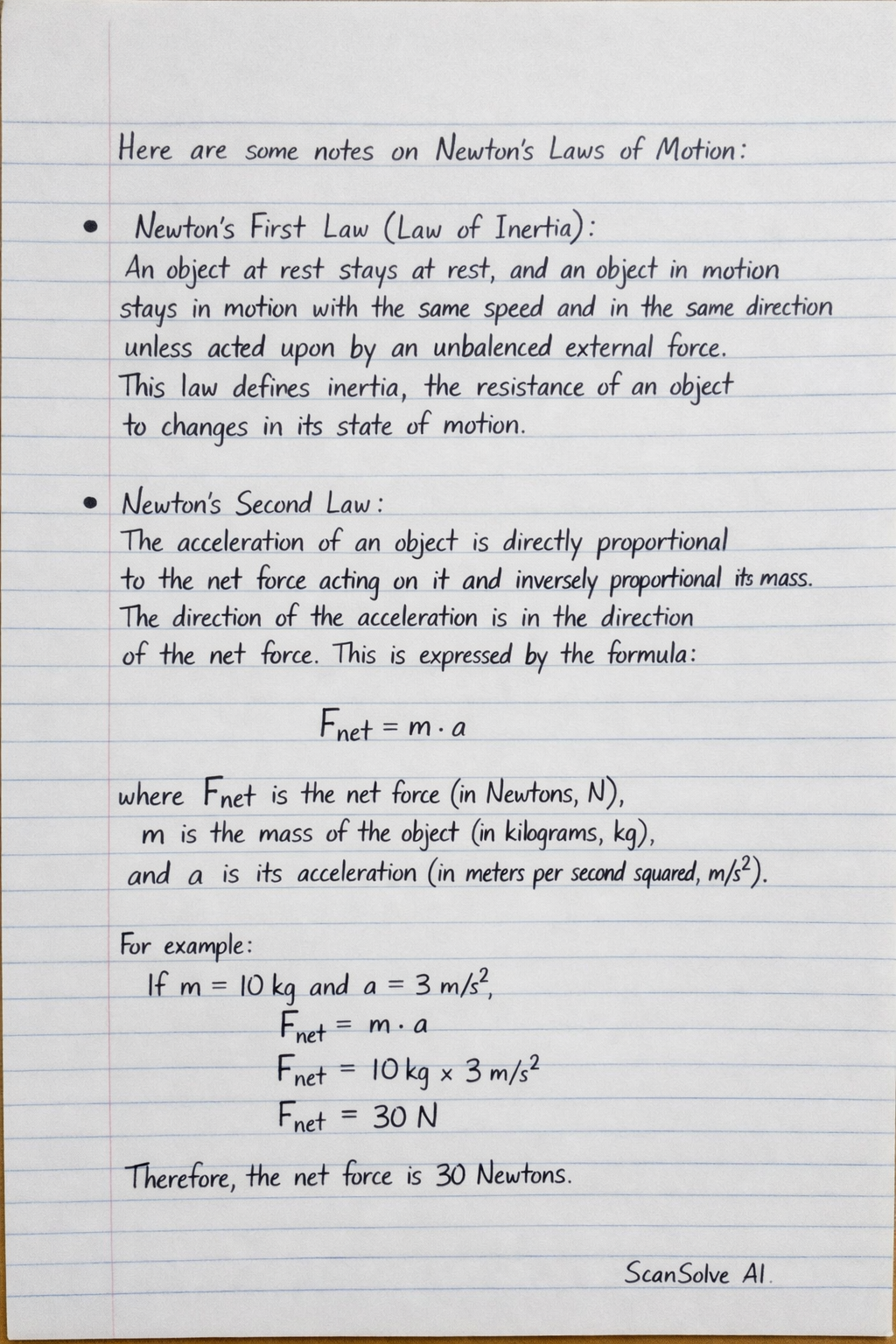
Here are some notes on Newton's Laws of Motion: Newton's First Law (Law of Inertia): An object at rest stays at rest, and an object in motion stays in motion with the same speed and in the same direction unless acted upon by an unbalanced external force. This law defines inertia*, the resistance of an object to changes in its state of motion. Newton's Second Law: The acceleration of an object is directly proportional to the net force acting on it and inversely proportional to its mass. The direction of the acceleration is in the direction of the net force. This is expressed by the formula: F_net = ma where F_net is the net force (in Newtons, N), m is the mass of the object (in kilograms, kg), and a is its acceleration (in meters per second squared, m/s^2). Newton's Third Law: For every action, there is an equal and opposite reaction. When one object exerts a force on a second object, the second object simultaneously exerts a force equal in magnitude and opposite in direction on the first object. These forces act on different objects and therefore do not cancel each other out. 3 done, 2 left today. You're making progress.