
Here is the question, explain why 9/10 was used to multiply 500: Find out the speed at which a four-cylinder engine using natural gas can develop a brake power of 50kW working under following conditions. Air-gas ratio 9:1, calorific value of the fuel = 34 MJ/m³, compression ratio 10:1, volumetric efficiency = 70%, indicated thermal efficiency = 35% and the mechanical efficiency = 80% and the total volume of the engine is 2 litres.
ScanSolve AI Answer
Answer
The value of represents the total volume () of one cylinder when the piston is at its lowest point (Bottom Dead Center, BDC). This total volume is the sum of the swept volume () and the clearance volume ().
The compression ratio () is given as . The compression ratio is defined as:
From this definition, we can also express the swept volume () in terms of the total volume () and the compression ratio ().
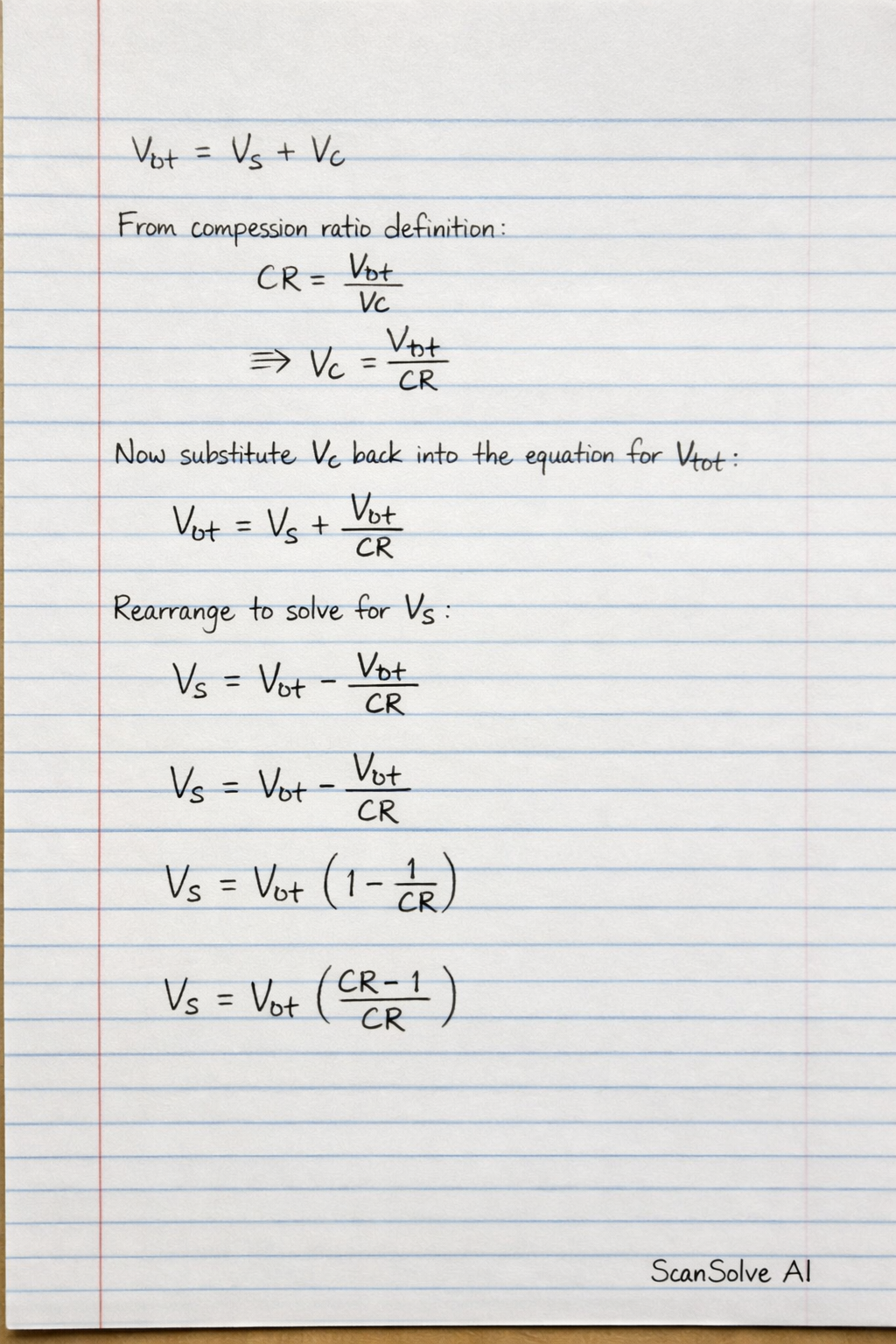
We know that .
From the compression ratio definition:
Now substitute back into the equation for :
Rearrange to solve for :
Given:
- per cylinder = (from the previous step, )
Substitute these values into the formula for :
Therefore, is used to multiply to calculate the swept volume () per cylinder, which is the volume displaced by the piston as it moves from Bottom Dead Center (BDC) to Top Dead Center (TDC).
Still stuck on this one?
Ask a follow-up, and the answer starts from this question.
More Physics Questions
Handwritten Step-by-Step Solution
Get this as a handwritten image on WhatsApp — like a tutor wrote it for you.
Try on WhatsApp