
Here why are conversions like that
ScanSolve AI Answer
Answer
Conversions are structured the way they are to change a measurement from one unit to another without changing its actual value. This is done using conversion factors.
Step-by-step solution
2 stepsUnderstand the concept of a conversion factor.
A conversion factor is a ratio of two equivalent quantities expressed in different units. Since the numerator and denominator represent the same amount, the conversion factor is essentially equal to 1.
For example, we know that is the same length as .
So, we can form two conversion factors:Both of these fractions are equal to 1.
Apply the conversion factor.
To convert a quantity, you multiply it by the appropriate conversion factor. The goal is to choose the factor that allows the original unit to cancel out, leaving the desired unit.
Let's use the example of converting to millimeters:
Here, the unit 'm' in the numerator of cancels with the unit 'm' in the denominator of the conversion factor:
If we had chosen the other conversion factor, the units would not cancel correctly:
This result is not in millimeters, indicating the wrong conversion factor was used.
The structure of conversions ensures that you are multiplying by 1 (so the value doesn't change) while simultaneously changing the units by cancelling them out.
Still stuck on this one?
Ask a follow-up, and the answer starts from this question.
More Physics Questions
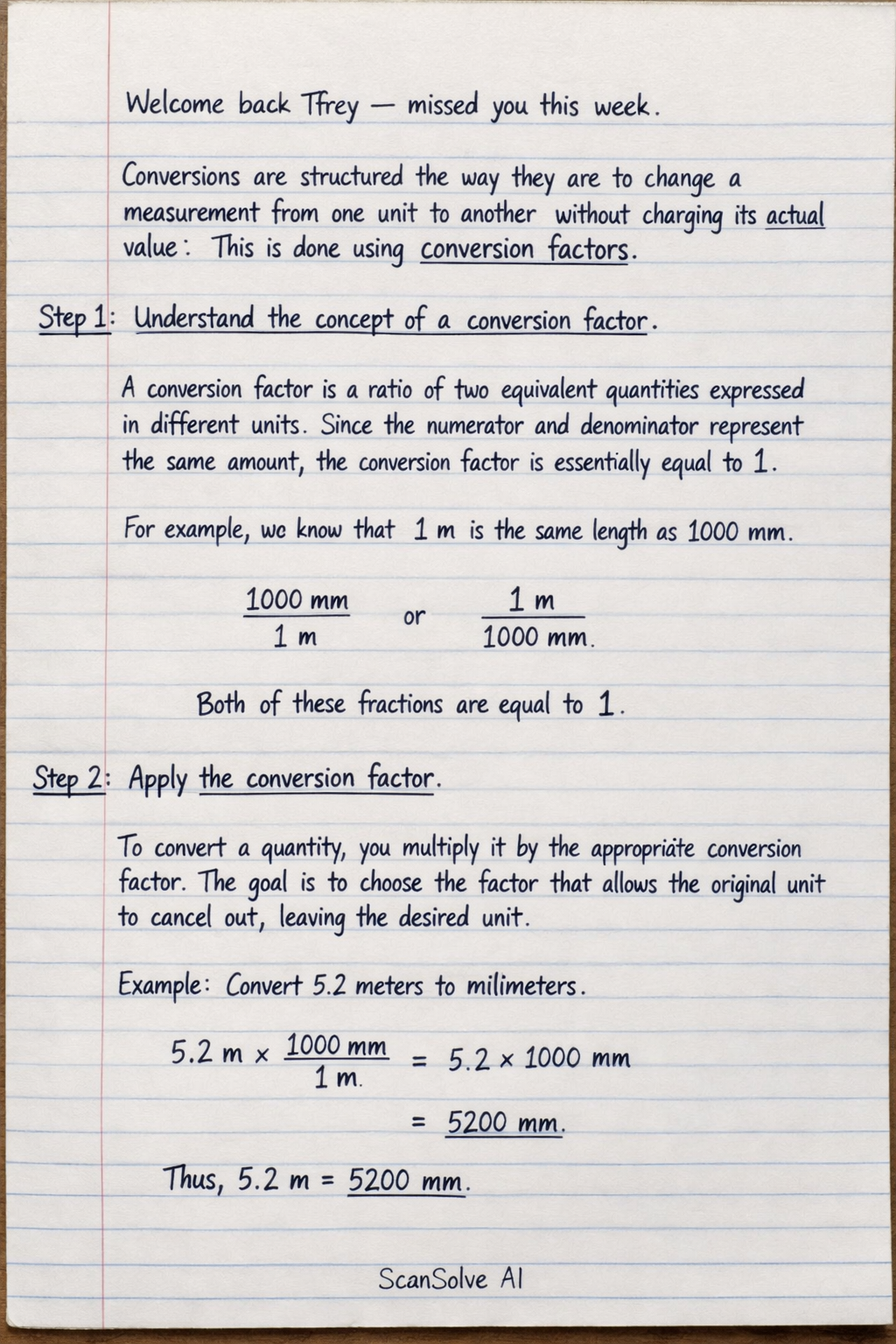
Handwritten Step-by-Step Solution
Get this as a handwritten image on WhatsApp — like a tutor wrote it for you.
Try on WhatsApp