
We read your photo as:
I) Heat is a form of energy that is transferred between objects or systems due to a temperature difference. It flows from a region of higher temperature to a region of lower temperature. Its S.I.
ScanSolve AI Answer
Answer
Step-by-step solution
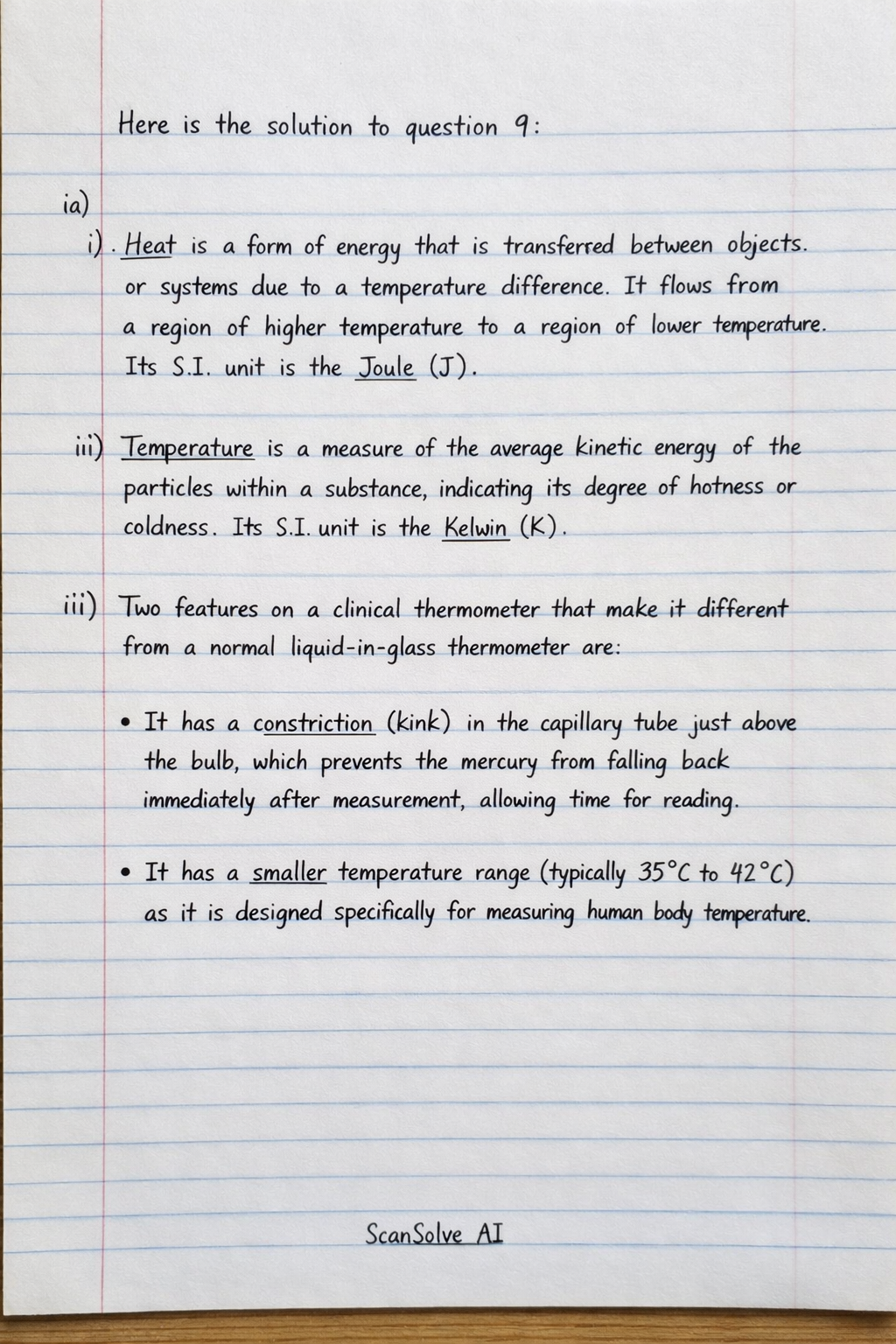
2 stepsHere is the solution to question 9:
Part a(ii)
Temperature is a measure of the average kinetic energy of the particles within a substance, indicating its degree of hotness or coldness. Its S.I. unit is the *Kelvin (K)
i) Heat is a form of energy that is transferred between objects or systems due to a temperature difference. It flows from a region of higher temperature to a region of lower temperature. Its S.I. unit is the Joule (J).
Part a(iii)
Two features on a clinical thermometer that make it different from a normal liquid-in-glass thermometer are
- It has a constriction (kink) in the capillary tube just above the bulb, which prevents the mercury from falling back immediately after measurement, allowing time for reading.
- It has a smaller temperature range (typically 35°C to 42°C) as it is designed specifically for measuring human body temperature.
Part b(i)
Heat capacity is the amount of heat energy required to raise the temperature of an entire object or substance by 1 Kelvin (or 1 degree Celsius). Its unit is J/K.
Specific heat capacity is the amount of heat energy required to raise the temperature of 1 unit mass (e.g., 1 kg) of a substance by 1 Kelvin (or 1 degree Celsius). Its unit is J/kg K.
Part b(ii)
Given:
Mass of water () = 500 g = 0.5 kg
Power of heater () = 1000 W
Time () = 2 minutes = s
Specific heat capacity of water () = 4200 J/kg K
Calculate the heat supplied by the heater.
Use the formula for heat absorbed to find the temperature change ().
The temperature change is .
iii) One use of water due to its high specific heat capacity is as a coolant in car engines or in central heating systems. Water can absorb a large amount of heat without a significant rise in its own temperature.
Part c(i)
Thermal expansion is the tendency of matter to change in volume (or length or area) in response to a change in temperature. Most substances expand when heated and contract when cooled.
ii) A bimetallic strip in an electric iron works as a thermostat. It consists of two different metals bonded together, each with a different coefficient of thermal expansion. When the iron heats up, one metal expands more than the other, causing the strip to bend. At a set temperature, this bending breaks an electrical contact, switching off the heating element. As the iron cools, the strip straightens, re-establishing the contact and switching the heater back on, thus maintaining the desired temperature.
iii) A metal spoon left beside a flame becomes hot to touch due to conduction. Metals are good conductors of heat. The heat from the flame causes the particles at the end of the spoon nearest the flame to vibrate more vigorously. These energetic particles collide with adjacent particles, transferring kinetic energy along the spoon. This process continues, transferring heat from the hotter end to the colder end, until the entire spoon becomes hot.
Try one yourself
A new problem that tests the same skill.
Still stuck on this one?
Ask a follow-up, and the answer starts from this question.
More Physics Questions
Handwritten Step-by-Step Solution
Get this as a handwritten image on WhatsApp — like a tutor wrote it for you.
Try on WhatsApp