
We read your photo as:
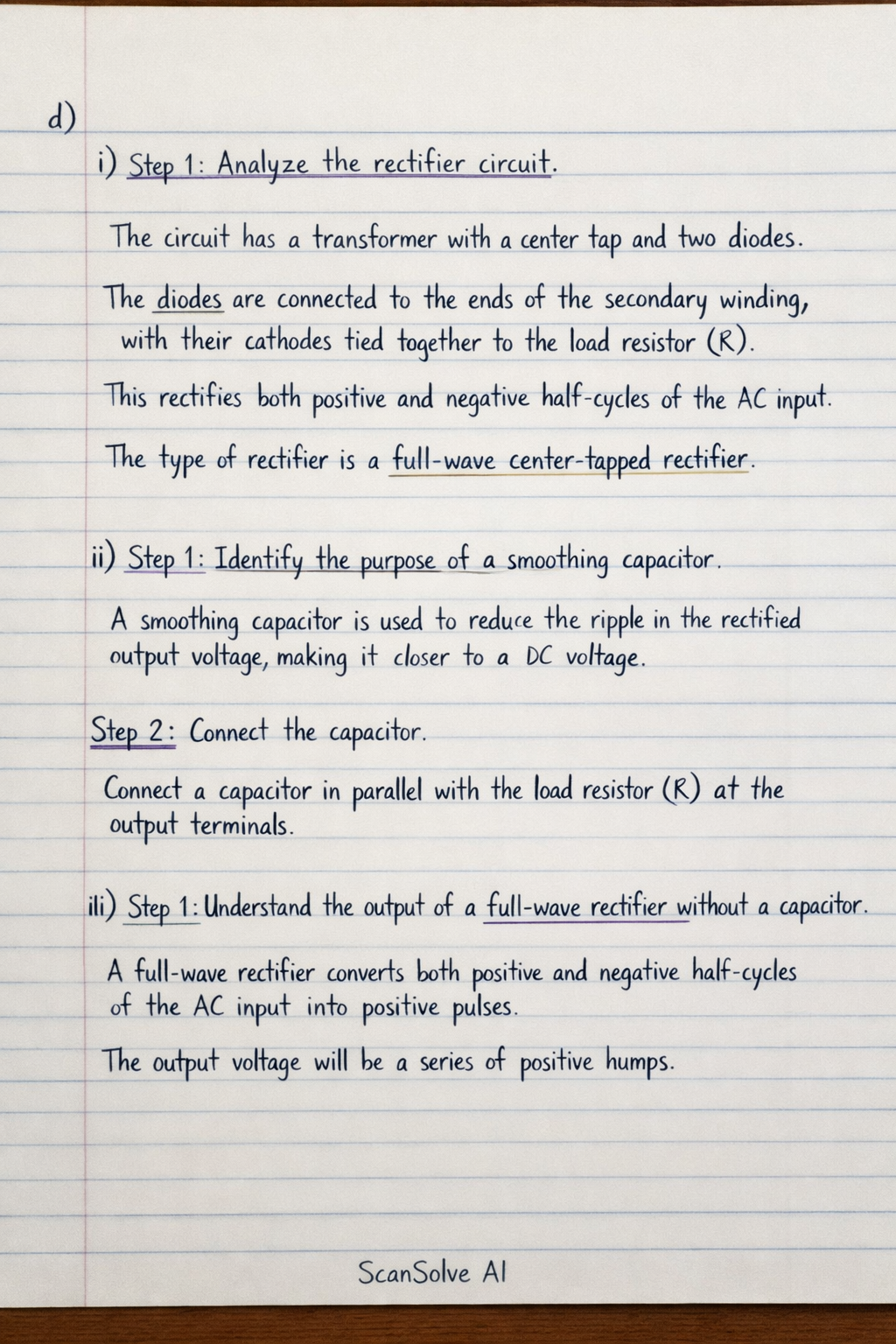
I) Step 1: Analyze the rectifier circuit.
ScanSolve AI Answer
Step-by-step solution
2 stepsPart d(i)
Step 1: Analyze the rectifier circuit.
The circuit shows a transformer with a center tap, and two diodes. The diodes are connected such that their anodes are connected to the ends of the secondary winding, and their cathodes are joined together to the load resistor. This configuration rectifies both positive and negative half-cycles of the AC input.
The type of rectifier is a full-wave center-tapped rectifier.
Part d(ii)· 1 step
Step 1: Identify the purpose of a smoothing capacitor.
A smoothing capacitor is used to reduce the ripple in the rectified output voltage, making it closer to a DC voltage.
Connect the capacitor.
To smooth the output, a capacitor should be connected in parallel with the load resistor (R) at the output terminals.
Part d(iii)· 1 step
Step 1: Understand the output of a full-wave rectifier without a capacitor.
A full-wave rectifier converts both positive and negative half-cycles of the AC input into positive pulses. The output voltage will be a series of positive humps.
Sketch the waveform on the provided axes.
The sketch should show a waveform that is always positive, with two peaks for every complete cycle of the input AC.
\begin{tikzpicture}[scale=0.8]
    % Axes
    \draw[->] (0,0) -- (6,0) node[below] {time (s)};
    \draw[->] (0,0) -- (0,4) node[left] {Voltage (V)};

    % Full-wave rectified waveform
    \draw[thick, blue] (0,0) parabola (0.5,3) parabola (1,0) parabola (1.5,3) parabola (2,0) parabola (2.5,3) parabola (3,0) parabola (3.5,3) parabola (4,0) parabola (4.5,3) parabola (5,0) parabola (5.5,3) parabola (6,0);
\end{tikzpicture}
Part e
No specific questions are provided for the graph of against resistance .
Still stuck on this one?
Ask a follow-up, and the answer starts from this question.
More Physics Questions
Handwritten Step-by-Step Solution
Get this as a handwritten image on WhatsApp — like a tutor wrote it for you.
Try on WhatsApp