
We read your photo as:
To determine the e.m.f. of the cells, experimental data such as voltage readings at different currents or open-circuit voltage is required. This information is not provided in the question.
ScanSolve AI Answer
Here are the solutions to the questions:
a)
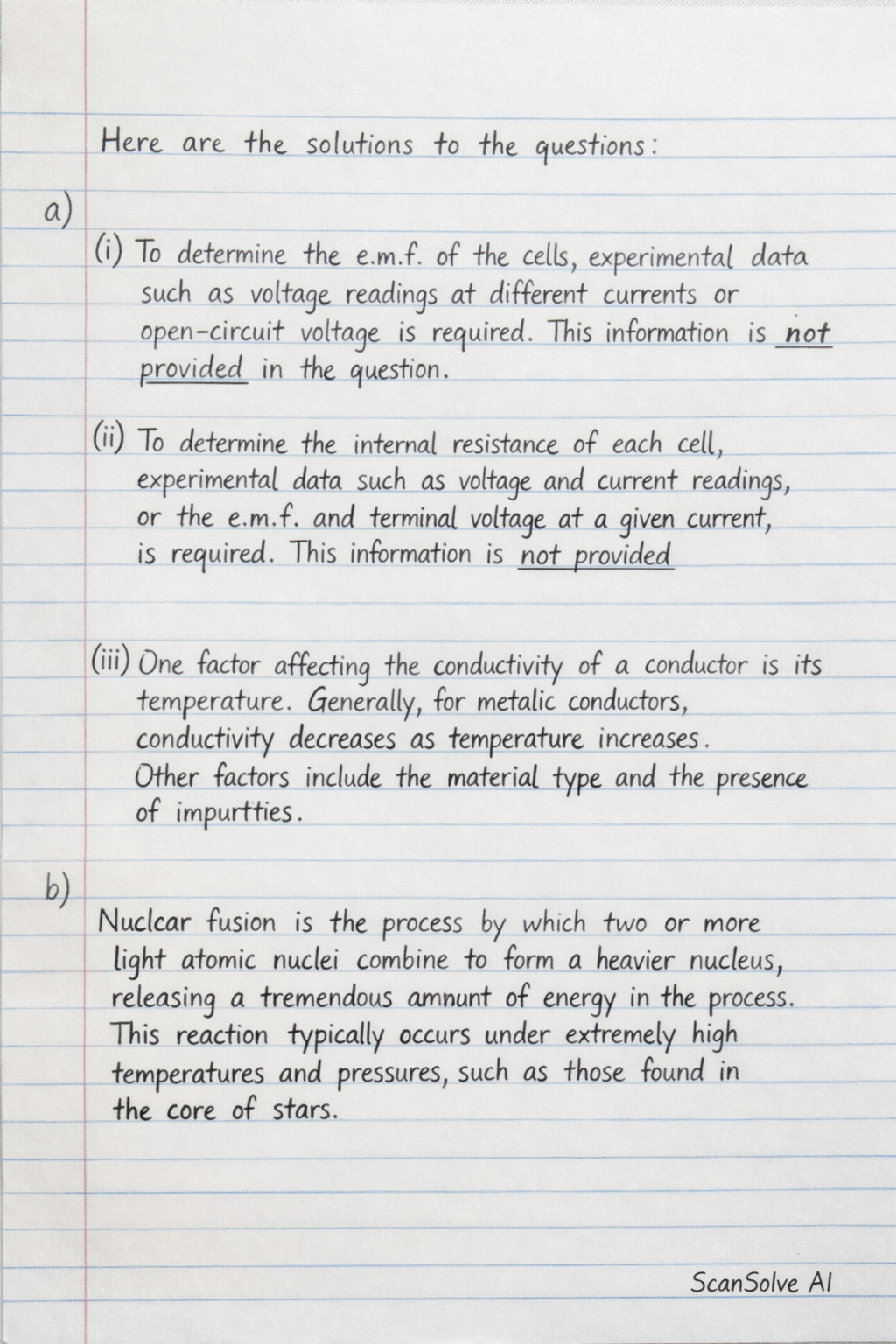
(i) To determine the e.m.f. of the cells, experimental data such as voltage readings at different currents or open-circuit voltage is required. This information is not provided in the question.
(ii) To determine the internal resistance of each cell, experimental data such as voltage and current readings, or the e.m.f. and terminal voltage at a given current, is required. This information is not provided in the question.
(iii) One factor affecting the conductivity of a conductor is its temperature. Generally, for metallic conductors, conductivity decreases as temperature increases. Other factors include the material type and the presence of impurities.
b) Nuclear fusion is the process by which two or more light atomic nuclei combine to form a heavier nucleus, releasing a tremendous amount of energy in the process. This reaction typically occurs under extremely high temperatures and pressures, such as those found in the core of stars.
c)
(i) Explanation of how the detector works (Cloud Chamber):
- The chamber contains a supercooled, supersaturated vapor (e.g., alcohol vapor).
- When ionizing radiation (like alpha or beta particles) passes through this vapor, it ionizes the gas molecules along its path.
- These ions act as condensation nuclei, causing the supersaturated vapor to condense into tiny liquid droplets around them.
- This forms visible tracks or trails, which reveal the path of the ionizing radiation. A light source illuminates these tracks for observation.
(ii) Name the part labelled A, hence state its function.
Name: Ion trails (or tracks of radiation)
Function: The ion trails visualize the path of the ionizing radiation, allowing for the study of its properties, such as its range, energy, and type.
Still stuck on this one?
Ask a follow-up, and the answer starts from this question.
More Physics Questions
Handwritten Step-by-Step Solution
Get this as a handwritten image on WhatsApp — like a tutor wrote it for you.
Try on WhatsApp