
We read your photo as:
Identify the bonding metal in brazing and answer true/false questions related to brazing and material properties.
ScanSolve AI Answer
Answer
Brazing
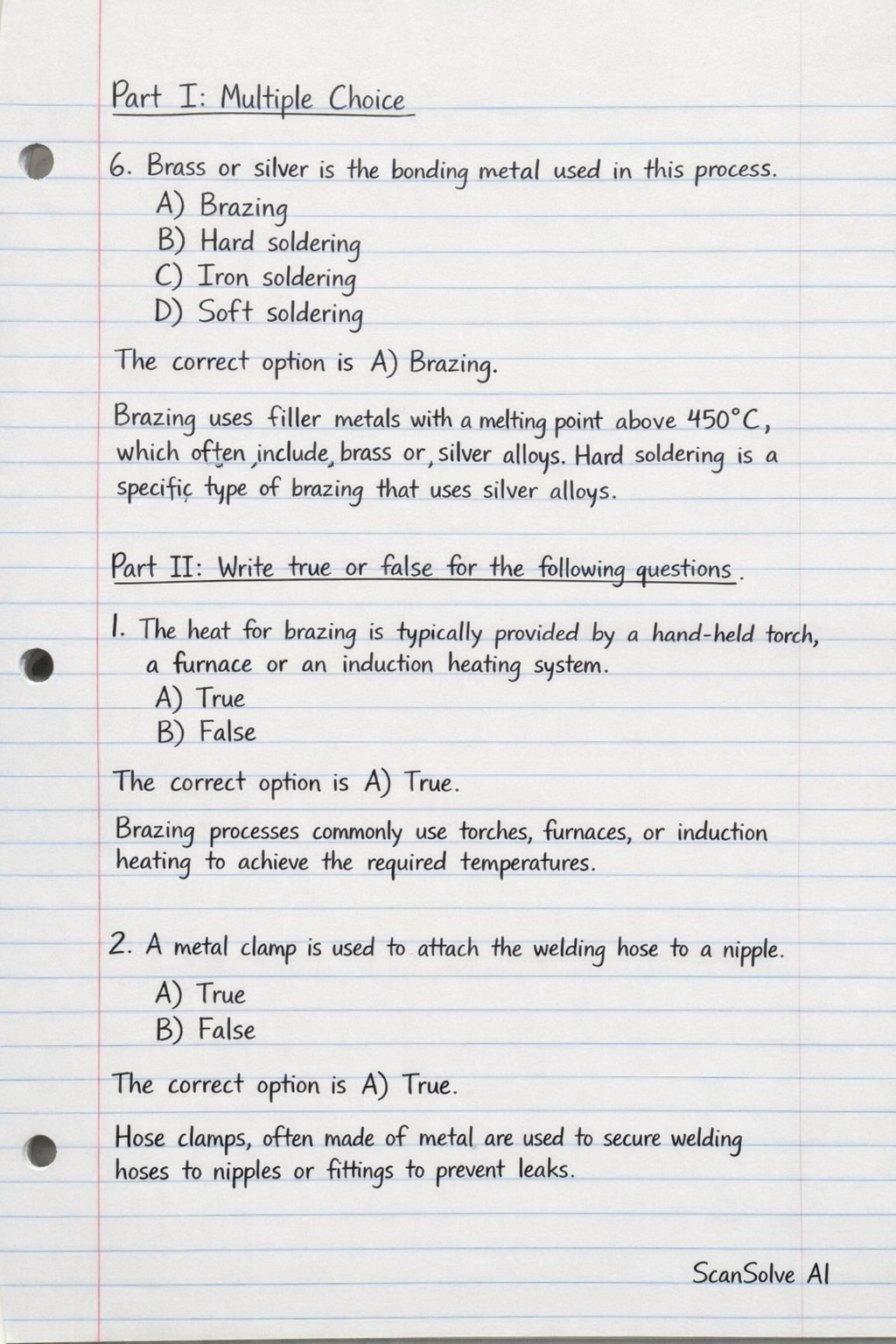
Part I: Multiple Choice
-
Brass or silver is the bonding metal used in this process
- A) Brazing
- B) Hard soldering
- C) Iron soldering
- D) Soft soldering
The correct option is A) Brazing.
Brazing uses filler metals with a melting point above , which often include brass or silver alloys. Hard soldering is a specific type of brazing that uses silver alloys.
Part II: Write true or false for the following questions
-
The heat for brazing is typically provided by a hand-held torch, a furnace or an induction heating system.
- A) True
- B) False
The correct option is A) True.
Brazing processes commonly use torches, furnaces, or induction heating to achieve the required temperatures. -
A metal clamp is used to attach the welding hose to a nipple.
- A) True
- B) False
The correct option is A) True.
Hose clamps, often made of metal, are used to secure welding hoses to nipples or fittings to prevent leaks. -
All materials have physical and working properties.
- A) True
- B) False
The correct option is A) True.
Every material possesses inherent physical properties (e.g., density, melting point) and working properties (e.g., ductility, machinability) that define its behavior and suitability for various applications.
Part III: Give the correct answer for the following questions
-
What is silver alloy? A silver alloy is a metallic mixture composed primarily of silver and one or more other elements, typically metals like copper, zinc, or nickel. These additional elements are added to enhance properties such as hardness, strength, durability, or to lower the melting point, making the silver more suitable for specific applications like jewelry or brazing filler metals.
-
What is silver solder? Silver solder is a type of filler metal used in brazing, specifically known as silver brazing or hard soldering. It is an alloy, predominantly containing silver, copper, and zinc, and sometimes other elements like cadmium or tin. Silver solders have melting points above but below the melting points of the base metals being joined, allowing for strong, leak-tight joints.
-
What is brazing? Brazing is a metal-joining process where two or more metal pieces are joined by melting and flowing a filler metal into the joint. The filler metal has a melting point above but below the melting point of the base metals, which remain unmelted. The molten filler metal flows into the joint by capillary action and, upon cooling, forms a strong metallurgical bond between the components.
-
Write list of distortion? Distortion in metal joining processes like brazing or welding refers to the unwanted changes in the shape or dimensions of a workpiece due to the heating and cooling cycles. Common types of distortion include:
- Angular distortion: A change in the angle between two joined parts.
- Transverse shrinkage: Shortening of the workpiece perpendicular to the joint line.
- Longitudinal shrinkage: Shortening of the workpiece parallel to the joint line.
- Bowing or camber: A general bending or curvature of the workpiece.
- Buckling: Warping or rippling, often seen in thin sheets.
- Rotational distortion: A twisting of the workpiece around an axis.
Try one yourself
A new problem that tests the same skill.
Still stuck on this one?
Ask a follow-up, and the answer starts from this question.
More Physics Questions
Handwritten Step-by-Step Solution
Get this as a handwritten image on WhatsApp — like a tutor wrote it for you.
Try on WhatsApp