
We read your photo as:
Identify the initial velocity (u), final velocity (v), and time (t) for the first 4 seconds.
ScanSolve AI Answer
Answers
3 partsStep-by-step solution
8 stepsHere's the solution to the problem based on the provided speed-time graph:
Part a· 2 steps
Acceleration in the first 4 seconds.
Identify the initial velocity (), final velocity (), and time () for the first 4 seconds.
The object starts from rest, so .
After 4 seconds, the speed is .
The time taken is .Calculate the acceleration using the formula .
The acceleration in the first 4 seconds is .
Part b
Total distance covered by the object.
The total distance covered is the area under the speed-time graph. We can divide the graph into three sections: a triangle (0-4 s), a rectangle (4-10 s), and another triangle (10-15 s).
Calculate the distance covered in the first 4 seconds (triangle).
Calculate the distance covered from 4 s to 10 s (rectangle).
The duration is . The speed is constant at .
Calculate the distance covered from 10 s to 15 s (triangle).
The duration is . The initial speed is and the final speed is .
Calculate the total distance.
The total distance covered by the object is .
Part c
Average speed in the last 4 seconds.
The last 4 seconds of the motion are from to .
Determine the speed at and .
At , the object comes to rest, so .
To find the speed at , we first calculate the deceleration in the last segment (10 s to 15 s).Now, use for the interval from to .
Here, (speed at ), , and .Calculate the average speed in the last 4 seconds.
For uniformly changing speed, the average speed is .
The average speed in the last 4 seconds is .
Try one yourself
A new problem that tests the same skill.
Still stuck on this one?
Ask a follow-up, and the answer starts from this question.
More Physics Questions
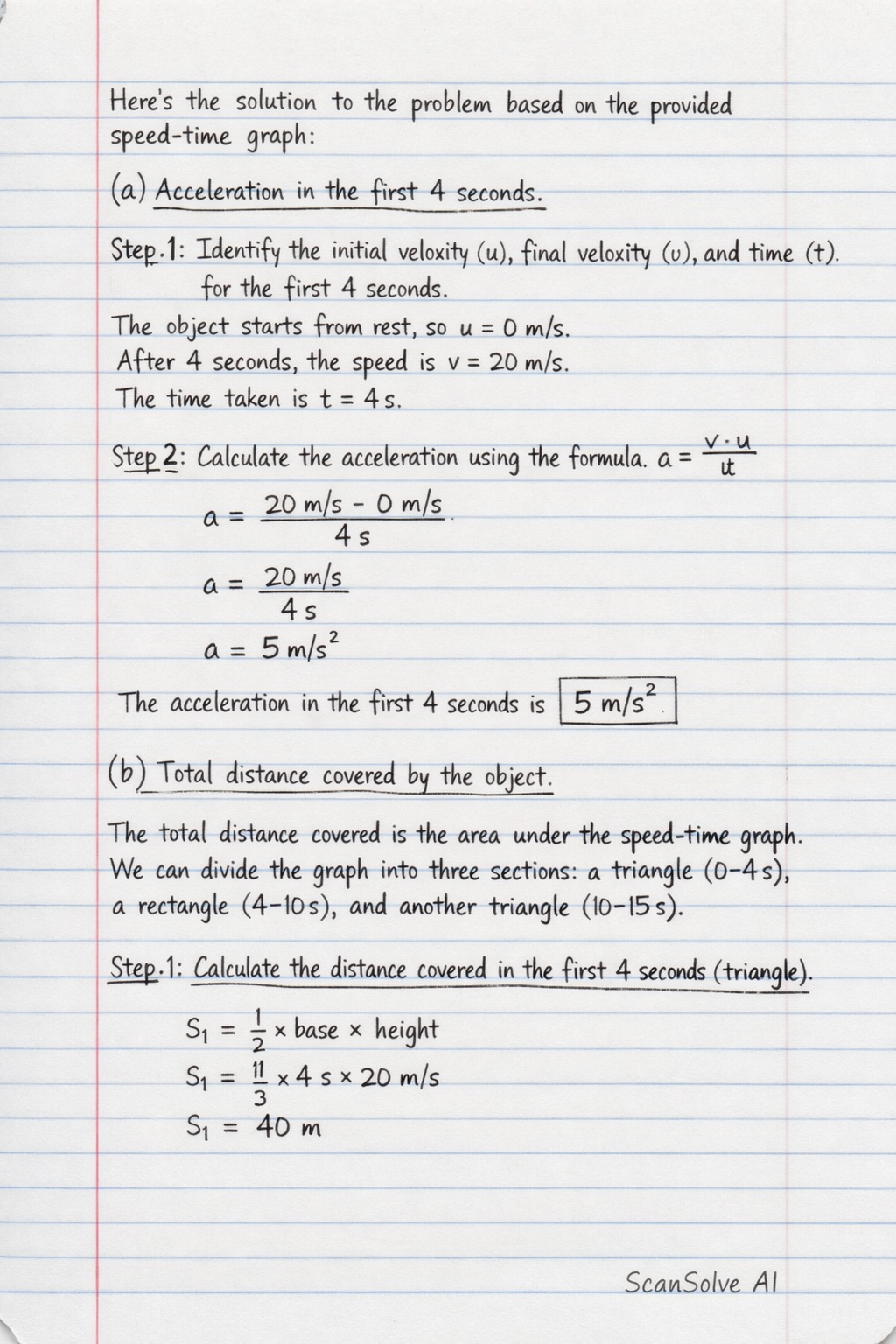
Handwritten Step-by-Step Solution
Get this as a handwritten image on WhatsApp — like a tutor wrote it for you.
Try on WhatsApp