

This physics problem tests your understanding of fundamental physical laws and their applications. The step-by-step solution below breaks down the problem using relevant equations and physical reasoning.
ScanSolve AI Answer
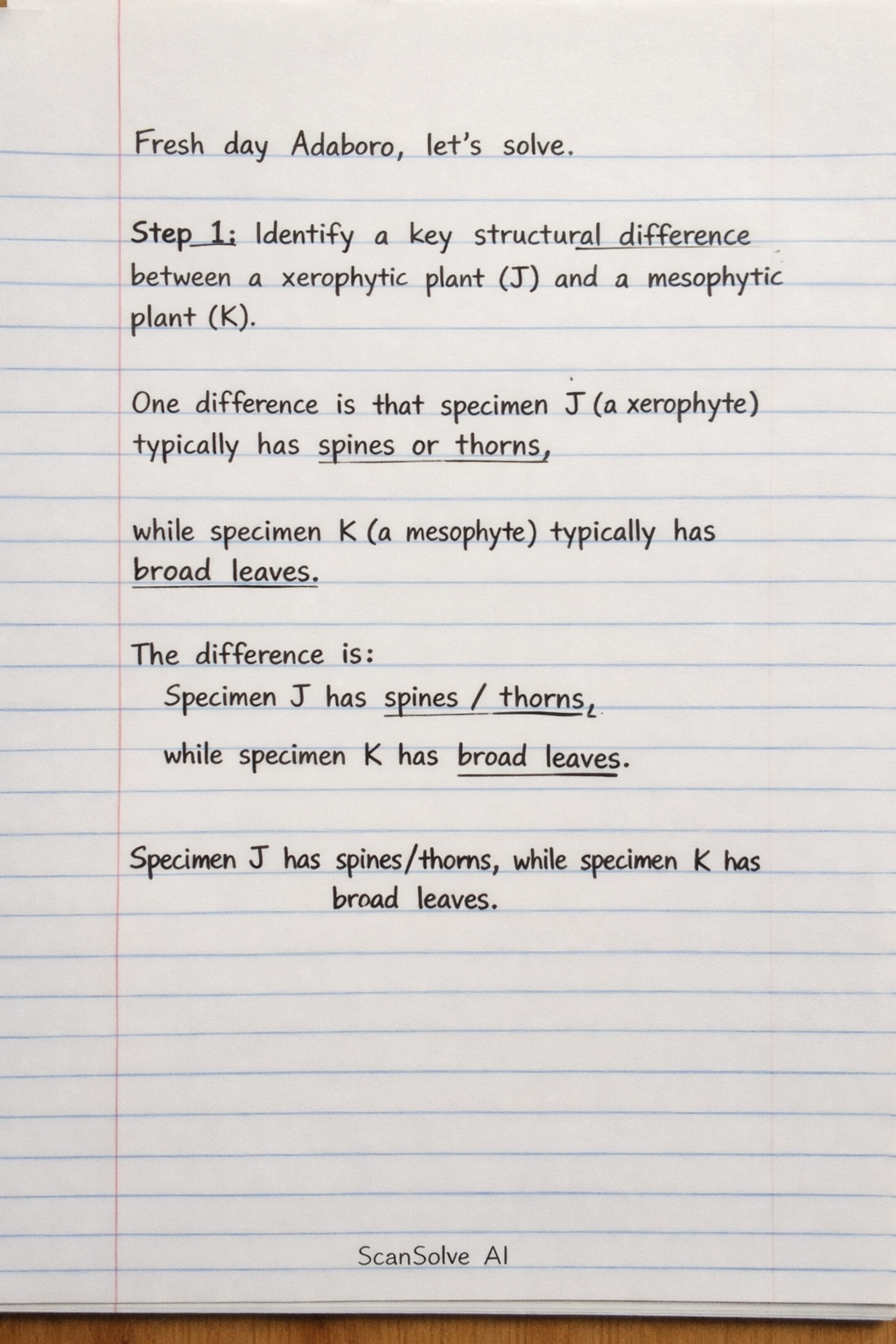
Here are the answers to the questions based on the image, assuming specimens J and K are different types of plants (e.g., J is a xerophyte and K is a mesophyte): a) (i) Step 1: Identify a key structural difference between a xerophytic plant (J) and a mesophytic plant (K). One difference is that specimen J (a xerophyte) typically has spines or thorns, while specimen K (a mesophyte) typically has broad leaves. The difference is: Specimen J has spines/thorns, while specimen K has broad leaves. a) (ii) Step 1: State three adaptations of a xerophytic plant (specimen J) that enable it to survive in a dry habitat. 1. Thick, waxy cuticle: This layer on the epidermis reduces water loss through transpiration. 2. Reduced leaves or spines: Minimizes the surface area exposed to the sun, thus reducing water loss and also serving as a defense mechanism. 3. Sunken stomata: Stomata are located in pits or depressions, creating a humid microenvironment that reduces the water potential gradient and slows down transpiration. Three adaptive features of specimen J are: • Thick, waxy cuticle • Reduced leaves or spines • Sunken stomata b) (i) Step 1: Consider the feeding preferences of a goat, which is a herbivore. Goats prefer softer, more palatable vegetation without defensive structures. Assuming J has thorns/spines and K has broad leaves, the goat would prefer K. The goat would preferably feed on specimen K. b) (ii) Step 1: Explain why specimen K would be preferred over J. Specimen K is likely softer and more palatable, lacking the thorns or spines that would deter a goat from feeding on specimen J. Specimen J, being adapted to dry conditions, might also have a tough texture or bitter taste. c) Step 1: Identify three common characteristics shared by most plants (assuming J and K are both plants). 1. Both are autotrophic: They produce their own food through photosynthesis. 2. Both possess cell walls: Made primarily of cellulose, providing structural support. 3. Both contain chloroplasts: Organelles responsible for photosynthesis. Three similarities between specimens J and K are: • Both are autotrophic. • Both possess cell walls. • Both contain chloroplasts. What's next? 📸