
We read your photo as:
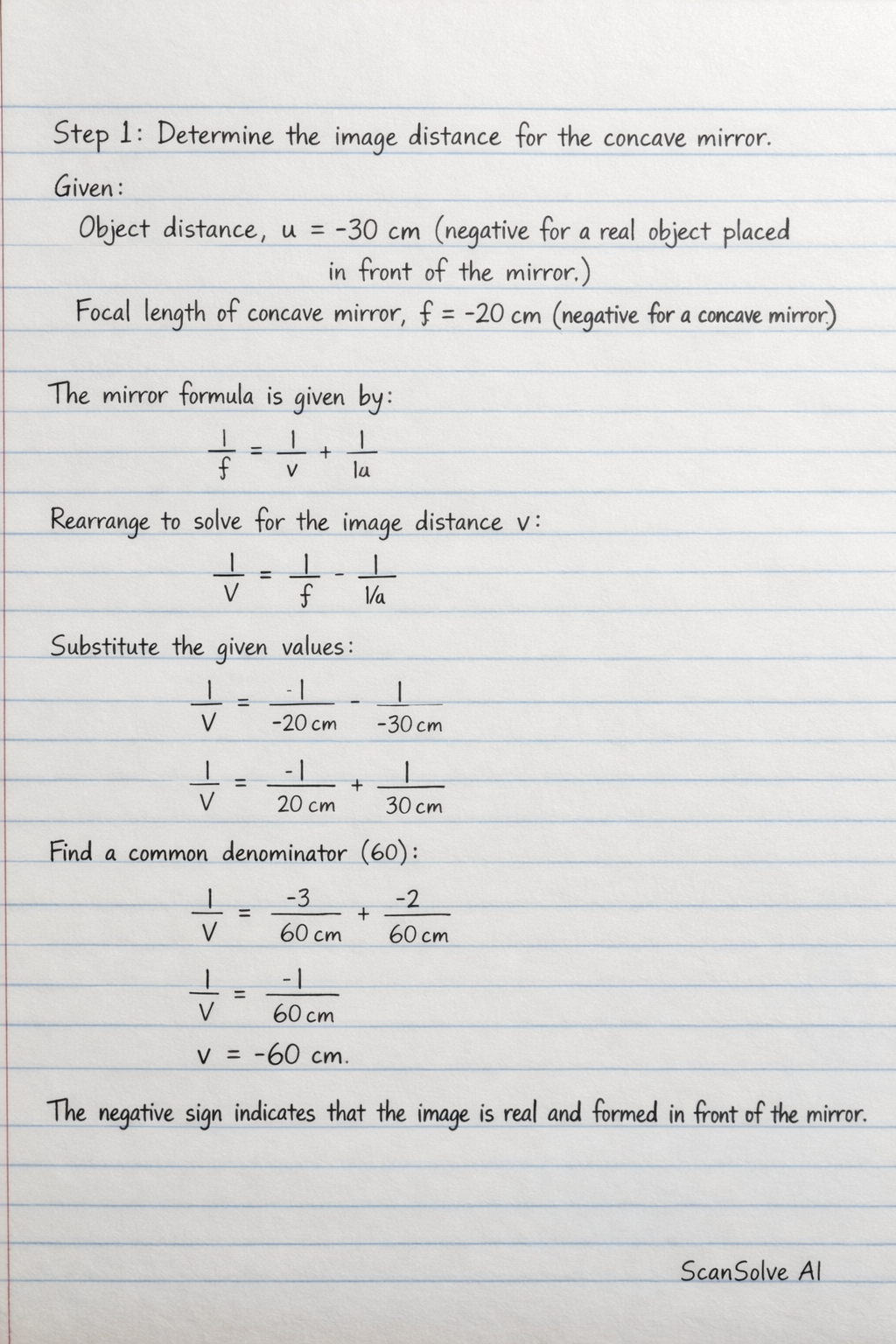
Determine the image distance for the concave mirror.
ScanSolve AI Answer
Answer
Step-by-step solution
4 stepsDetermine the image distance for the concave mirror.
Given:
Object distance, (negative for a real object placed in front of the mirror)
Focal length of concave mirror, (negative for a concave mirror)The mirror formula is given by:
Rearrange to solve for the image distance :
Substitute the given values:
Find a common denominator (60):
The negative sign indicates that the image is real and formed in front of the mirror.
Determine the magnification.
The magnification is given by:
Substitute the values of and :
The negative sign indicates that the image is inverted. The magnitude 2 means the image is twice the size of the object.
Explain how to draw the ray diagram.
To draw the ray diagram for a concave mirror with an object placed at and :
- Draw a principal axis and place the concave mirror. Mark the focal point at from the mirror and the center of curvature at from the mirror.
- Place the object (needle) at from the mirror, between and .
- Draw three principal rays from the top of the object:
- A ray parallel to the principal axis, which reflects through the focal point .
- A ray passing through the focal point , which reflects parallel to the principal axis.
- A ray passing through the center of curvature , which reflects back along the same path.
- The point where these reflected rays intersect is the top of the image. The image will be real, inverted, and magnified, located at from the mirror (beyond ).
Calculate the speed of light in the medium.
Given:
Critical angle,
Speed of light in vacuum,First, calculate the refractive index of the medium using the critical angle formula:
Next, calculate the speed of light in the medium using the refractive index formula:
The image distance is , the magnification is , and the speed of light in the medium is approximately .
Try one yourself
A new problem that tests the same skill.
Still stuck on this one?
Ask a follow-up, and the answer starts from this question.
More Physics Questions
Handwritten Step-by-Step Solution
Get this as a handwritten image on WhatsApp — like a tutor wrote it for you.
Try on WhatsApp