
We read your photo as:
Explain impulse and calculate the impulse experienced by a ball during a collision, and determine the initial height from which it was dropped.
ScanSolve AI Answer
Step-by-step solution
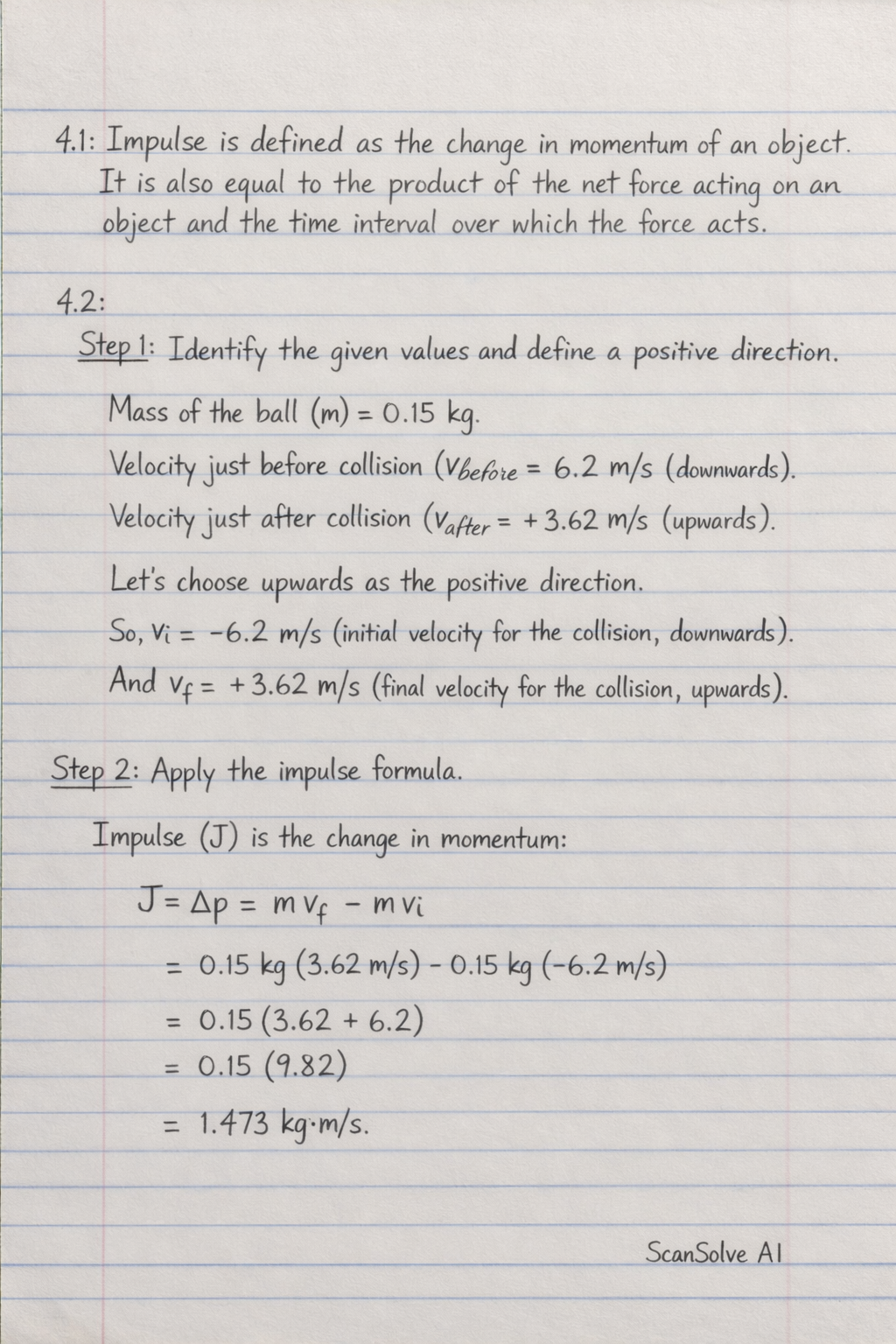
6 steps4.1: Impulse is defined as the change in momentum of an object. It is also equal to the product of the net force acting on an object and the time interval over which the force acts.
4.2:
Identify the given values and define a positive direction.
Mass of the ball () = .
Velocity just before collision () = (downwards).
Velocity just after collision () = (upwards).
Let's choose upwards as the positive direction.
So, (initial velocity for the collision, downwards).
And (final velocity for the collision, upwards).Apply the impulse formula.
Impulse () is the change in momentum: .
Substitute the values and calculate the impulse.
The magnitude of the impulse is .
4.3:
Determine the initial height () from which the ball was dropped.
The ball is dropped from rest () and strikes the floor at . We use the conservation of mechanical energy.
Let the floor be the reference point for potential energy ().Using :
Calculate the minimum required bounce height ().
The requirement is to bounce to one third of the height it was dropped from.
Compare the actual bounce height () with the minimum required bounce height.
The problem states the ball bounces to a height of . So, .
Comparing and :
vs
Since , the ball does not meet the minimum requirements.The ball does not meet the minimum requirements because its actual bounce height of is less than the required bounce height of .
Still stuck on this one?
Ask a follow-up, and the answer starts from this question.
More Physics Questions
Handwritten Step-by-Step Solution
Get this as a handwritten image on WhatsApp — like a tutor wrote it for you.
Try on WhatsApp