
We read your photo as:
In a binary alloy system, two components A and B showed the following characteristics; i. Complete solubility in molten state. ii. Limited solubility when they fully solidified. State the phase r
ScanSolve AI Answer
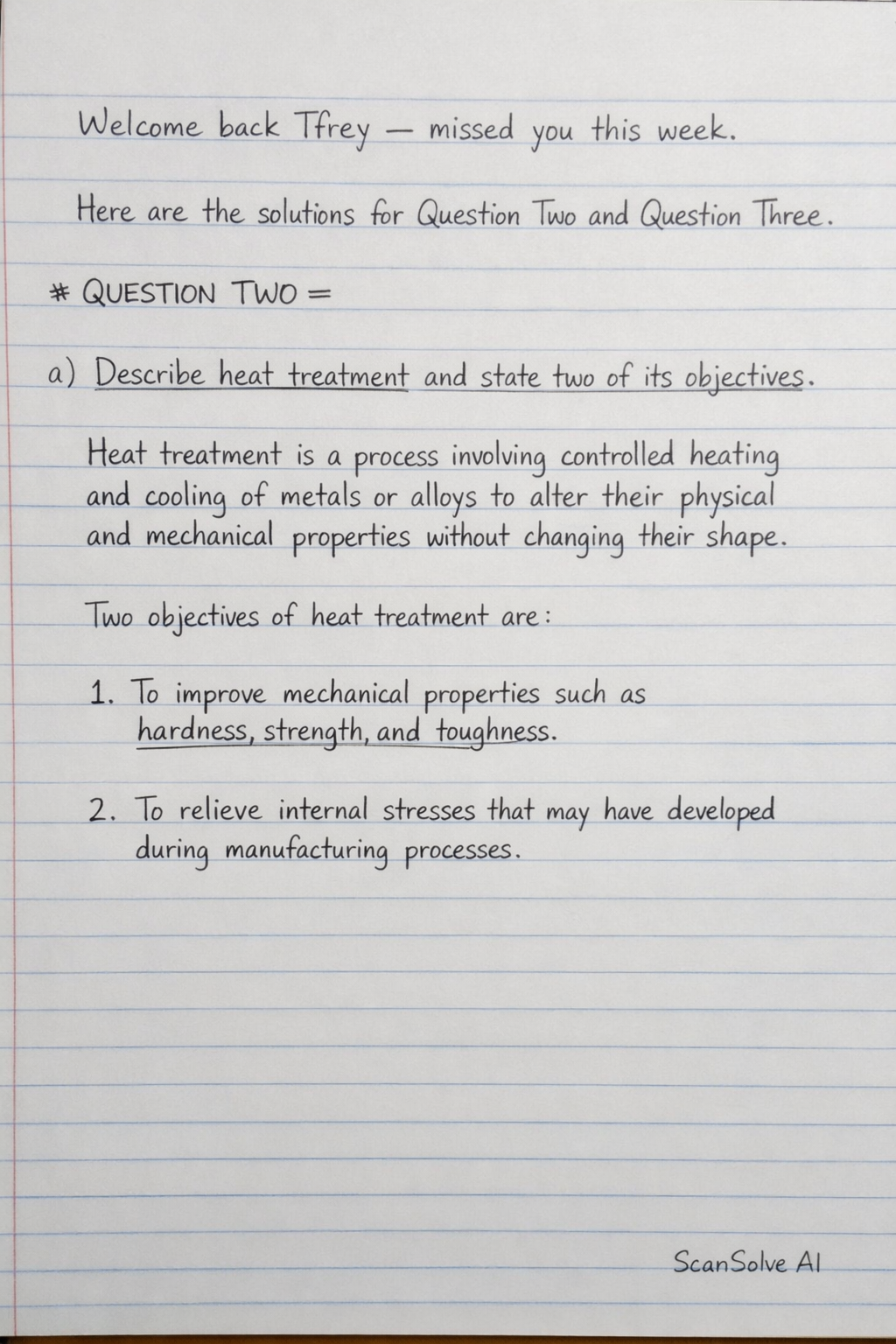
Here are the solutions for Question Two and Question Three.
QUESTION TWO
a) Describe heat treatment and state two of its objectives.
Heat treatment is a process involving controlled heating and cooling of metals or alloys to alter their physical and mechanical properties without changing their shape.
Two objectives of heat treatment are:
- To improve mechanical properties such as hardness, strength, and toughness.
- To relieve internal stresses that may have developed during manufacturing processes.
b) Explain the term "ruling section" and mass "effect".
The ruling section refers to the thickest or most critical section of a component that dictates the cooling rate during heat treatment. It is the section that cools slowest and therefore determines the overall heat treatment parameters.
The mass effect is the phenomenon where the cooling rate of a material during heat treatment varies with its size and shape (mass). Larger or thicker sections cool slower than smaller or thinner sections, leading to differences in microstructure and properties throughout the component.
c) Describe the following surface hardening processes:
i) Flame hardening.
Flame hardening is a process where the surface of a steel component is rapidly heated above its critical temperature using an oxy-acetylene flame (or similar), followed by rapid quenching. This creates a hard martensitic case on the surface while the core remains tough and ductile.
ii) Induction hardening.
Induction hardening is a surface hardening process that uses electromagnetic induction to rapidly heat the surface of a steel component. An alternating current passes through a coil, inducing eddy currents in the workpiece, which generate heat. This is followed by quenching to form a hard surface layer.
iii) Pack carburizing.
Pack carburizing is a thermochemical heat treatment process where carbon is diffused into the surface of low-carbon steel. The component is packed in a carbonaceous material (e.g., charcoal, coke) and heated to a high temperature (typically ) for an extended period. This increases the carbon content of the surface, allowing it to be hardened by subsequent quenching.
iv) Nitriding.
Nitriding is a thermochemical heat treatment process that diffuses nitrogen into the surface of steel, forming hard nitride compounds. This is typically done at lower temperatures (around ) than carburizing, using a nitrogen-rich atmosphere (e.g., ammonia gas). Nitriding produces a very hard, wear-resistant surface with good fatigue strength and corrosion resistance, with minimal distortion.
QUESTION THREE
a) In a binary alloy system, two components A and B showed the following characteristics;
i) Complete solubility in molten state.
ii) Limited solubility when they fully solidified.
This describes a eutectic system or a system exhibiting partial solid solubility. In such a system, the components are completely miscible in the liquid state, forming a single liquid phase. However, upon solidification, they form two distinct solid phases (often denoted as and ), each being a solid solution of one component in the other, but with limited solubility. This means that only a certain amount of one component can dissolve in the solid lattice of the other.
Still stuck on this one?
Ask a follow-up, and the answer starts from this question.
More Physics Questions
Handwritten Step-by-Step Solution
Get this as a handwritten image on WhatsApp — like a tutor wrote it for you.
Try on WhatsApp