
We read your photo as:
In the diagram above, a ball placed on top of a tower 150 m high is kicked with a velocity of 20 m s−1 to hit the ground at a distance, S, as shown. Determine the value of S. [Take g = 10.0 m s−2]
Physics
ScanSolve AI Answer
Answer
Step-by-step solution
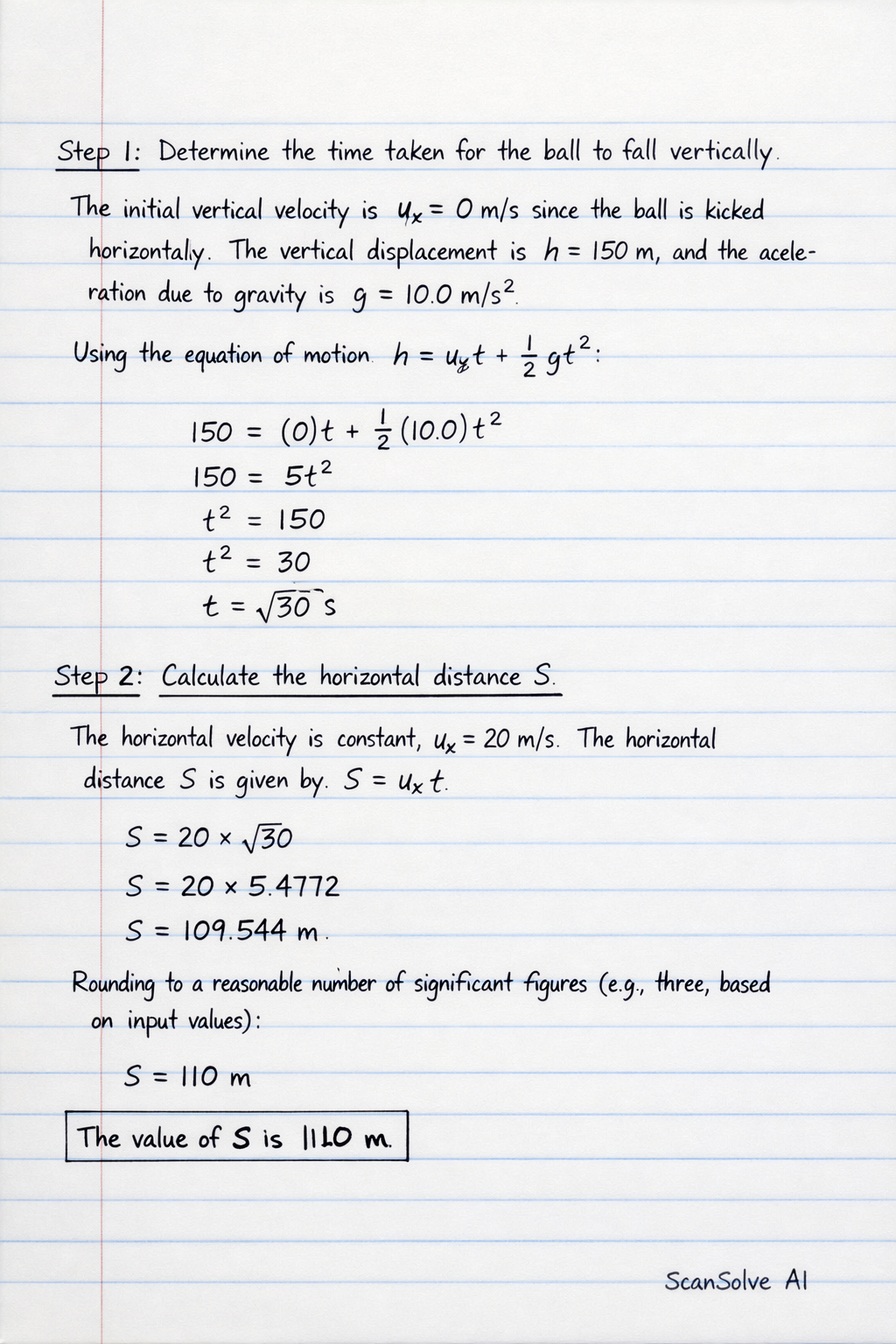
3 stepsDetermine the time taken for the ball to fall vertically.
The initial vertical velocity is m/s since the ball is kicked horizontally. The vertical displacement is m, and the acceleration due to gravity is m/s.
Using the equation of motion :Calculate the horizontal distance .
The horizontal velocity is constant, m/s. The horizontal distance is given by .
Rounding to a reasonable number of significant figures (e.g., three, based on input values):
The value of is
List three applications of the photoelectric effect.
- Photocells (used in automatic doors, street lights, and burglar alarms)
- Solar cells (photovoltaic cells) for generating electricity
- Digital cameras and other image sensors (e.g., CCDs, CMOS sensors)
Was this helpful?
Try one yourself
A new problem that tests the same skill.
Still stuck on this one?
Ask a follow-up, and the answer starts from this question.
Got a different question?Ask your own question
More Physics Questions
QA ball is thrown horizontally from the top of a vertical tower and strikes the ground 50m from the…QA stone is projected vertically upward with a speed of 30ms-1 form the top of a tower of height 50m…QA stone of mass 0.50 kg is dropped from a height of 20 m above the ground. Calculate its speed just…QA ball is kicked with an initial velocity of 25 s at an angle of 35° to the ground. Calculate: (a)…QA ball of mass 400 gm is dropped from tower of height 90 m. Find: i) Time to reach the ground. ii)…
Browse by topic:Mechanics
Handwritten Step-by-Step Solution
Get this as a handwritten image on WhatsApp — like a tutor wrote it for you.
Try on WhatsApp