
We read your photo as:
In the diagram below calculate the magnitude of that force that (a) q1 exerts on q2 (b) q2 exerts on q1.
ScanSolve AI Answer
Step-by-step solution
4 stepsHere is the solution for question 10.
Part 10· 4 steps
In the diagram below calculate the magnitude of that force that (a) exerts on (b) exerts on .
Given values from the diagram:
C
C
Horizontal distance, m
Vertical distance, m
Coulomb's constant,
Calculate the distance between and using the Pythagorean theorem.
Use Coulomb's Law to calculate the magnitude of the electrostatic force between and .
Substitute the values into the formula.
Calculate the force.
According to Newton's third law, the magnitude of the force exerts on is equal to the magnitude of the force exerts on .
Part a
The magnitude of the force that exerts on is* .
Part b
The magnitude of the force that exerts on is* .
Still stuck on this one?
Ask a follow-up, and the answer starts from this question.
More Physics Questions
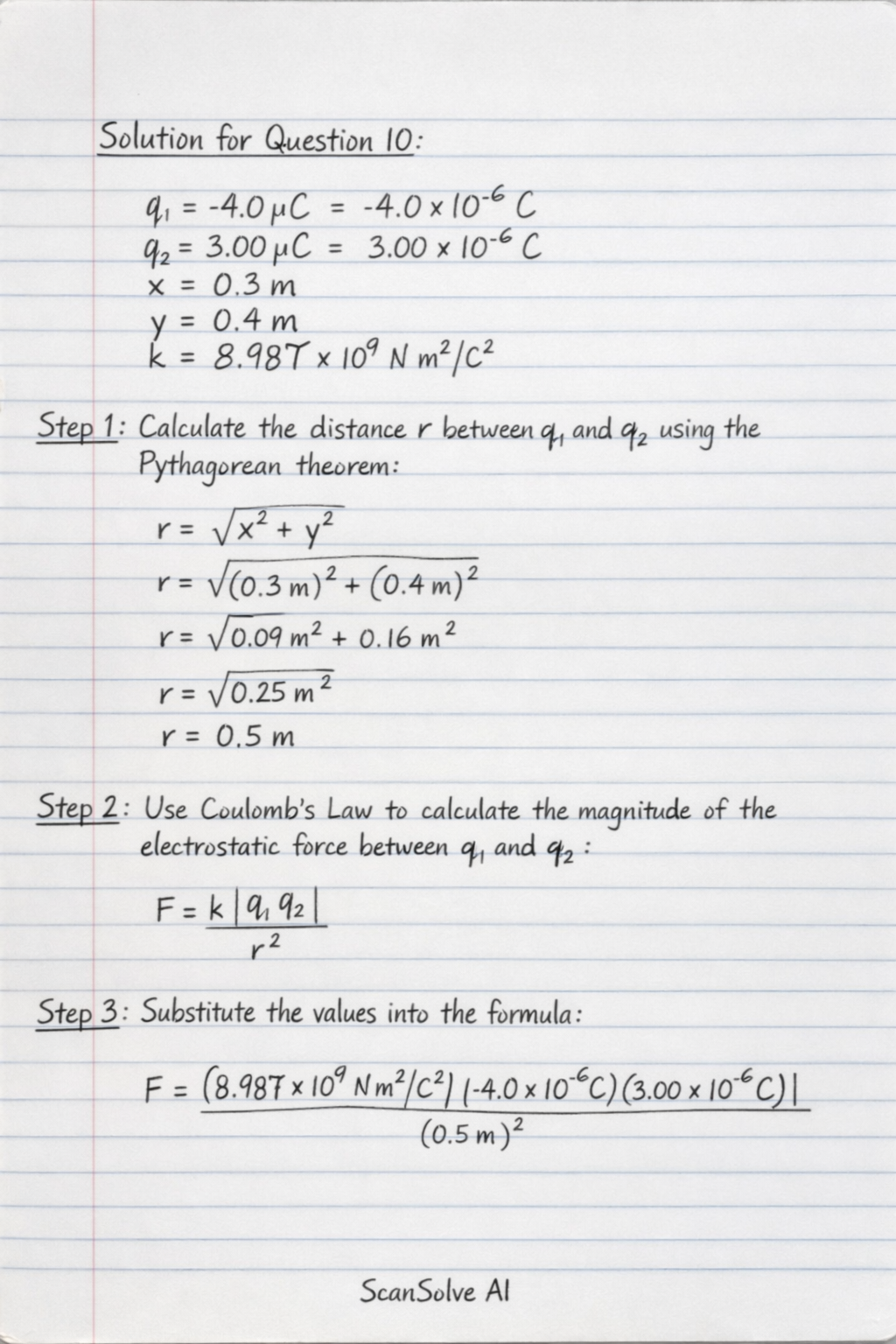
Handwritten Step-by-Step Solution
Get this as a handwritten image on WhatsApp — like a tutor wrote it for you.
Try on WhatsApp