
We read your photo as:
Determine the initial velocity (u) of the stone.
ScanSolve AI Answer
Answer
Step-by-step solution
4 stepsDetermine the initial velocity () of the stone.
We use the kinematic equation for displacement: .
Let the upward direction be positive. The initial position is above the ground. The final position is (ground level). So, the displacement .
The acceleration due to gravity .
The total time .Calculate the greatest height above the ground (i).
The stone reaches its maximum height when its vertical velocity becomes .
We use the kinematic equation: .
Here, , , and .
Let be the additional height reached above the tower.The greatest height above the ground is the tower's height plus this additional height.
The greatest height above the ground is .
Calculate the velocity with which it reaches the ground (ii).
We use the kinematic equation: .
Here, , , and .The negative sign indicates the velocity is directed downwards.
The velocity with which it reaches the ground is .Calculate the time taken to reach the maximum height (iii).
We use the kinematic equation: .
At maximum height, the final velocity .
Here, and .The time taken to reach the maximum height is .
Try one yourself
A new problem that tests the same skill.
Still stuck on this one?
Ask a follow-up, and the answer starts from this question.
More Physics Questions
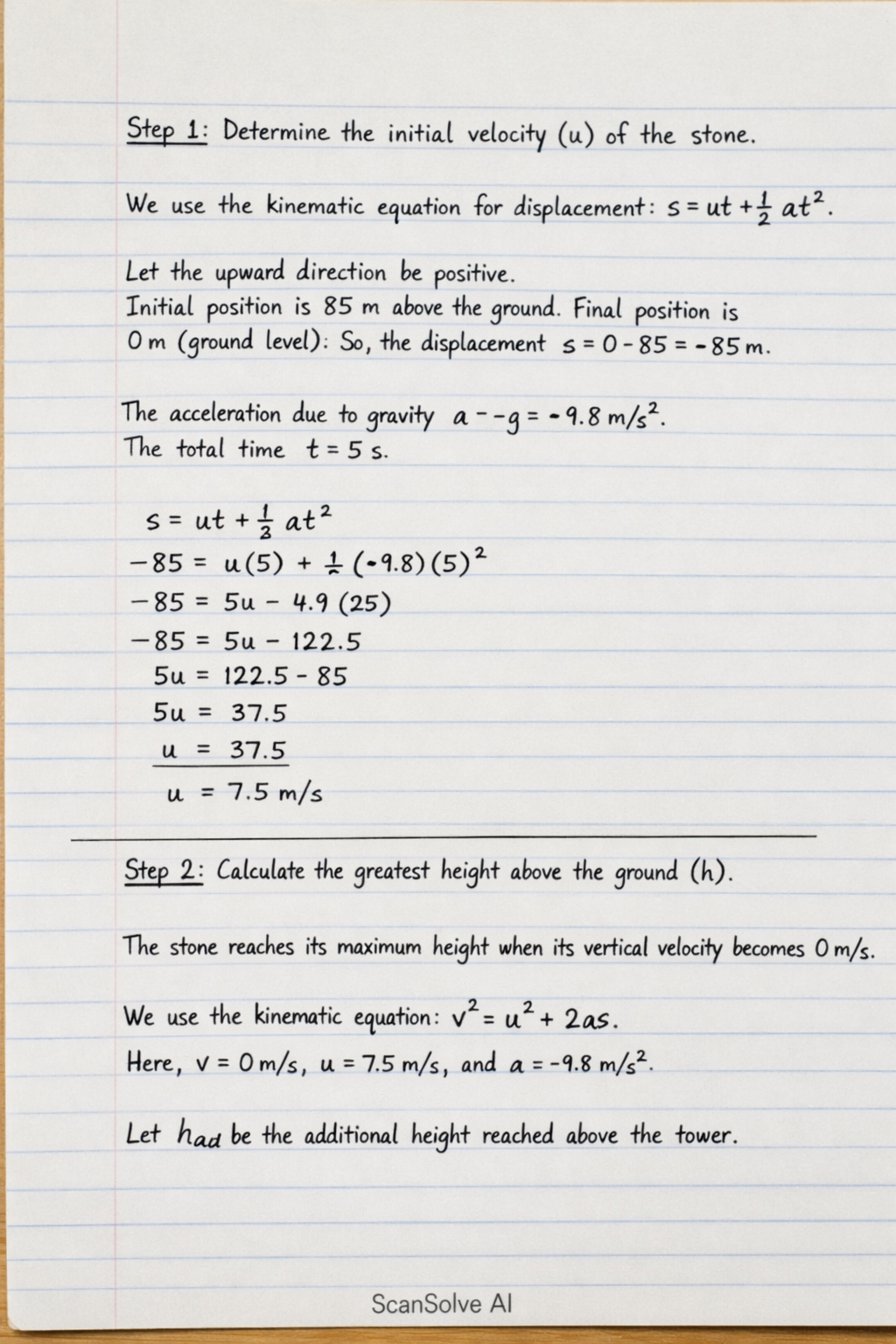
Handwritten Step-by-Step Solution
Get this as a handwritten image on WhatsApp — like a tutor wrote it for you.
Try on WhatsApp