
Teach me the steps to solve questions using examples under centre of mass ànd centre of gravity in maths mechanics
ScanSolve AI Answer
Answer
Step-by-step solution
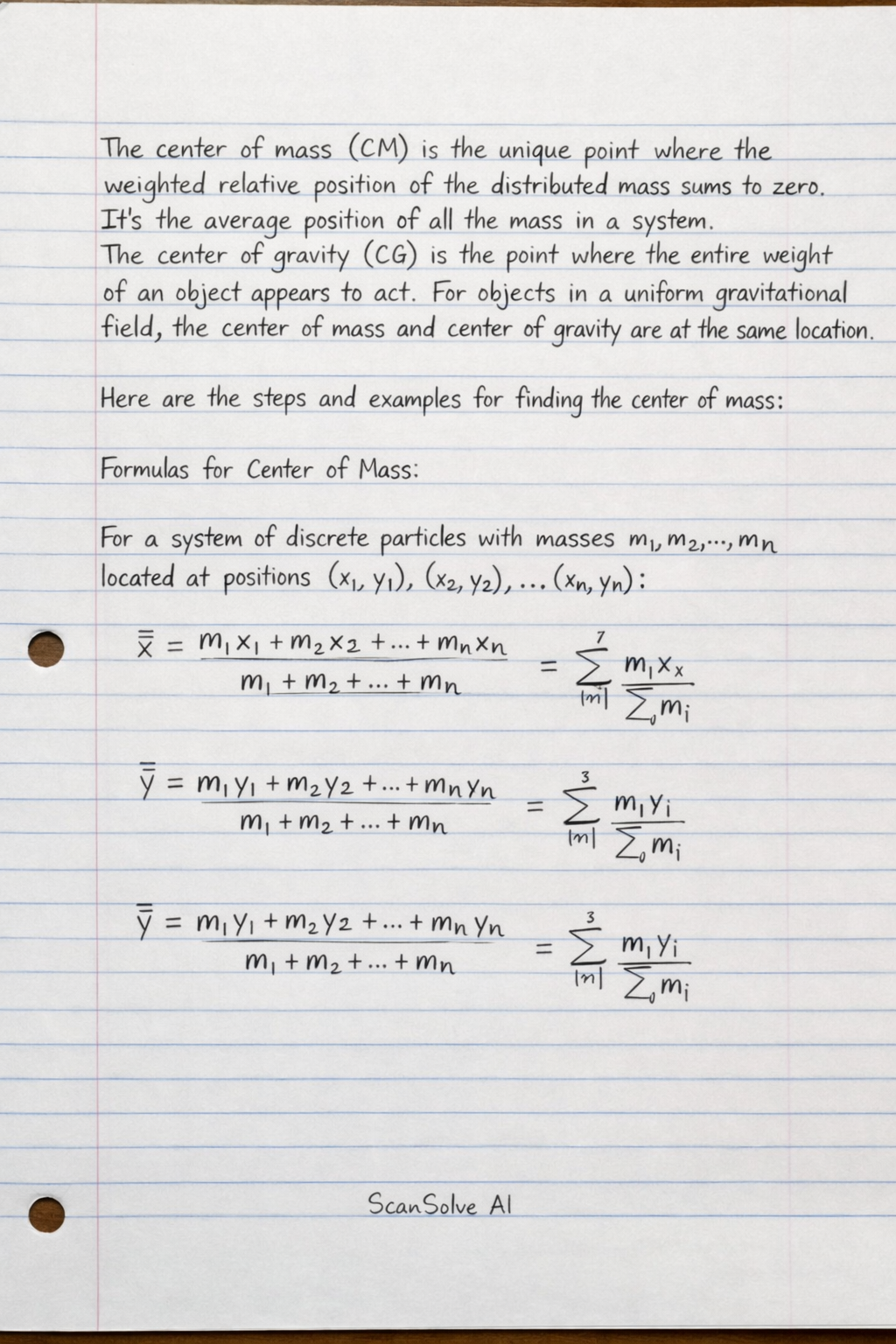
18 stepsThe center of mass (CM) is the unique point where the weighted relative position of the distributed mass sums to zero. It's the average position of all the mass in a system. The center of gravity (CG) is the point where the entire weight of an object appears to act. For objects in a uniform gravitational field, the center of mass and center of gravity are at the same location.
Here are the steps and examples for finding the center of mass:
Formulas for Center of Mass
For a system of discrete particles with masses located at positions :
For a composite lamina (a flat, thin object of uniform density), the mass is proportional to its area. So, we can replace mass () with area () in the formulas, where is the area of each part and is the centroid of that part:
Example 1: Discrete Particles
Find the center of mass of three particles with masses , , and located at coordinates , , and respectively.
Identify the masses and their coordinates.
- at
- at
- at
Calculate the sum of the masses.
Calculate the sum of the products of mass and x-coordinate ().
Calculate the x-coordinate of the center of mass ().
Calculate the sum of the products of mass and y-coordinate ().
Calculate the y-coordinate of the center of mass ().
The center of mass is at .
Example 2: Composite Lamina (L-shaped)
Find the center of mass of a uniform L-shaped lamina formed by two rectangles:
- Rectangle 1: Base from to , height from to .
- Rectangle 2: Base from to , height from to .
Divide the composite shape into simpler geometric shapes and find their individual areas and centroids.
- Rectangle 1 (R1):
- Dimensions: width 6, height 2.
- Area .
- Centroid : Midpoint of width is . Midpoint of height is . So, .
- Rectangle 2 (R2):
- Dimensions: width 2, height 3 (from to ).
- Area .
- Centroid : Midpoint of width is . Midpoint of height is . So, .
- Rectangle 1 (R1):
Calculate the total area of the lamina.
Calculate the sum of the products of area and x-coordinate ().
Calculate the x-coordinate of the center of mass ().
Calculate the sum of the products of area and y-coordinate ().
Calculate the y-coordinate of the center of mass ().
The center of mass is at .
Example 3: Lamina with a Hole
Find the center of mass of a square lamina with side length (from to , to ) with a circular hole of radius centered at .
Treat the shape as a large square with a "negative mass" (or negative area) circular hole.
- Square (S):
- Dimensions: side length .
- Area .
- Centroid : Midpoint of width is . Midpoint of height is . So, .
- Circular Hole (H):
- Radius .
- Area .
- Centroid : Given as .
- For calculation, we use this area as negative: .
- Square (S):
Calculate the total effective area.
Calculate the sum of the products of area and x-coordinate ().
Calculate the x-coordinate of the center of mass ().
Calculate the sum of the products of area and y-coordinate ().
Calculate the y-coordinate of the center of mass ().
The center of mass is at .
Try one yourself
A new problem that tests the same skill.
Still stuck on this one?
Ask a follow-up, and the answer starts from this question.
More Physics Questions
Handwritten Step-by-Step Solution
Get this as a handwritten image on WhatsApp — like a tutor wrote it for you.
Try on WhatsApp