
We read your photo as:
Calculate the resultant force R by summing the given forces F1, F2, and F3.
ScanSolve AI Answer
This answer stops before the end.
It was cut off when it was first written. Ask ScanSolve this question again for the full working.
Here's the solution to question 1.
Part (i): Show that the system of forces is not in equilibrium.
Step 1: Calculate the resultant force by summing the given forces , , and .
Since the resultant force , the system of forces is not in equilibrium.
Part (ii): A fourth force is added to the system at the point with position vector to form a couple. Find:
a) The force .
Step 2: For the system to form a couple, the net force must be zero. Therefore, must be equal and opposite to the resultant force of the first three forces.
b) The moment of the couple.
Step 3: Calculate the moment of each force about the origin using the formula .
Still stuck on this one?
Ask a follow-up, and the answer starts from this question.
More Physics Questions
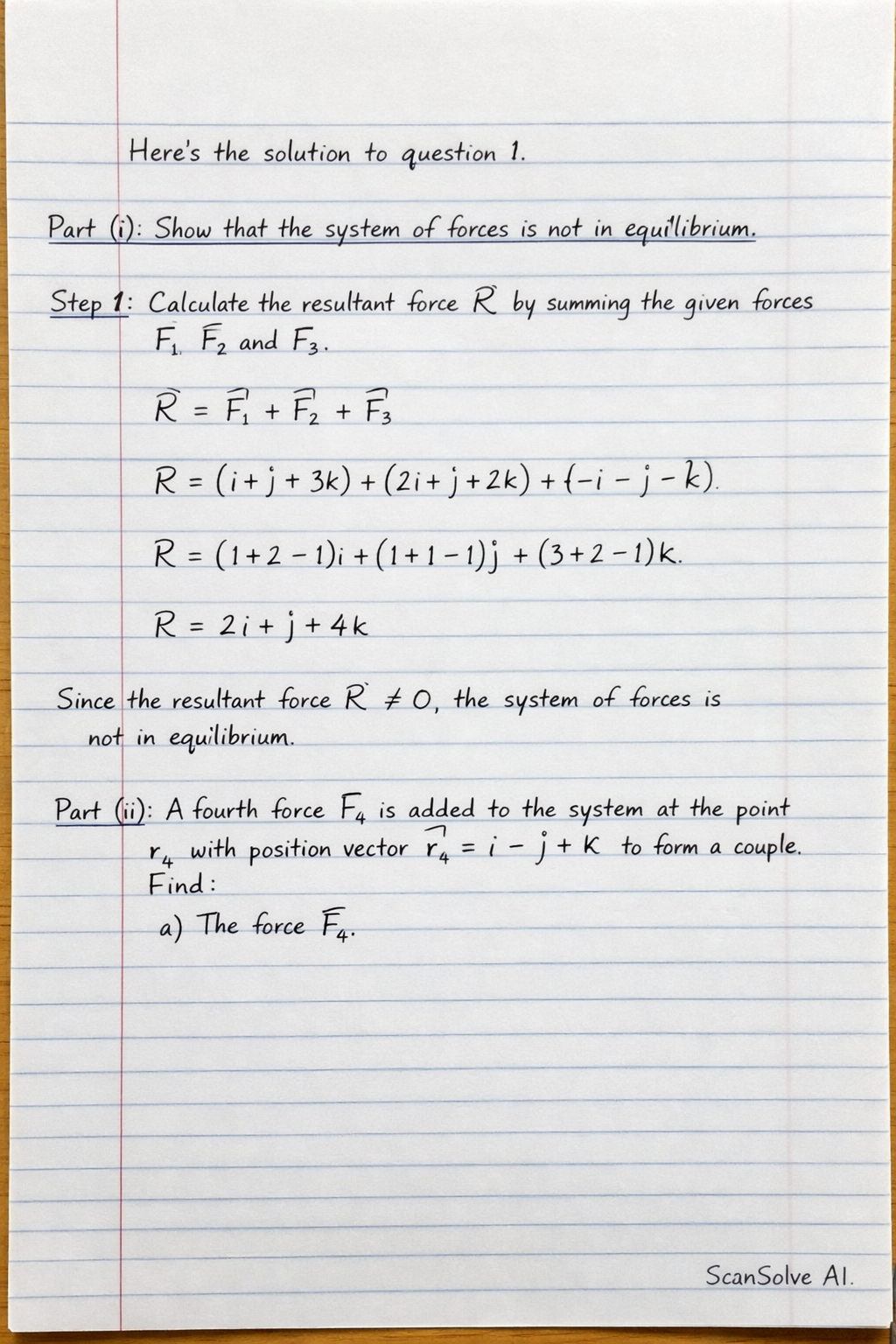
Handwritten Step-by-Step Solution
Get this as a handwritten image on WhatsApp — like a tutor wrote it for you.
Try on WhatsApp