
We read your photo as:
Define limiting friction and draw free body diagrams for a system with a 20 kg trolley on a surface with rolling friction and a 3 kg hanging block.
ScanSolve AI Answer
Step-by-step solution
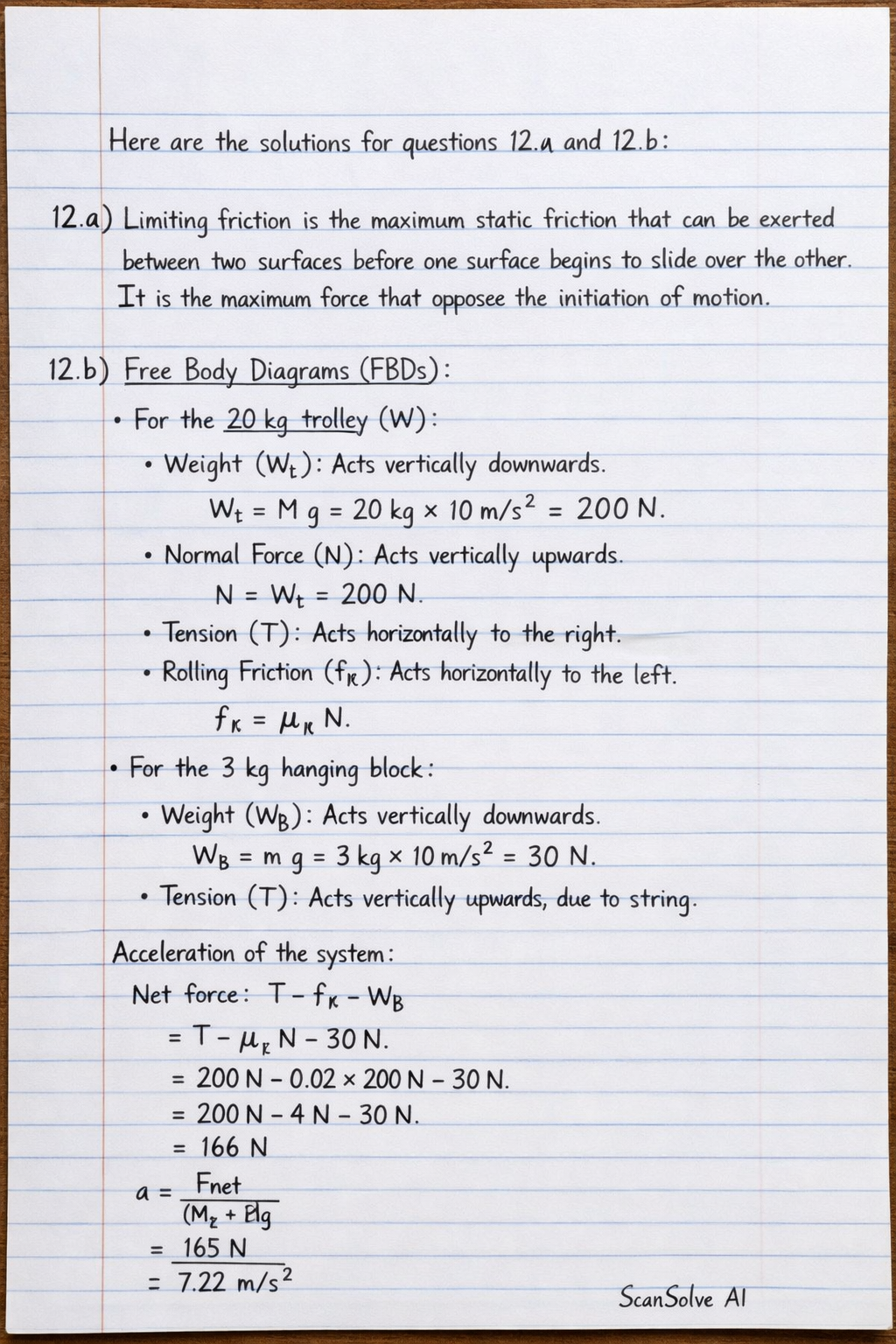
4 stepsHere are the solutions for questions 12.a and 12.b:
12.a) Limiting friction is the maximum static friction that can be exerted between two surfaces before one surface begins to slide over the other. It is the maximum force that opposes the initiation of motion.
12.b)
Free Body Diagrams (FBDs):
-
For the 20 kg trolley (W):
- Weight (): Acts vertically downwards. .
- Normal Force (): Acts vertically upwards, perpendicular to the surface. .
- Tension (): Acts horizontally to the right, due to the string.
- Rolling Friction (): Acts horizontally to the left, opposing the motion. .
-
For the 3 kg hanging block:
- Weight (): Acts vertically downwards. .
- Tension (): Acts vertically upwards, due to the string.
Acceleration of the system:
Calculate the rolling friction force.
The normal force on the trolley is .
The rolling friction force is .
Write down the equations of motion for each body using Newton's second law ().
For the 20 kg trolley (horizontal motion):
For the 3 kg hanging block (vertical motion, downwards is positive):
Solve the system of equations for acceleration ().
Add equation (1) and equation (2):
Calculate the acceleration.
The acceleration of the block and the trolley system is .
Still stuck on this one?
Ask a follow-up, and the answer starts from this question.
More Physics Questions
Handwritten Step-by-Step Solution
Get this as a handwritten image on WhatsApp — like a tutor wrote it for you.
Try on WhatsApp