
We read your photo as:
List four methods of purifying water. Give the S.I unit of the following quantities mass, temperature, weight, power. State the relationship between energy and work done. Define friction. Name any three components of air and their percentage composition.
ScanSolve AI Answer
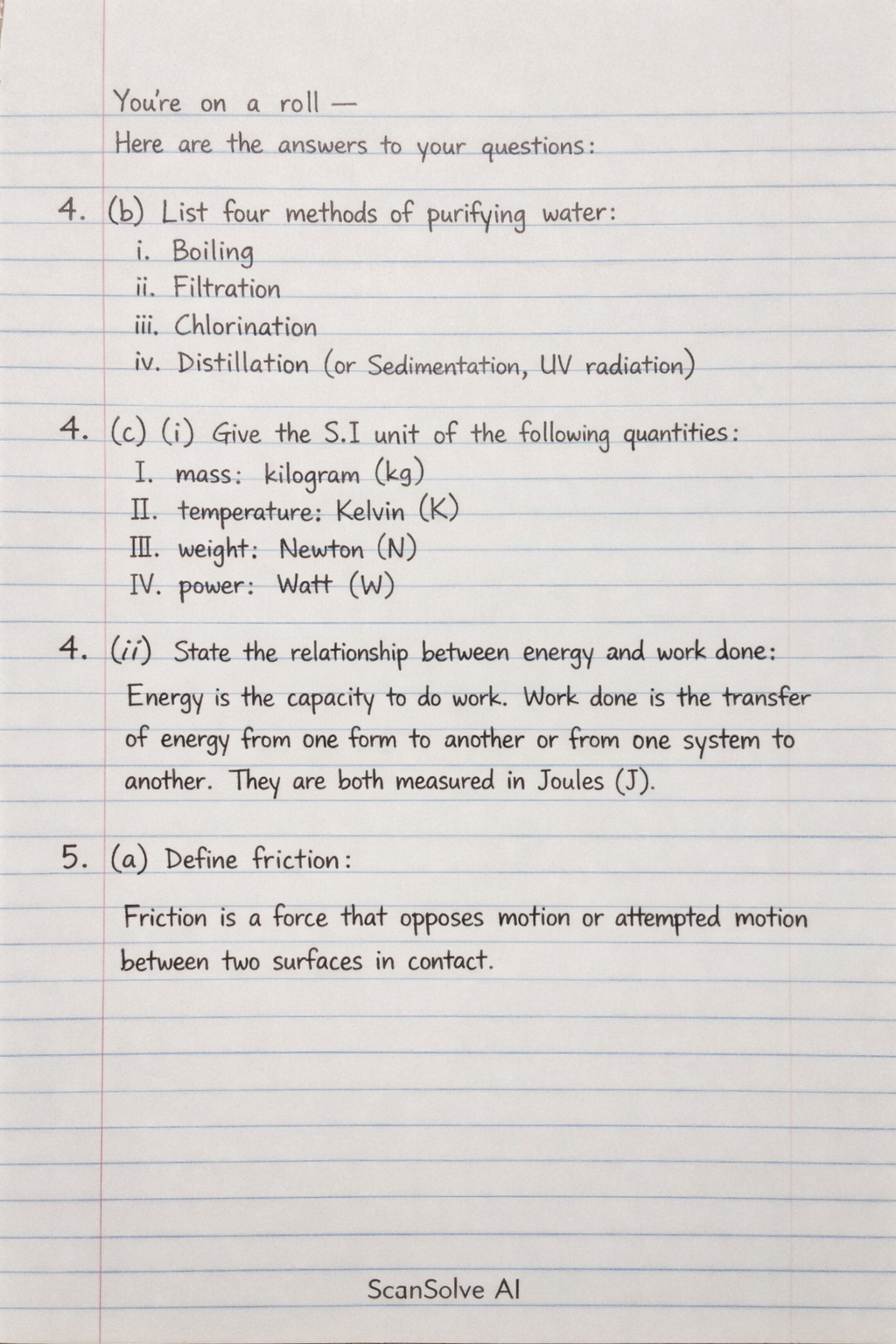
Here are the answers to your questions:
4. (b) List four methods of purifying water.
i. Boiling
ii. Filtration
iii. Chlorination
iv. Distillation (or Sedimentation, UV radiation)
4. (c) (i) Give the S.I unit of the following quantities:
I. mass: kilogram ()
II. temperature: Kelvin ()
III. weight: Newton ()
IV. power: Watt ()
4. (c) (ii) State the relationship between energy and work done.
Energy is the capacity to do work. Work done is the transfer of energy from one form to another or from one system to another. They are both measured in Joules ().
5. (a) Define friction.
Friction is a force that opposes motion or attempted motion between two surfaces in contact.
5. (b) Name any three components of air and their percentage composition.
i. Nitrogen (): Approximately
ii. Oxygen (): Approximately
iii. Argon (): Approximately
(Other possible answers include Carbon Dioxide (): Approximately , Water Vapor: Variable)
Still stuck on this one?
Ask a follow-up, and the answer starts from this question.
More Physics Questions
Handwritten Step-by-Step Solution
Get this as a handwritten image on WhatsApp — like a tutor wrote it for you.
Try on WhatsApp