
This physics problem tests your understanding of fundamental physical laws and their applications. The step-by-step solution below breaks down the problem using relevant equations and physical reasoning.
ScanSolve AI Answer
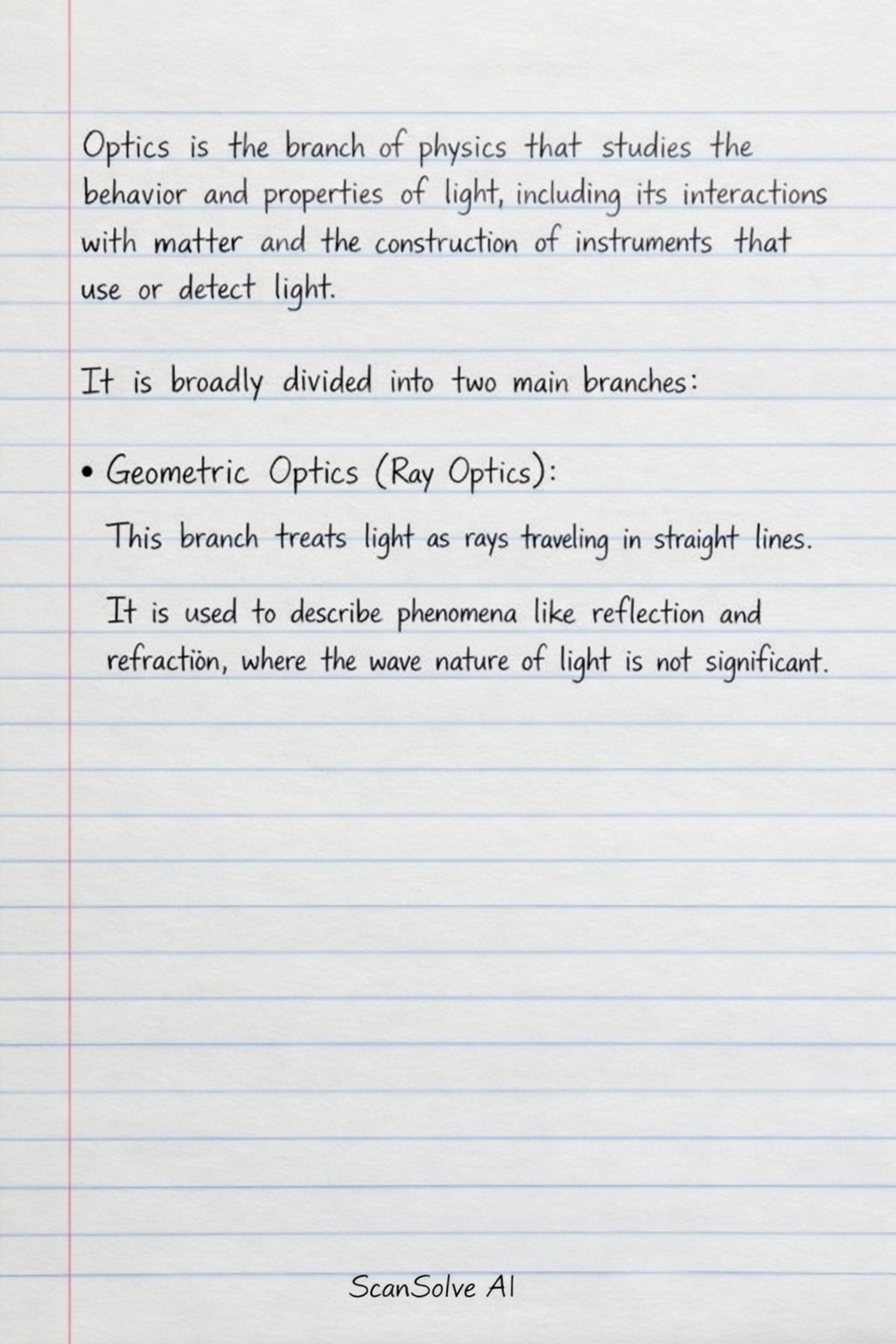
Optics is the branch of physics that studies the behavior and properties of light, including its interactions with matter and the construction of instruments that use or detect light. It is broadly divided into two main branches: • Geometric Optics (Ray Optics): This branch treats light as rays traveling in straight lines. It is used to describe phenomena like reflection and refraction, where the wave nature of light is not significant. Reflection: The bouncing back of light when it strikes a surface. Laws of Reflection: 1. The incident ray, the reflected ray, and the normal to the surface at the point of incidence all lie in the same plane. 2. The angle of incidence (_i) is equal to the angle of reflection (_r). _i = _r Mirrors: Plane mirrors* form virtual, erect, and laterally inverted images of the same size as the object. Spherical mirrors* (concave and convex) can form real or virtual images, depending on the object's position. The mirror formula relates object distance (u), image distance (v), and focal length (f): (1)/(f) = (1)/(u) + (1)/(v) Magnification (M) is given by: M = -(v)/(u) = Image heightObject height Refraction: The bending of light as it passes from one medium to another due to a change in its speed. Refractive Index (n): A measure of how much the speed of light is reduced in a medium. n = speed of light in vacuum (c)speed of light in medium (v) Snell's Law: Relates the angles of incidence and refraction to the refractive indices of the two media. n_1 _1 = n_2 _2 Lenses: Converging (convex) lenses* focus parallel light rays to a point. Diverging (concave) lenses* spread out parallel light rays. The lens formula is similar to the mirror formula: (1)/(f) = (1)/(u) + (1)/(v) Magnification (M) is also similar: M = -(v)/(u) Total Internal Reflection (TIR): Occurs when light traveling from a denser medium to a less dense medium strikes the interface at an angle greater than the critical angle (_c), causing all the light to be reflected back into the denser medium. _c = (n_2)/(n_1) (where n_1 > n_2) • Physical Optics (Wave Optics): This branch treats light as an electromagnetic wave and explains phenomena that cannot be described by ray optics, such as interference, diffraction, and polarization. Interference: The superposition of two or more waves resulting in a new wave pattern. Constructive interference* occurs when waves combine to produce a larger amplitude. Destructive interference* occurs when waves combine to produce a smaller or zero amplitude. Examples include Young's double-slit experiment. Diffraction: The bending of waves as they pass around obstacles or through small openings. The extent of diffraction depends on the wavelength of the light and the size of the obstacle/opening. Polarization: The phenomenon where light waves oscillate in a single plane. Unpolarized light vibrates in multiple planes. Polarization can occur through reflection, scattering, or by passing light through certain filters. • Electromagnetic Spectrum: Light is a form of electromagnetic radiation, which exists across a spectrum of wavelengths and frequencies, including radio waves, microwaves, infrared, visible light, ultraviolet, X-rays, and gamma rays. Visible light is a small portion of this spectrum. Last free one today — make it count tomorrow, or type /upgrade for unlimited.