

This physics problem tests your understanding of fundamental physical laws and their applications. The step-by-step solution below breaks down the problem using relevant equations and physical reasoning.
ScanSolve AI Answer
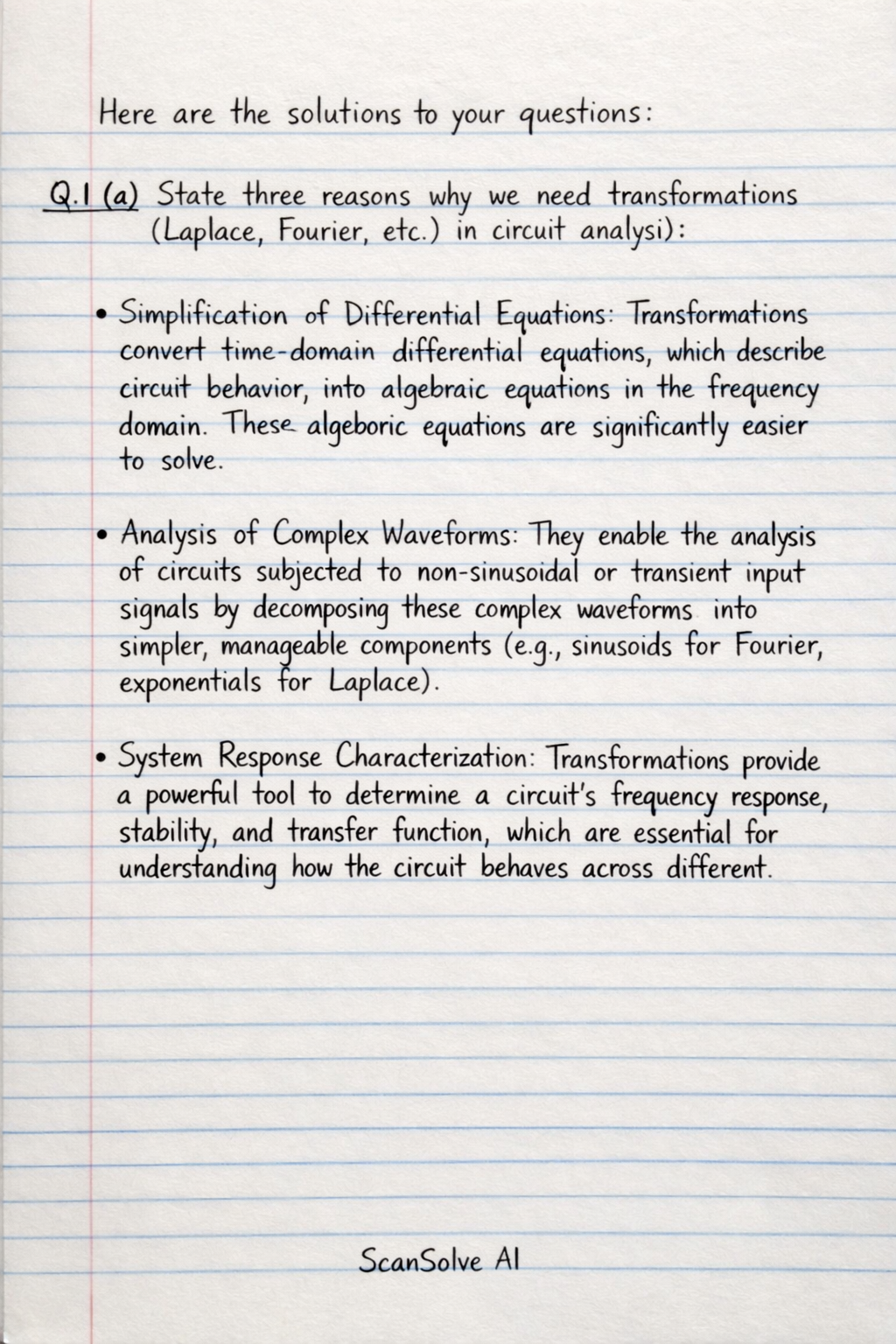
Here are the solutions to your questions: Q.1 (a) State three reasons why we need transformations (Laplace, Fourier, etc.) in circuit analysis. • Simplification of Differential Equations: Transformations convert time-domain differential equations, which describe circuit behavior, into algebraic equations in the frequency domain. These algebraic equations are significantly easier to solve. • Analysis of Complex Waveforms: They enable the analysis of circuits subjected to non-sinusoidal or transient input signals by decomposing these complex waveforms into simpler, manageable components (e.g., sinusoids for Fourier, exponentials for Laplace). • System Response Characterization: Transformations provide a powerful tool to determine a circuit's frequency response, stability, and transfer function, which are essential for understanding how the circuit behaves across different