

This physics problem tests your understanding of fundamental physical laws and their applications. The step-by-step solution below breaks down the problem using relevant equations and physical reasoning.
ScanSolve AI Answer
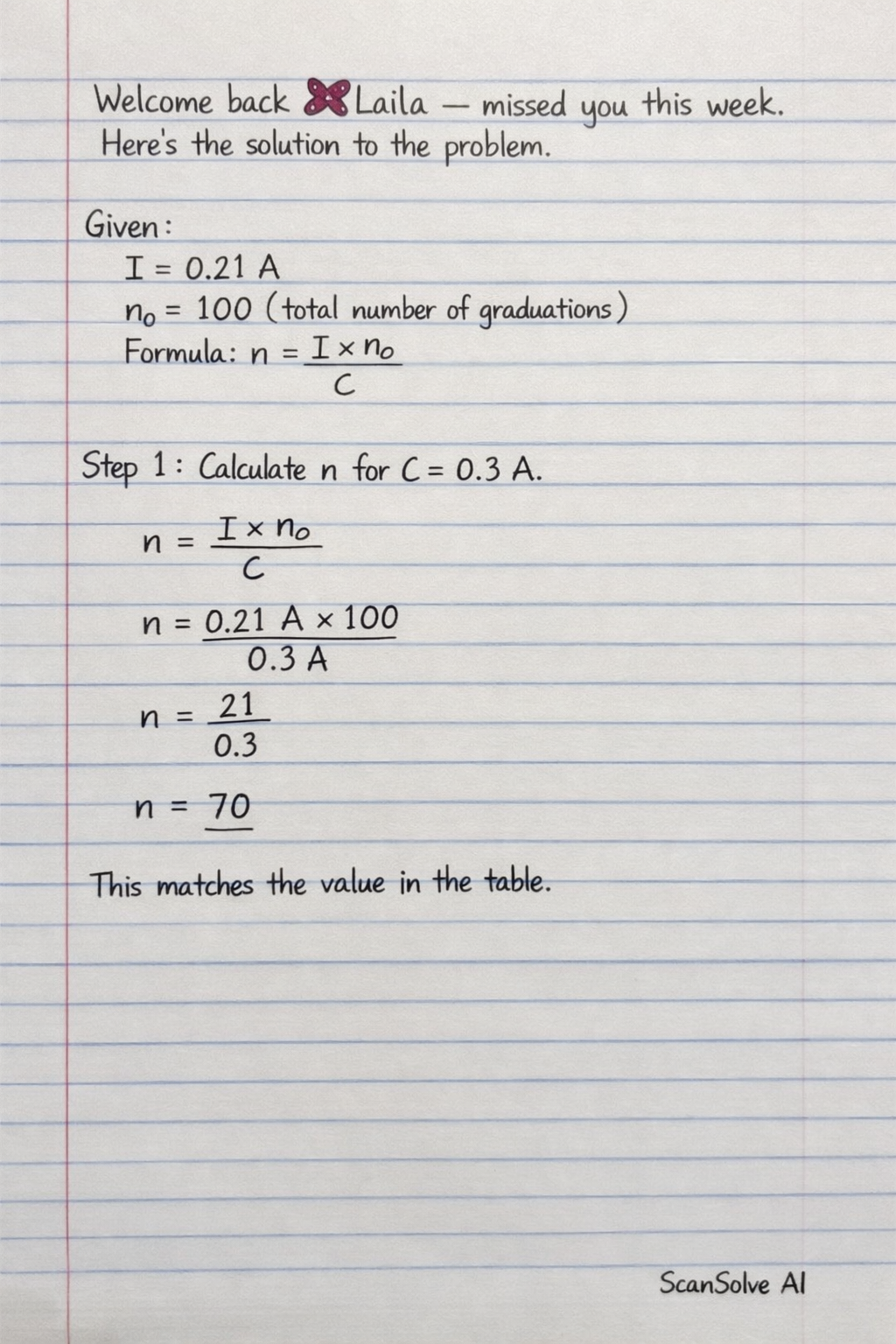
Welcome back 🎀Laila — missed you this week. Here's the solution to the problem. The problem asks to complete a table and then identify the best caliber (range) for measuring current I. The current I = 0.21 A remains constant. The formula for graduation n is given as n = (I × n_0)/(C), where n_0 is the total number of graduations (which is 100, as seen in the calculations for 0.5 A and 1 A), and C is the caliber (range). 2. Compléter le tableau (Complete the table) The table provides different calibers (C) and the corresponding graduations (n) and current intensity (I). We need to verify the values in the table using the given formula. Given: I = 0.21 A n_0 = 100 (total number of graduations) Formula: n = (I × n_0)/(C) Step 1: Calculate n for C = 0.3 A. n = 0.21 A × 1000.3 A n = (21)/(0.3) n = 70 This matches the value in the table. Step 2: Calculate n for C = 0.5 A. n = 0.21 A × 1000.5 A n = (21)/(0.5) n = 42 This matches the value in the table. Step 3: Calculate n for C = 1 A. n = 0.21 A × 1001 A n = (21)/(1) n = 21 This matches the value in the table. The table is correctly completed. 3. Quel est le meilleur calibre pour mesurer I ? (What is the best caliber to measure I?) The best caliber for measuring a current is the one that is closest to the measured value but still greater than it. This ensures the highest precision (largest deviation on the scale) without exceeding the range of the instrument. Step 4: Identify the best caliber. The measured current is I = 0.21 A. The available calibers are 0.3 A, 0.5 A, and 1 A. We need to choose the caliber that is just above 0.21 A. • 0.3 A is greater than 0.21 A. • 0.5 A is greater than 0.21 A. • 1 A is greater than 0.21 A. Comparing the calibers that are greater than 0.21 A, the closest one is 0.3 A. Using this caliber will result in the largest possible deflection on the scale (70 graduations out of 100), which provides the most precise reading. The best caliber is 0.3 A. Send me the next one 📸