
We read your photo as:
The table for Vs(V) and I(mA) is empty. Perform the experiment, collect data, and then perform the following actions: (i) Plot the graph of voltage, Vs, on the vertical axis against current, I, on the
ScanSolve AI Answer
Answer
Step-by-step solution
6 stepsThe questions (a) through (h) describe the experimental procedure to collect data. Since the table for and is empty, I cannot perform the experiment or provide specific numerical answers for parts (i) and (j). However, I can explain how you would approach these steps.
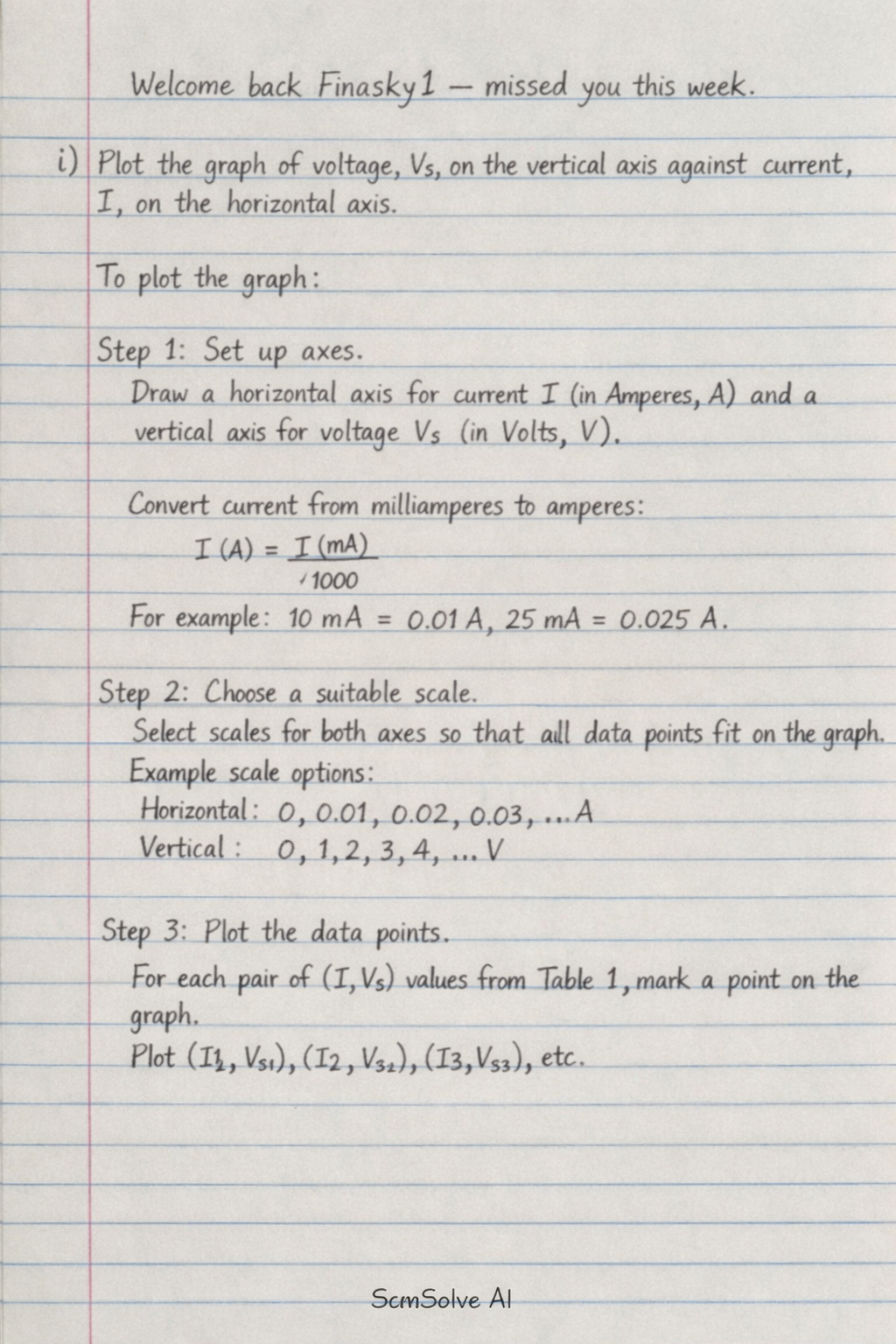
i) Plot the graph of voltage, , on the vertical axis against current, , on the horizontal axis.
To plot the graph:
Set up axes.* Draw a horizontal axis for current (in Amperes, A) and a vertical axis for voltage (in Volts, V).
Remember to convert the current readings from milliamperes (mA) to amperes (A) by dividing by 1000 (e.g., ).
Choose a suitable scale.* Select scales for both axes that allow all your data points to fit and spread out well across the graph paper.
Plot the data points.* For each pair of values from Table 1, mark a point on your graph.
Draw the line of best fit.* Draw a straight line that passes as close as possible to most of the plotted points.
This line should also pass through the origin if the resistor is ohmic.
j) Determine the slope, , of the graph.
Select two points on the line of best fit.* Choose two points on the straight line you drew, preferably far apart, that are easy to read.
Let these points be and .
Calculate the slope.* The slope is calculated using the formula
Ensure that is in Volts and is in Amperes for the slope to be in Ohms.
k) What does the slope, , represent?
The slope, , of the voltage-current graph represents the resistance of the unknown resistor. According to Ohm's Law, , where is voltage, is current, and is resistance. If you plot on the y-axis and on the x-axis, the slope is equal to the resistance .
The slope represents the resistance of the unknown resistor .
Try one yourself
A new problem that tests the same skill.
Still stuck on this one?
Ask a follow-up, and the answer starts from this question.
More Physics Questions
Handwritten Step-by-Step Solution
Get this as a handwritten image on WhatsApp — like a tutor wrote it for you.
Try on WhatsApp