
We read your photo as:
Complete the table and plot a graph of 1/I against 1/l using the provided data.
ScanSolve AI Answer
This answer stops before the end.
It was cut off when it was first written. Ask ScanSolve this question again for the full working.
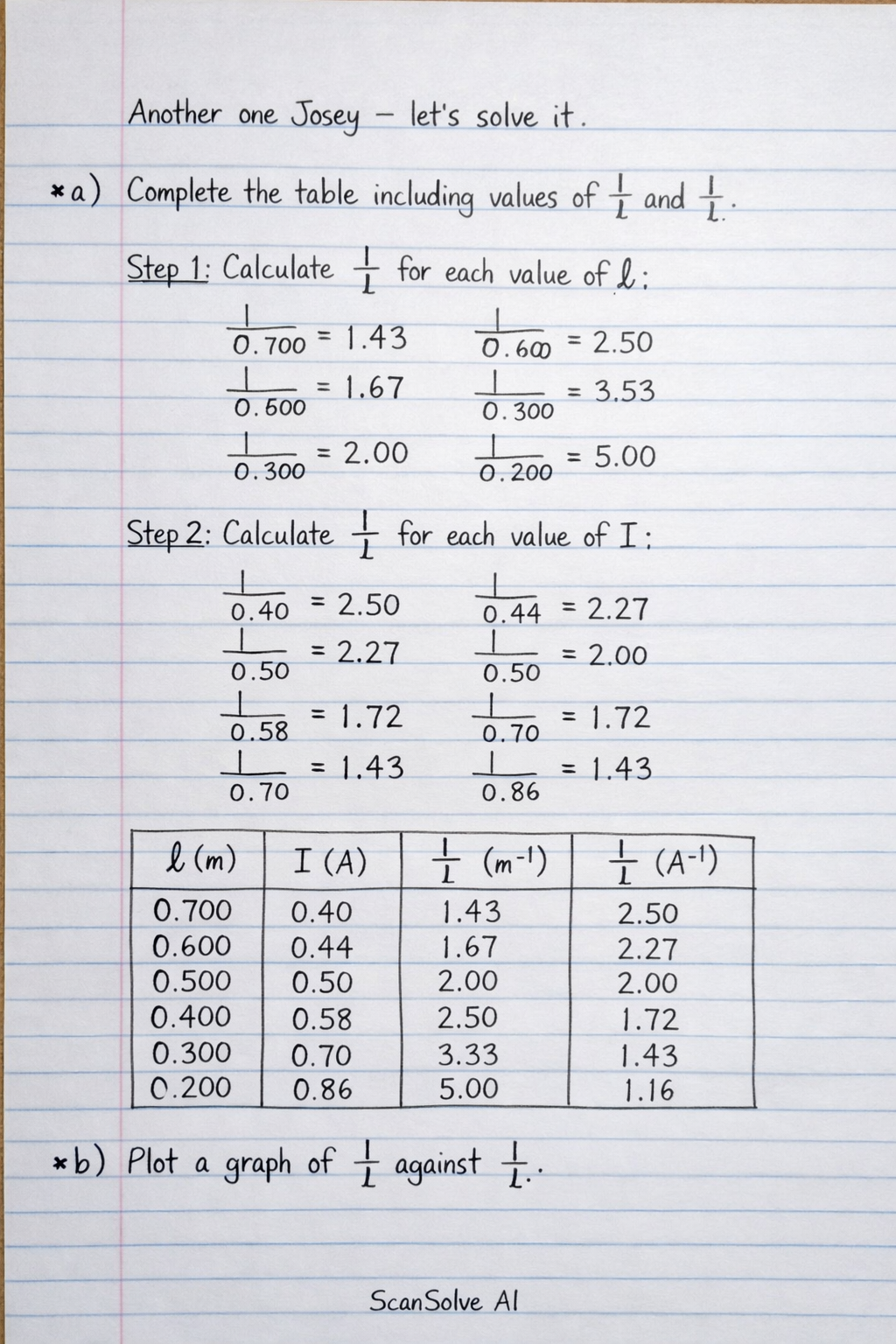
a) Complete the table including values of and .
Step 1: Calculate for each value of .
Step 2: Calculate for each value of .
Round values to two decimal places for the table.
| 0.700 | 0.40 | 1.43 | 2.50 |
| 0.600 | 0.44 | 1.67 | 2.27 |
| 0.500 | 0.50 | 2.00 | 2.00 |
| 0.400 | 0.58 | 2.50 | 1.72 |
| 0.300 | 0.70 | 3.33 | 1.43 |
| 0.200 | 0.86 | 5.00 | 1.16 |
b) Plot a graph of against .
To plot the graph:
- Draw a set of axes. Label the y-axis as and the x-axis as .
- Choose appropriate scales for both axes to accommodate the range of values from the completed table.
- Plot the points from the table: , , , , , and .
- Draw the best-fit straight line through the plotted points.
c) Find the slope, S of the graph.
Step 1: Choose two points from the best-fit line. For calculation purposes, we will use the first and last data points from the table for maximum accuracy.
Point 1:
Point 2:
Step 2: Calculate the slope using the formula .
Still stuck on this one?
Ask a follow-up, and the answer starts from this question.
More Physics Questions
Handwritten Step-by-Step Solution
Get this as a handwritten image on WhatsApp — like a tutor wrote it for you.
Try on WhatsApp