
We read your photo as:
A) Plot the graph between If and Vf. b) State the precautions taken during the experiment for you to get accurate readings of the instruments.
ScanSolve AI Answer
Here are the answers to your questions.
Question 1:
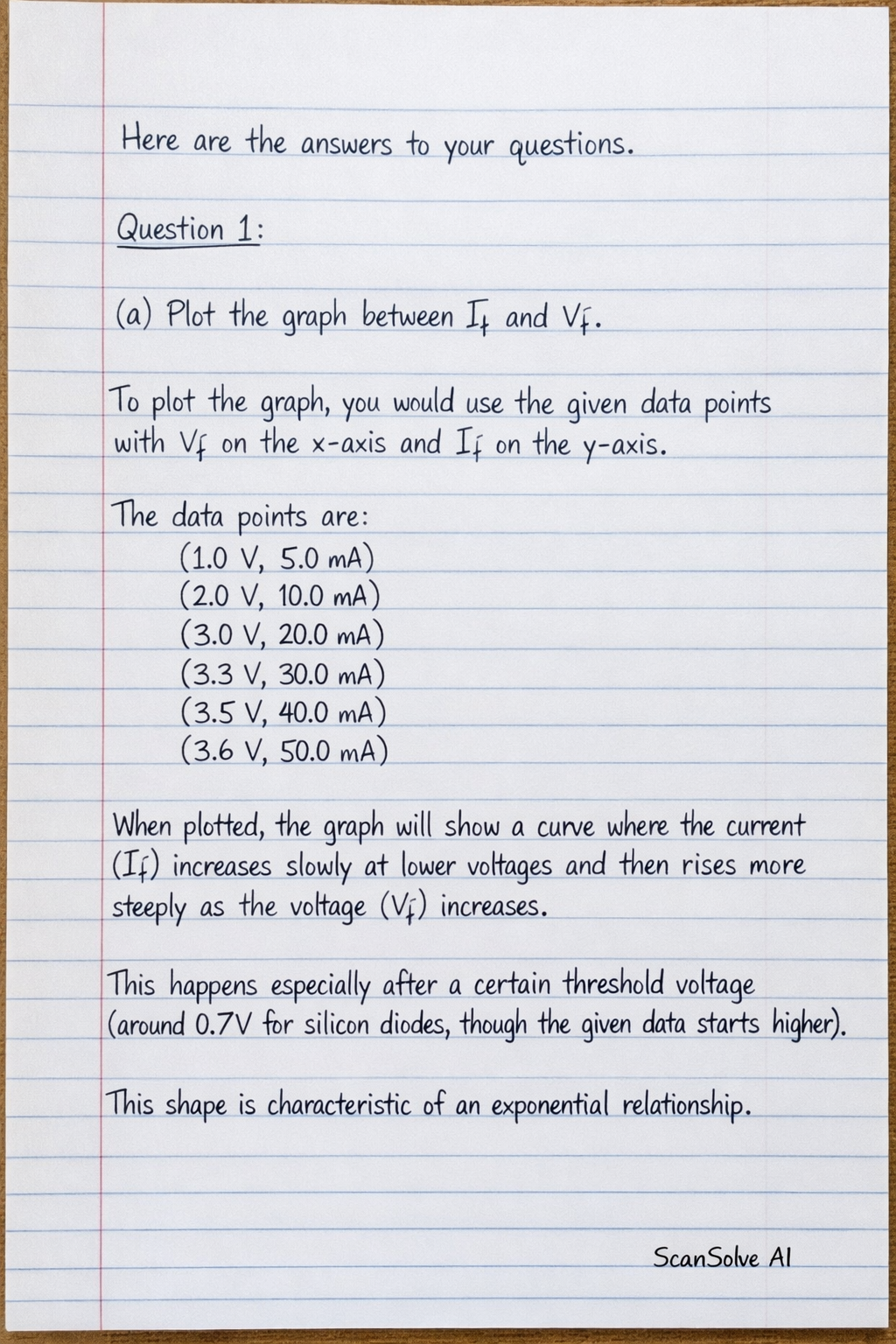
a) Plot the graph between and .
To plot the graph, you would use the given data points with on the x-axis and on the y-axis.
The data points are:
When plotted, the graph will show a curve where the current () increases slowly at lower voltages and then rises more steeply as the voltage () increases, especially after a certain threshold voltage (around 0.7V for silicon diodes, though the given data starts higher). This shape is characteristic of an exponential relationship.
b) State the precautions taken during the experiment for you to get accurate readings of the instruments.
- Ensure all connections are tight and secure to minimize contact resistance.
- Connect the voltmeter in parallel across the diode and the ammeter in series with the diode, ensuring correct polarity.
- Select appropriate ranges for the voltmeter and ammeter to ensure readings are within the scale and to maximize precision.
- Avoid parallax error when reading analog meters by viewing the pointer directly from above.
- Do not exceed the maximum current rating of the diode (given as in the problem description, although the table shows readings up to 50 mA, which implies the experiment might have exceeded the rated value or the rating was different).
- Allow a brief stabilization time after adjusting the RPS voltage before taking readings.
c) Answer the following questions:
(i) What is a P-N junction diode?
A P-N junction diode is a two-terminal semiconductor device formed by joining a p-type semiconductor material (rich in holes) with an n-type semiconductor material (rich in electrons). This junction creates a depletion region and allows current to flow predominantly in one direction.
(ii) Is the V-I relationship of a diode linear or exponential?
The V-I relationship of a diode in forward bias is exponential. Current increases exponentially with increasing forward voltage after the threshold voltage is reached.
(iii) What is forward bias?
Forward bias occurs when the positive terminal of a voltage source is connected to the p-type material and the negative terminal to the n-type material of a P-N junction diode. This reduces the width of the depletion region, allowing current to flow easily through the diode.
(iv) What is reverse bias?
Reverse bias occurs when the negative terminal of a voltage source is connected to the p-type material and the positive terminal to the n-type material of a P-N junction diode. This increases the width of the depletion region, effectively blocking current flow (except for a very small leakage current).
Question 2:
The provided image for Question 2 is incomplete and unclear, showing only fragments of text like "S", "V 2cn + S'1", and "C 2cn + S" without any accompanying diagrams or context to describe the experimental setup or results related to Lenz's Law. Therefore, a detailed explanation of what happened and the results of each experiment cannot be provided based on the visible information.
However, generally, an experiment to verify Lenz's Law of electromagnetic induction would involve:
- Moving a magnet near a coil of wire.
- Observing the induced current or voltage using a galvanometer.
Lenz's Law states that the direction of the induced electromotive force (EMF) and current in a conductor by a changing magnetic field is such that it opposes the change in magnetic flux that produced it.
a) What happened:
In a typical Lenz's Law experiment, when a magnet is moved towards or away from a coil, a current is induced in the coil. This induced current creates its own magnetic field, which always acts to oppose the motion of the magnet or the change in magnetic flux. For example, if a North pole is moved towards a coil, the induced current will create a North pole on the coil face nearest the magnet, repelling the incoming magnet.
b) The result of each experiment as it is illustrated by the diagram shown:
Without the diagrams, it is impossible to describe the specific results. However, generally, the results would show:
- A deflection of the galvanometer needle, indicating an induced current.
- The direction of deflection would reverse when the direction of the magnet's motion is reversed or when the polarity of the magnet is reversed.
- The magnitude of the deflection would depend on the speed of the magnet's motion and the strength of the magnetic field.
Still stuck on this one?
Ask a follow-up, and the answer starts from this question.
More Physics Questions
Handwritten Step-by-Step Solution
Get this as a handwritten image on WhatsApp — like a tutor wrote it for you.
Try on WhatsApp