
We read your photo as:
Explain the main objectives of Electrostatics, including identification of charges, uses of an electroscope, Coulomb's Law, and electric field/potential.
ScanSolve AI Answer
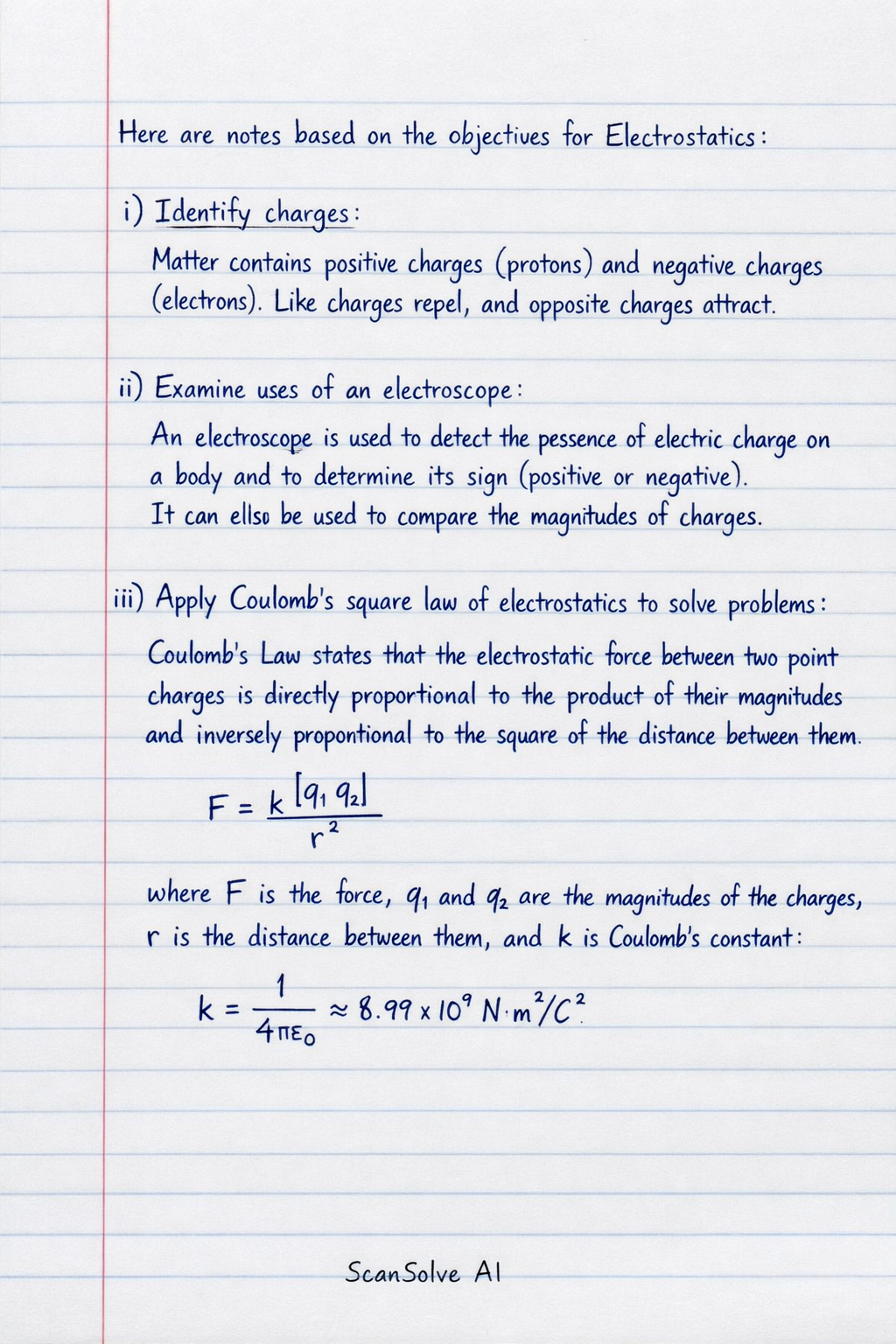
Here are notes based on the objectives for Electrostatics:
-
i) Identify charges: Matter contains positive charges (protons) and negative charges (electrons). Like charges repel, and opposite charges attract.
-
ii) Examine uses of an electroscope: An electroscope is used to detect the presence of electric charge on a body and to determine its sign (positive or negative). It can also be used to compare the magnitudes of charges.
-
iii) Apply Coulomb's square law of electrostatics to solve problems: Coulomb's Law states that the electrostatic force between two point charges is directly proportional to the product of their magnitudes and inversely proportional to the square of the distance between them.
where is the force, and are the magnitudes of the charges, is the distance between them, and is Coulomb's constant ().
-
iv) Deduce expressions for electric field intensity and potential difference: Electric field intensity () at a point is the force per unit positive test charge placed at that point. For a point charge :
Electric potential () at a point is the work done per unit positive test charge to bring it from infinity to that point. For a point charge :
Potential difference () between two points A and B is the work done per unit positive test charge in moving it from A to B:
-
v) Identify electric field flux patterns of isolated and interacting charges: Electric field lines originate from positive charges and terminate on negative charges. They never cross each other. The density of field lines indicates the strength of the electric field.
- For an isolated positive charge, field lines radiate outwards.
- For an isolated negative charge, field lines radiate inwards.
- For interacting charges (e.g., a dipole), field lines curve from the positive charge to the negative charge.
-
vi) Analyze the distribution of charges on a conductor and how it is used in lightning conductors: On an isolated conductor, excess charges reside entirely on its outer surface. The charge density is highest at points of greatest curvature (sharp points). Lightning conductors are tall metal rods with sharp points installed on buildings. The sharp points allow for a high concentration of charge, leading to a strong electric field that ionizes the air, facilitating a gradual discharge of atmospheric charge or providing a safe path for a lightning strike to the ground, protecting the building.
Still stuck on this one?
Ask a follow-up, and the answer starts from this question.
More Physics Questions
Handwritten Step-by-Step Solution
Get this as a handwritten image on WhatsApp — like a tutor wrote it for you.
Try on WhatsApp