
We read your photo as:
Match the following terms with their definitions and answer the questions about pressure, force, and barometers.
ScanSolve AI Answer
This answer stops before the end.
It was cut off when it was first written. Ask ScanSolve this question again for the full working.
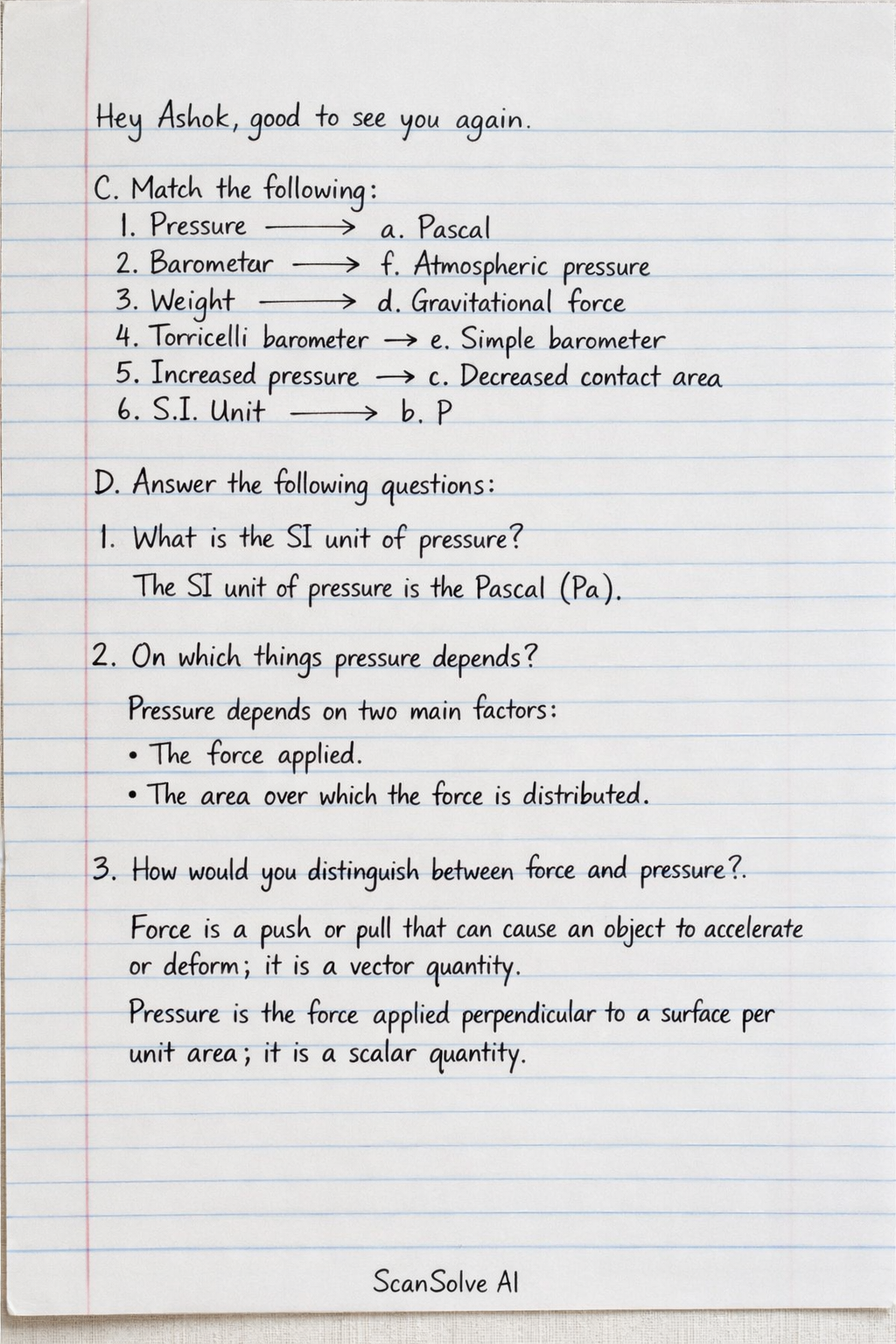
C. Match the following:
- Pressure a. Pascal
- Barometer f. Atmospheric pressure
- Weight d. Gravitational force
- Torricelli barometer e. Simple barometer
- Increased pressure c. Decreased contact area
- S.I. Unit b. P (Assuming 'P' refers to the common symbol for pressure, as 'Pascal' is already matched with the SI unit of pressure.)
D. Answer the following questions:
1. What is the SI unit of pressure?
The SI unit of pressure is the Pascal (Pa).
2. On which things pressure depends?
Pressure depends on two main factors:
- The force applied.
- The area over which the force is distributed.
3. How would you distinguish between force and pressure?
Force is a push or pull that can cause an object to accelerate or deform; it is a vector quantity. Pressure is the force applied perpendicular to a surface per unit area; it is a scalar quantity.
4. How does the pressure exerted by liquid change with depth?
The pressure exerted by a liquid increases with depth because the weight of the liquid column above a point increases.
5. A drawing pin is pushed against a wooden table with a force of 10 N. Calculate the pressure exerted by the pin at a point on a table if the area of the point is 180 cm.
Step 1: Identify the given values.
Step 2: Convert the area to square meters (m).
Step 3: Calculate the pressure using the formula .
The pressure exerted by the pin is .
6. A person weight of 120, 96. The area under one foot of the person is 180 cm. Find the pressure exerted on the ground by the person. When he is standing?
Assumption: The person's weight is 120 N, and they are standing on two feet. The area under one foot is 180 cm.
Step 1: Identify the given values.
Step 2: Calculate the total area of contact when standing on two feet.
Still stuck on this one?
Ask a follow-up, and the answer starts from this question.
More Physics Questions
Handwritten Step-by-Step Solution
Get this as a handwritten image on WhatsApp — like a tutor wrote it for you.
Try on WhatsApp