
We read your photo as:
Derive the mathematical expression for electric field intensity and solve problems related to parallel capacitors.
ScanSolve AI Answer
Step-by-step solution
20 stepsHere are the solutions to questions Q.14, Q.15, and Q.16.
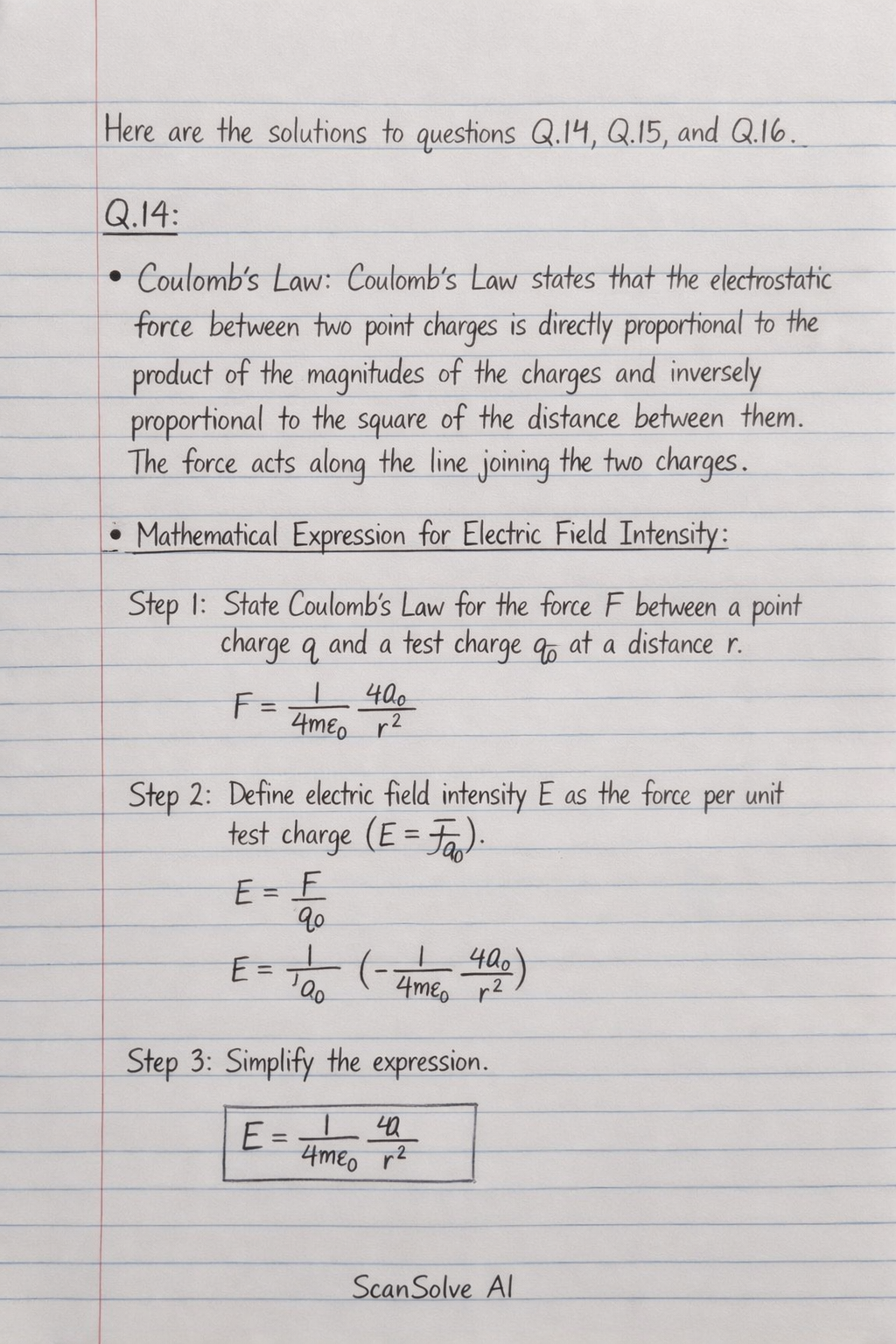
Q.14:
a)
- Coulomb's Law: Coulomb's Law states that the electrostatic force between two point charges is directly proportional to the product of the magnitudes of the charges and inversely proportional to the square of the distance between them. The force acts along the line joining the two charges.
- Mathematical Expression for Electric Field Intensity:
State Coulomb's Law for the force between a point charge and a test charge at a distance .
$$ F = \frac{1}{4\pi\epsilon_0} \frac{q q_0}{r^2} $$Define electric field intensity as the force per unit test charge ().
$$ E = \frac{F}{q_0} = \frac{1}{q_0} \left( \frac{1}{4\pi\epsilon_0} \frac{q q_0}{r^2} \right) $$Simplify the expression.
$$ E = \boxed{\frac{1}{4\pi\epsilon_0} \frac{q}{r^2}} $$b)
Given: , , .a) Calculate the equivalent capacitance of the combination.
For capacitors connected in parallel, the equivalent capacitance is the sum of individual capacitances.
Substitute the given values.
b) Calculate the charge stored on each capacitor.
In a parallel connection, the voltage across each capacitor is the same as the source voltage ().
Use the formula .
For :For :
Q.15:
a)
- Ampere's Law: Ampere's Law states that the line integral of the magnetic field around any closed loop is equal to times the total current passing through the loop.
- Magnetic Field Inside an Ideal Solenoid:
Consider an ideal solenoid with turns per unit length carrying current .
The magnetic field inside is uniform and parallel to the axis, and zero outside.
Choose a rectangular Amperian loop ABCD of length inside the solenoid, with side AB parallel to the axis and side CD outside.
Apply Ampere's Law.
The line integral simplifies to because the field is uniform and parallel to AB, and zero or perpendicular along other segments.
Calculate the total current enclosed by the loop.
If there are turns per unit length, then in length , there are turns. Each turn carries current .
Equate the line integral and .
$$ BL = \mu_0 nLI $$Solve for .
$$ B = \boxed{\mu_0 n I} $$b)
The four factors that affect the magnitude of the force acting on a charged particle moving in a magnetic field are:- The magnitude of the charge () of the particle.
- The magnitude of the velocity () of the particle.
- The magnitude of the magnetic field strength ().
- The angle () between the velocity vector of the particle and the magnetic field vector.
Q.16:
a)
- Condition for Resonance: In an RLC series AC circuit, resonance occurs when the inductive reactance () is equal to the capacitive reactance ().
- Formula for Resonant Frequency:
Express reactances in terms of frequency.
$$ \omega_0 L = \frac{1}{\omega_0 C} $$Solve for the angular resonant frequency .
$$ \omega_0^2 = \frac{1}{LC} \implies \omega_0 = \frac{1}{\sqrt{LC}} $$Convert angular frequency to linear frequency ().
$$ f_0 = \boxed{\frac{1}{2\pi\sqrt{LC}}} $$- Impedance at Resonance:
The impedance of an RLC series circuit is given by .
At resonance, , so .
$$ Z = \sqrt{R^2 + 0^2} $$ $$ Z = \boxed{R} $$b)
Given: , , power factor .Use the formula for average power consumed in an AC circuit.
Substitute the given values.
Calculate the power.
Still stuck on this one?
Ask a follow-up, and the answer starts from this question.
More Physics Questions
Handwritten Step-by-Step Solution
Get this as a handwritten image on WhatsApp — like a tutor wrote it for you.
Try on WhatsApp