
Multiple Choice Quiz (Practice) Here are 10 multiple-choice questions covering all the concepts we just reviewed. Try to answer them without looking at the solutions first. Newton's Second Law states that: a) A body in motion stays in motion. b) Force is equal to mass times velocity. c) Force is equal to mass times acceleration. d) For every action, there is an equal and opposite reaction. A 50-kg crate weighs approximately: a) 5 N b) 50 N c) 500 N d) 5000 N What does the Normal Force always do in a Work-Energy problem? a) Positive work. b) Negative work. c) No work. d) It depends on the angle. When solving for acceleration using Force & Acceleration, the FIRST step should always be to: a) Apply the kinematic equations. b) Draw a Free Body Diagram. c) Write T 1 + Σ U 1 − 2 = T 2 T 1 +ΣU 1−2 =T 2 . d) Find the normal force. An object is moving to the right. If friction is acting on the object, the work done by friction is: a) Positive. b) Negative. c) Zero. d) Cannot be determined. The equation for Kinetic Energy is: a) T = m v T=mv b) T = 1 2 m v 2 T= 2 1 mv 2 c) T = m g h T=mgh d) T = 1 2 k x 2 T= 2 1 kx 2 A 2-kg ball is thrown straight up. As it moves upward, the work done by its weight (gravity) is: a) Positive. b) Negative. c) Zero. d) Increasing. A car accelerates from rest to 20 m/s. Its final kinetic energy is 40,000 J. What is its mass? a) 100 kg b) 200 kg c) 1000 kg d) 2000 kg A 5-kg box is pulled horizontally with a force of 30 N over a distance of 10 m. Friction is neglected. What is the final speed of the box if it starts from rest? a) 7.75 m/s b) 10.95 m/s c) 15.49 m/s d) 60 m/s An object has a mass of 10 kg and is accelerating at 4 m/s². What is the net force acting on it? a) 2.5 N b) 14 N c) 40 N d) 400 N Answer Key and Explanations F = m a F=ma W = m g = 50 ( 81 = 5 N W=mg=50(9.81)=490.5N, which is approximately 500 N. No work. Work is F ⋅ d ⋅ cos ( θ F⋅d⋅cos(θ), and θ = 90 ° θ=90° for a normal force. Draw a Free Body Diagram. This is the key to visualizing all the forces. Negative work. Friction opposes the motion. Kinetic energy is T = 1 2 m v 2 T= 2 1 mv 2 . Negative work. The force (gravity) acts downward, while the displacement is upward. 40000 = 1 2 ( m ( 20 2 → 40000 = 200 m → m = 200 k g 40000= 2 1 (20) 2 →40000=200m→m=200kg. T 1 = 0 T 1 =0, U = F ⋅ d = 30 ( 10 = 300 J U=F⋅d=30(10)=300J. 300 = 1 2 ( 5 v 2 → 300 = 5 v 2 → v 2 = 120 → v = 95 m / s 300= 2 1 (5)v 2 →300=2.5v 2 →v 2 =120→v=10.95m/s. F = m a = 10 ( 4 = 40 N F=ma=10(4)=40N.
ScanSolve AI Answer
Step-by-step solution
10 stepsHere are the solutions to the multiple-choice questions:
1. Newton's Second Law states that:
c) Force is equal to mass times acceleration.
Explanation:
Newton's Second Law of Motion mathematically states that the net force () acting on an object is equal to the product of its mass () and its acceleration ().
2. A 50-kg crate weighs approximately:
c) 500 N
Identify the formula for weight.
Weight () is the force of gravity acting on an object, calculated as mass () multiplied by the acceleration due to gravity (). We use .
Substitute the given values and calculate.
This value is approximately 500 N.
3. What does the Normal Force always do in a Work-Energy problem?
c) No work.
Explanation:
Work done by a force is given by , where is the force, is the displacement, and is the angle between the force and displacement vectors. The normal force always acts perpendicular to the surface of contact, and thus perpendicular to the displacement if the object moves along that surface. When , , so the work done by the normal force is zero.
4. When solving for acceleration using Force & Acceleration, the FIRST step should always be to:
b) Draw a Free Body Diagram.
Explanation:
A Free Body Diagram (FBD) is essential for visualizing all the forces acting on an object. By drawing an FBD, you can correctly identify and resolve all forces, which is crucial before applying Newton's Second Law () to solve for acceleration.
5. An object is moving to the right. If friction is acting on the object, the work done by friction is:
b) Negative.
Explanation:
Friction is a force that always opposes the direction of motion. If an object is moving to the right, the friction force acts to the left. Since the force of friction and the displacement are in opposite directions (angle ), the work done by friction () will be negative.
6. The equation for Kinetic Energy is:
b)
Explanation:
Kinetic energy () is the energy an object possesses due to its motion. It is defined by the formula:where is the mass of the object and is its speed.
7. A 2-kg ball is thrown straight up. As it moves upward, the work done by its weight (gravity) is:
b) Negative.
Explanation:
The weight (force of gravity) on the ball always acts downward. As the ball moves upward, its displacement is in the opposite direction to the force of gravity. Therefore, the angle between the force and displacement is , resulting in negative work done by gravity.
8. A car accelerates from rest to 20 m/s. Its final kinetic energy is 40,000 J. What is its mass?
b) 200 kg
Write the formula for kinetic energy.
Substitute the given values into the formula.
We are given and . We need to find .
Solve for mass ().
9. A 5-kg box is pulled horizontally with a force of 30 N over a distance of 10 m. Friction is neglected. What is the final speed of the box if it starts from rest?
b) 10.95 m/s
Calculate the work done by the pulling force.
Since friction is neglected and the force is horizontal, the work done () is simply the force () multiplied by the distance ().
Apply the Work-Energy Theorem.
The Work-Energy Theorem states that the net work done on an object equals the change in its kinetic energy (). Since the box starts from rest, its initial kinetic energy () is 0.
Use the kinetic energy formula to find the final speed.
10. An object has a mass of 10 kg and is accelerating at 4 m/s². What is the net force acting on it?
c) 40 N
Apply Newton's Second Law.
Newton's Second Law states that the net force () acting on an object is equal to its mass () multiplied by its acceleration ().
Substitute the given values and calculate.
Still stuck on this one?
Ask a follow-up, and the answer starts from this question.
More Physics Questions
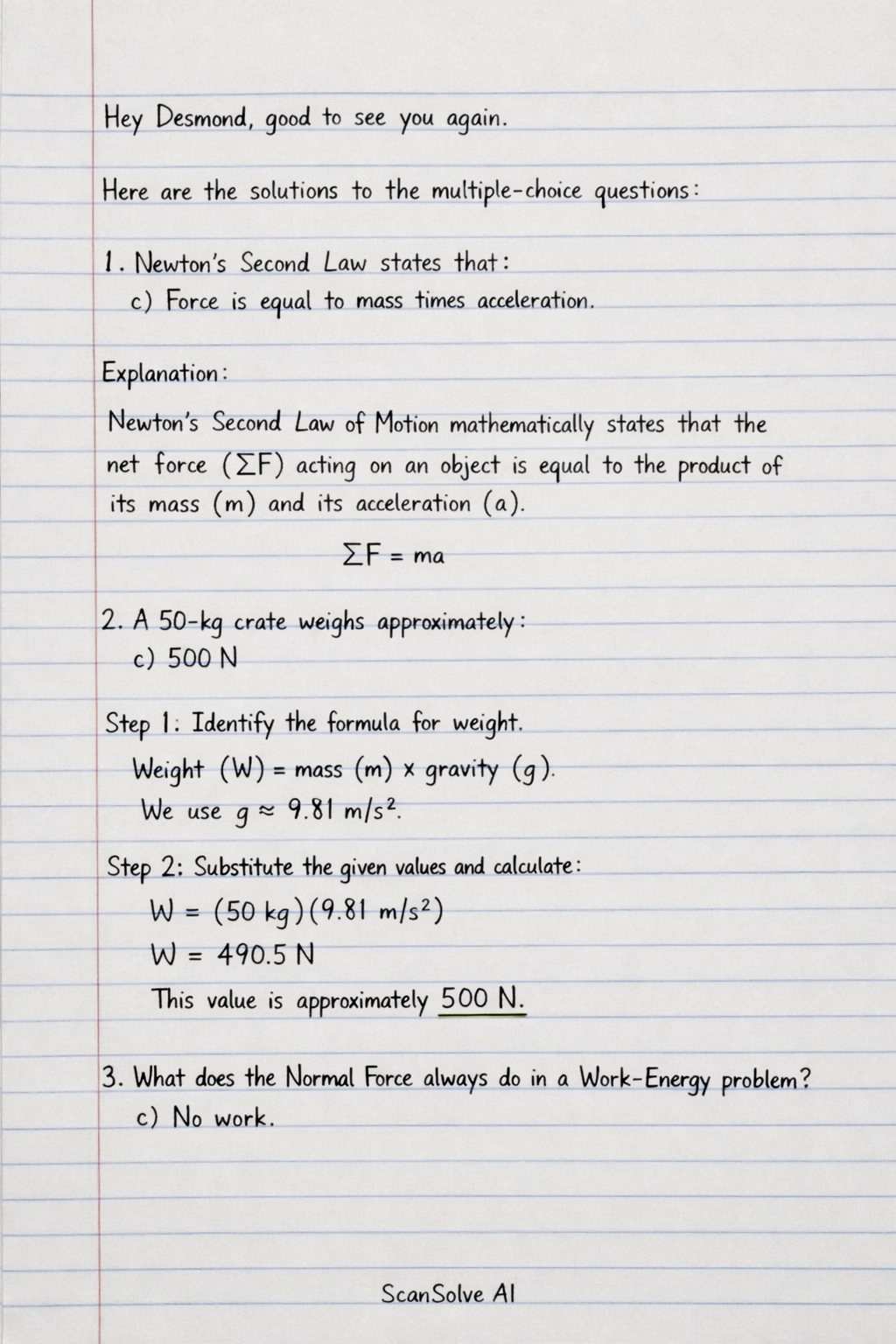
Handwritten Step-by-Step Solution
Get this as a handwritten image on WhatsApp — like a tutor wrote it for you.
Try on WhatsApp