This physics problem tests your understanding of fundamental physical laws and their applications. The step-by-step solution below breaks down the problem using relevant equations and physical reasoning.
ScanSolve AI Answer
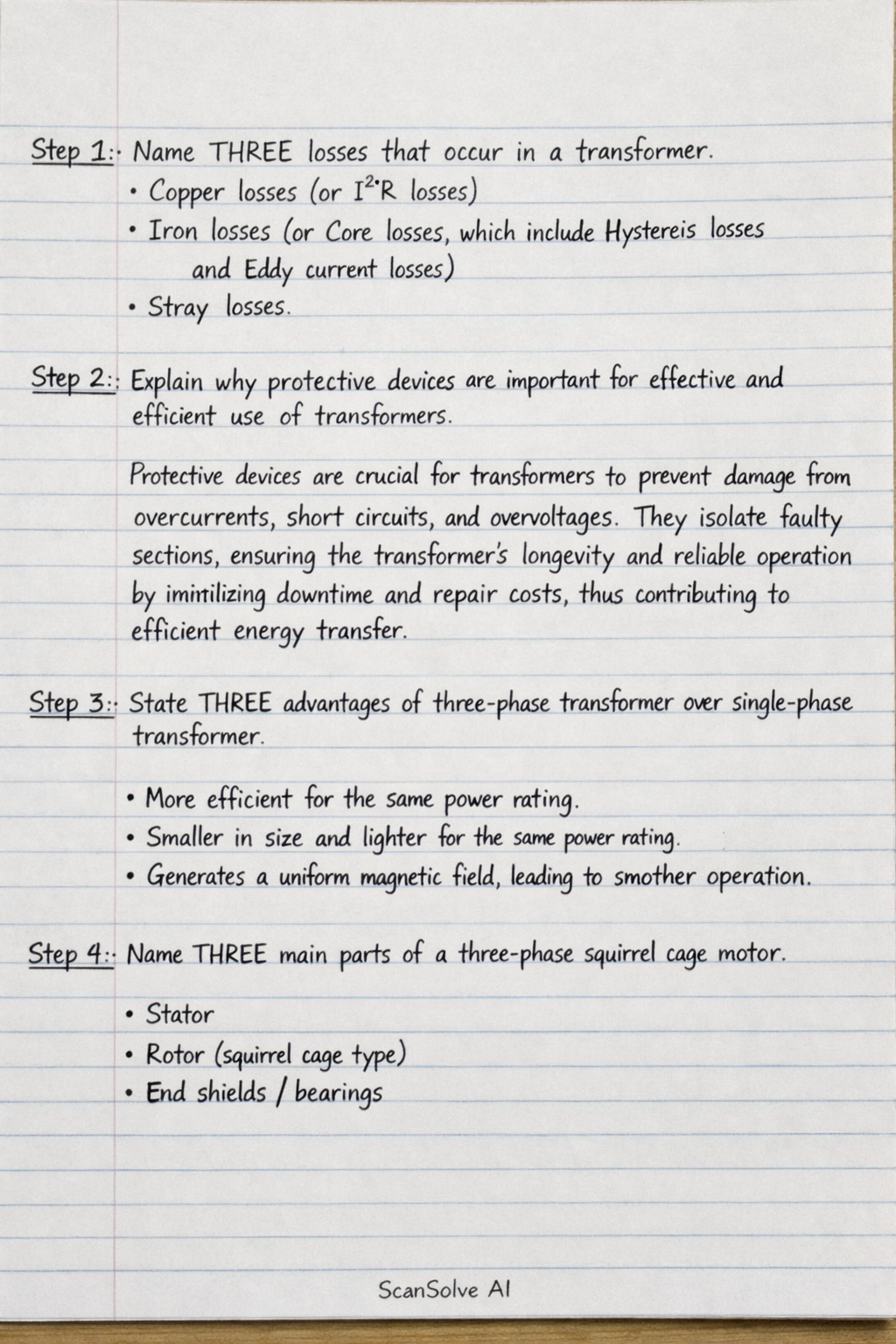
Step 1: Name THREE losses that occur in a transformer.
• Copper losses (or $I^2R$ losses)
• Iron losses (or Core losses, which include Hysteresis losses and Eddy current losses)
• Stray losses
Step 2: Explain why protective devices are important for effective and efficient use of transformers.
Protective devices are crucial for transformers to prevent damage from overcurrents, short circuits, and overvoltages. They isolate faulty sections, ensuring the transformer's longevity and reliable operation by minimizing downtime and repair costs, thus contributing to efficient energy transfer.
Step 3: State THREE advantages of three-phase transformer over single-phase transformer.
• More efficient for the same power rating.
• Smaller in size and lighter for the same power rating.
• Generates a uniform magnetic field, leading to smoother operation.
Step 4: Name THREE main parts of a three-phase squirrel cage motor.
• Stator
• Rotor (squirrel cage type)
• End shields/bearings
Step 5: Explain how the direction of rotation of a three-phase motor may be reversed.
The direction of rotation of a three-phase motor can be reversed by interchanging any two of the three supply phase connections to the motor. This changes the phase sequence, which reverses the direction of the rotating magnetic field.
Step 6: State THREE electrical tests that must be carried out on a motor before it can be activated.
• Insulation resistance test (Megger test)
• Continuity test (or Resistance test of windings)
• Earth continuity test
Step 7: Calculate the Active power for question 6.4.1.
Given:
$V = 400 \text{ V}$ (line voltage for delta connection, so $V_{ph} = V_L = 400 \text{ V}$)
$pf = 0.85$
$I_{ph} = 20 \text{ A}$
The formula for active power in a three-phase system using phase values is:
$$P = 3 V_{ph} I_{ph} \cos\theta$$
Substitute the given values:
$$P = 3 \times 400 \text{ V} \times 20 \text{ A} \times 0.85$$
$$P = 20400 \text{ W}$$
$$P = 20.4 \text{ kW}$$
The active power is $\boxed{\text{20.4 kW}}$.
Step 8: Calculate the Synchronous speed for question 6.4.2.
Given:
$f = 50 \text{ Hz}$
poles $= 36$
The formula for synchronous speed in revolutions per minute (rpm) is:
$$N_s = \frac{120f}{\text{poles}}$$
Substitute the given values:
$$N_s = \frac{120 \times 50 \text{ Hz}}{36}$$
$$N_s = \frac{6000}{36}$$
$$N_s = 166.67 \text{ rpm}$$
The synchronous speed is $\boxed{\text{166.67 rpm}}$.
Step 9: Calculate the Rotor speed if the slip is 5% for question 6.4.3.
Given:
Slip $s = 5\% = 0.05$
Synchronous speed $N_s = 166.67 \text{ rpm}$ (from Step 8)
The formula for rotor speed is:
$$N_r = N_s (1 - s)$$
Substitute the values:
$$N_r = 166.67 \text{ rpm} (1 - 0.05)$$
$$N_r = 166.67 \text{ rpm} \times 0.95$$
$$N_r = 158.3365 \text{ rpm}$$
The rotor speed is $\boxed{\text{158.34 rpm}}$.
Step 10: Calculate The phase current of the motor for question 6.5.1.
Given:
$I_L = 8.59 \text{ A}$ (line current)
The motor is delta-connected. For a delta connection, the relationship between line current ($I_L$) and phase current ($I_{ph}$) is:
$$I_L = \sqrt{3} I_{ph}$$
Rearrange to solve for $I_{ph}$:
$$I_{ph} = \frac{I_L}{\sqrt{3}}$$
Substitute the given line current:
$$I_{ph} = \frac{8.59 \text{ A}}{\sqrt{3}}$$
$$I_{ph} = \frac{8.59 \text{ A}}{1.73205}$$
$$I_{ph} = 4.9594 \text{ A}$$
The phase current of the motor is $\boxed{\text{4.96 A}}$.
Send me the next one 📸
Name THREE losses that occur in a transformer.
|Physics
Name THREE losses that occur in a transformer.
ScanSolve AI Answer
Step 1: Name THREE losses that occur in a transformer.
• Copper losses (or I2R losses)
• Iron losses (or Core losses, which include Hysteresis losses and Eddy current losses)
• Stray losses
Step 2: Explain why protective devices are important for effective and efficient use of transformers.
Protective devices are crucial for transformers to prevent damage from overcurrents, short circuits, and overvoltages. They isolate faulty sections, ensuring the transformer's longevity and reliable operation by minimizing downtime and repair costs, thus contributing to efficient energy transfer.
Step 3: State THREE advantages of three-phase transformer over single-phase transformer.
• More efficient for the same power rating.
• Smaller in size and lighter for the same power rating.
• Generates a uniform magnetic field, leading to smoother operation.
Step 4: Name THREE main parts of a three-phase squirrel cage motor.
• Stator
• Rotor (squirrel cage type)
• End shields/bearings
Step 5: Explain how the direction of rotation of a three-phase motor may be reversed.
The direction of rotation of a three-phase motor can be reversed by interchanging any two of the three supply phase connections to the motor. This changes the phase sequence, which reverses the direction of the rotating magnetic field.
Step 6: State THREE electrical tests that must be carried out on a motor before it can be activated.
• Insulation resistance test (Megger test)
• Continuity test (or Resistance test of windings)
• Earth continuity test
Step 7: Calculate the Active power for question 6.4.1.
Given:
V=400 V (line voltage for delta connection, so Vph=VL=400 V)
pf=0.85Iph=20 A
The formula for active power in a three-phase system using phase values is:
P=3VphIphcosθ
Substitute the given values:
P=3×400V×20A×0.85P=20400 WP=20.4 kW
The active power is 20.4kW.
Step 8: Calculate the Synchronous speed for question 6.4.2.
Given:
f=50 Hz
poles =36
The formula for synchronous speed in revolutions per minute (rpm) is:
Ns=poles120f
Substitute the given values:
Ns=36120×50HzNs=366000Ns=166.67 rpm
The synchronous speed is 166.67rpm.
Step 9: Calculate the Rotor speed if the slip is 5% for question 6.4.3.
Given:
Slip s=5%=0.05
Synchronous speed Ns=166.67 rpm (from Step 8)
The formula for rotor speed is:
Nr=Ns(1−s)
Substitute the values:
Nr=166.67rpm(1−0.05)Nr=166.67rpm×0.95Nr=158.3365 rpm
The rotor speed is 158.34rpm.
Step 10: Calculate The phase current of the motor for question 6.5.1.
Given:
IL=8.59 A (line current)
The motor is delta-connected. For a delta connection, the relationship between line current (IL) and phase current (Iph) is:
IL=3Iph
Rearrange to solve for Iph:
Iph=3IL
Substitute the given line current:
Iph=38.59AIph=1.732058.59AIph=4.9594 A
The phase current of the motor is 4.96A.
Send me the next one 📸
Need help with your own homework?
Get instant step-by-step solutions to any question. Free to start.