
We read your photo as:
Why do newspaper wrappers keep roasted fish hot, why does a full glass bottle crack in the fridge, and why does it take more energy to turn water into steam than ice?
ScanSolve AI Answer
Step-by-step solution
10 stepsHere are the solutions to your homework questions:
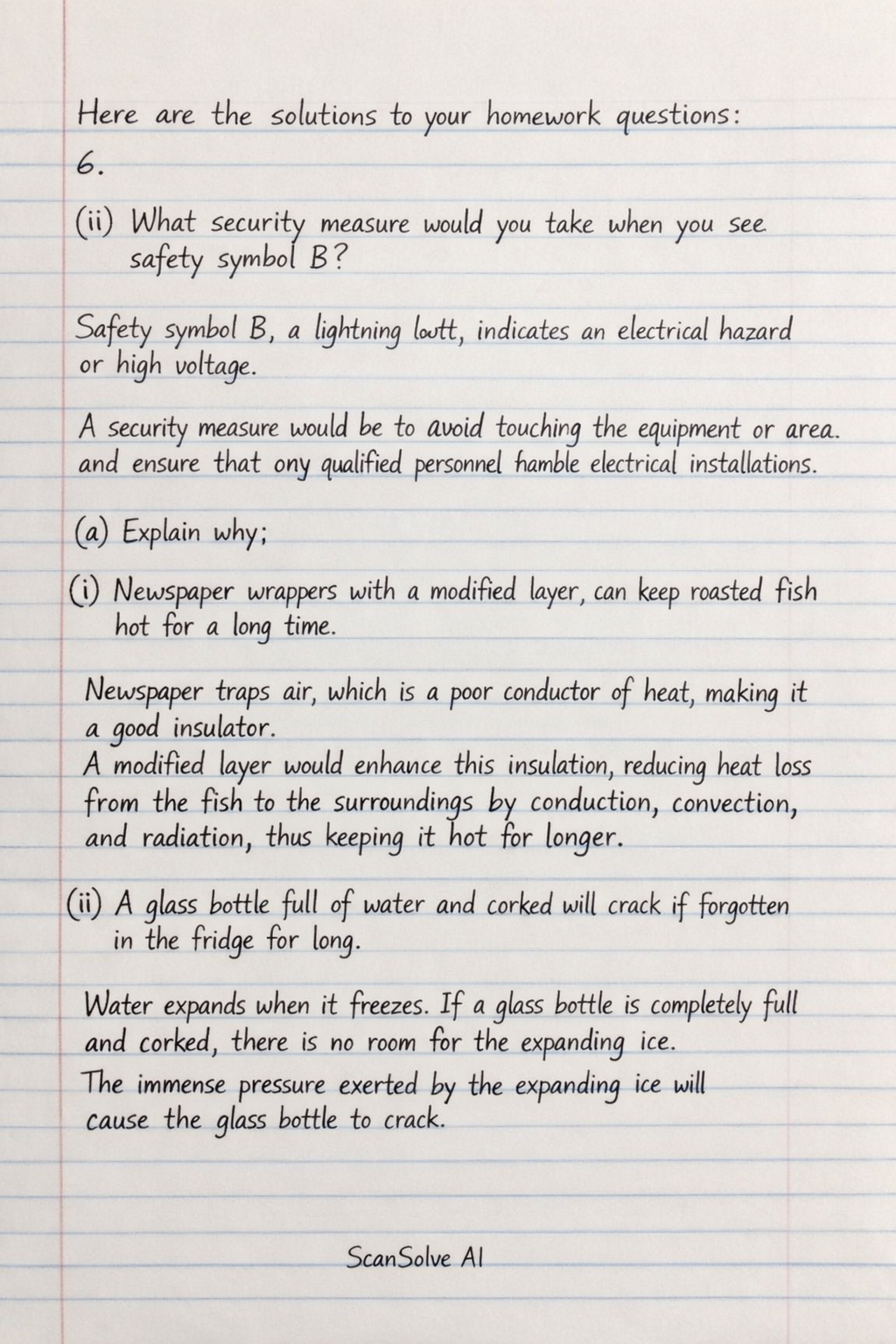
6.
(ii) What security measure would you take when you see safety symbol B?
Safety symbol B, a lightning bolt, indicates an electrical hazard or high voltage. A security measure would be to avoid touching the equipment or area and ensure that only qualified personnel handle electrical installations.
(a) Explain why:
- (i) Newspaper wrappers with a modified layer, can keep roasted fish hot for a long time. Newspaper traps air, which is a poor conductor of heat, making it a good insulator. A modified layer would enhance this insulation, reducing heat loss from the fish to the surroundings by conduction, convection, and radiation, thus keeping it hot for longer.
- (ii) A glass bottle full of water and corked will crack if forgotten in the fridge for long. Water expands when it freezes. If a glass bottle is completely full and corked, there is no room for the expanding ice. The immense pressure exerted by the expanding ice will cause the glass bottle to crack.
- (iii) of energy are required to convert 1kg of water to steam at its normal boiling point, while only of energy are required to convert 1kg of water to ice at the ice point. The energy required to convert water to steam is the latent heat of vaporization, which is significantly higher than the latent heat of fusion (energy to convert water to ice). This is because a large amount of energy is needed to overcome the strong intermolecular forces in liquid water to separate the molecules into a gaseous state.
- (iv) Give the difference between specific heat capacity and specific latent heat of a body.
- Specific heat capacity is the amount of heat energy required to raise the temperature of 1 kg of a substance by 1 degree Celsius (or Kelvin) without changing its state.
- Specific latent heat is the amount of heat energy required to change the state (e.g., from solid to liquid or liquid to gas) of 1 kg of a substance at a constant temperature.
(b)
- (i) A 5 KW electric heater is left on for 2.5 minutes after the water starts to boil. What mass of water boils off in this time? The specific latent heat of vaporization of water is .
Convert power to Watts and time to seconds.
$$ P = 5 \text{ KW} = 5000 \text{ W} $$ $$ t = 2.5 \text{ minutes} = 2.5 \times 60 \text{ s} = 150 \text{ s} $$Calculate the total energy supplied by the heater.
$$ E = P \times t = 5000 \text{ W} \times 150 \text{ s} = 750000 \text{ J} $$Use the formula for latent heat to find the mass of water boiled off.
$$ E = m L_v $$ $$ m = \frac{E}{L_v} = \frac{750000 \text{ J}}{2.3 \times 10^6 \text{ J/Kg}} $$Calculate the mass.
$$ m = 0.3260869... \text{ Kg} \approx 0.326 \text{ Kg} $$ The mass of water that boils off is $\boxed{\text{0.326 Kg}}$.- (ii) Give two reasons why the boiling point of water is sometimes greater than 100°C.
- Increased external pressure: When the external pressure on the surface of the water is higher than atmospheric pressure (e.g., in a pressure cooker), more energy is required for the water molecules to escape into the gaseous phase, thus raising the boiling point.
- Presence of impurities: Dissolving non-volatile solutes (impurities) in water raises its boiling point. This phenomenon is known as boiling point elevation.
(c) Name the logic gate in figure 7 and draw its truth table.
The logic gate in Figure 7 is a NOR gate.Truth Table for a NOR Gate:
Input A Input B Output Q 0 0 1 0 1 0 1 0 0 1 1 0 7.
(a) Figure 8 shows a ray of light ray traveling from air to glass.
- (i) Determine the angle of incidence.
- (ii) Give two reasons why the boiling point of water is sometimes greater than 100°C.
The angle given (43°) is between the incident ray and the surface.
The angle of incidence () is measured from the normal.
Calculate the angle of incidence.
$$ \theta_i = 47^\circ $$ The angle of incidence is $\boxed{47^\circ}$.- (ii) Calculate the angle of refraction, if the refractive index of glass is 1.5.
Apply Snell's Law
.
Given: (air) = 1, , (glass) = 1.5.Calculate .
$$ \sin(47^\circ) \approx 0.73135 $$Solve for .
$$ \sin(\theta_2) = \frac{0.73135}{1.5} \approx 0.48757 $$Calculate .
$$ \theta_2 = \arcsin(0.48757) \approx 29.18^\circ $$ The angle of refraction is $\boxed{29.18^\circ}$.- (iii) Can total internal reflection occur for light traveling from air to glass? No, total internal reflection cannot occur when light travels from air (a rarer medium) to glass (a denser medium). Total internal reflection only happens when light travels from a denser medium to a rarer medium and the angle of incidence exceeds the critical angle.
Still stuck on this one?
Ask a follow-up, and the answer starts from this question.
More Physics Questions
Handwritten Step-by-Step Solution
Get this as a handwritten image on WhatsApp — like a tutor wrote it for you.
Try on WhatsApp