We read your photo as:

State Newton's Law of Universal Gravitation in words.

Physics

ScanSolve AI Answer

Answers

2 parts
5.5

0.15 m\text{0.15 m}

5.6

3.07×10⁻⁸ N\text{3.07} \times 10^{-8} \text{ N}

Step-by-step solution

6 steps

Part 5.1

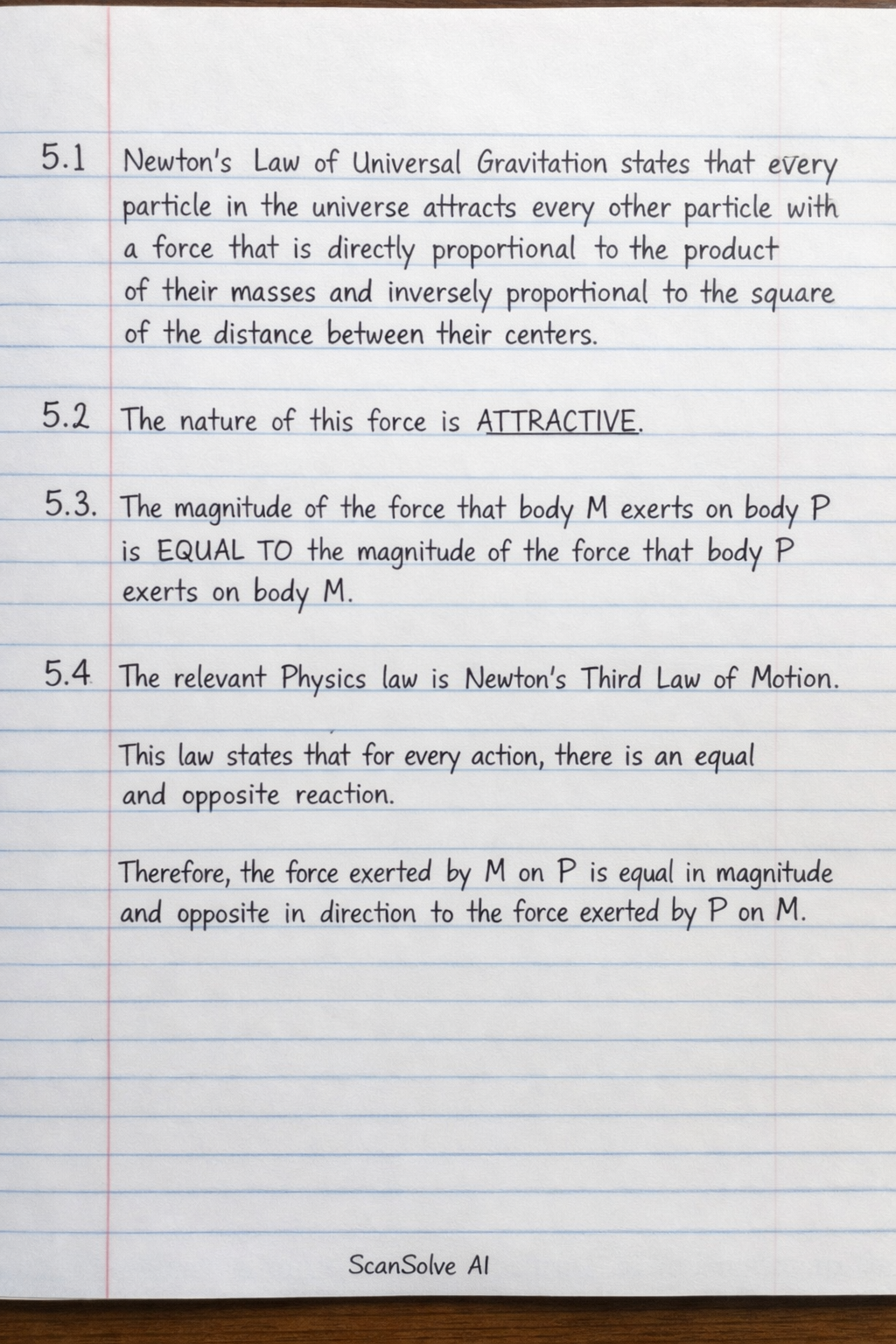
Newton's Law of Universal Gravitation states that every particle in the universe attracts every other particle with a force that is directly proportional to the product of their masses and inversely proportional to the square of the distance between their centers.

Part 5.2

The nature of this force is ATTRACTIVE.

Part 5.3

The magnitude of the force that body M exerts on body P is EQUAL TO the magnitude of the force that body P exerts on body M.

Part 5.4

The relevant Physics law is Newton's Third Law of Motion.
This law states that for every action, there is an equal and opposite reaction. Therefore, the force exerted by M on P is equal in magnitude and opposite in direction to the force exerted by P on M.

Part 5.5

0.15 m\text{0.15 m}

  1. Write down Newton's Law of Universal Gravitation and define the distance rr.

    The formula for gravitational force is:

    F=GmMmPr2F = \frac{G m_M m_P}{r^2}

    The distance rr between the centers of the two bodies is:

    r=RM+dsurface+RPr = R_M + d_{\text{surface}} + R_P

    Given RM=0.10 mR_M = 0.10 \text{ m} and dsurface=1.24 md_{\text{surface}} = 1.24 \text{ m}, we have:

    r=0.10 m+1.24 m+RP=1.34 m+RPr = 0.10 \text{ m} + 1.24 \text{ m} + R_P = 1.34 \text{ m} + R_P
  2. Substitute the expression for rr into the force equation and rearrange to solve for (1.34+RP)2(1.34 + R_P)^2.

    F=GmMmP(1.34+RP)2F = \frac{G m_M m_P}{(1.34 + R_P)^2} (1.34+RP)2=GmMmPF(1.34 + R_P)^2 = \frac{G m_M m_P}{F}
  3. Substitute the given values (G=6.67×10⁻¹¹ N⋅m2/kg2G = 6.67 \times 10^{-11} \text{ N}\cdot\text{m}^2/\text{kg}^2, mM=16 kgm_M = 16 \text{ kg}, mP=48 kgm_P = 48 \text{ kg}, F=2.30×10⁻⁸ NF = 2.30 \times 10^{-8} \text{ N}).

    (1.34+RP)2=(6.67×10⁻¹¹ N⋅m2/kg2)(16 kg)(48 kg)2.30×10⁻⁸ N(1.34 + R_P)^2 = \frac{(6.67 \times 10^{-11} \text{ N}\cdot\text{m}^2/\text{kg}^2)(16 \text{ kg})(48 \text{ kg})}{2.30 \times 10^{-8} \text{ N}} (1.34+RP)2=5.12376×10−82.30×10−8(1.34 + R_P)^2 = \frac{5.12376 \times 10^{-8}}{2.30 \times 10^{-8}} (1.34+RP)2=2.2277217(1.34 + R_P)^2 = 2.2277217
  4. Take the square root and solve for RPR_P.

    1.34+RP=2.22772171.34 + R_P = \sqrt{2.2277217} 1.34+RP=1.4925551.34 + R_P = 1.492555 RP=1.492555−1.34R_P = 1.492555 - 1.34 RP=0.152555 mR_P = 0.152555 \text{ m}

    Rounding to two decimal places:

    RP≈0.15 mR_P \approx 0.15 \text{ m}

    The radius of body P is 0.15 m\boxed{\text{0.15 m}}.

Part 5.6

3.07×10⁻⁸ N\text{3.07} \times 10^{-8} \text{ N}

  1. Identify the new mass and note that the radius of G is the same as P, meaning the distance between centers rr remains unchanged.

    New mass mG=64 kgm_G = 64 \text{ kg}.
    The distance between centers r=1.34+RP=1.492555 mr = 1.34 + R_P = 1.492555 \text{ m}.

  2. Calculate the new force F′F' using Newton's Law of Universal Gravitation.

    F′=GmMmGr2F' = \frac{G m_M m_G}{r^2} F′=(6.67×10⁻¹¹ N⋅m2/kg2)(16 kg)(64 kg)(1.492555 m)2F' = \frac{(6.67 \times 10^{-11} \text{ N}\cdot\text{m}^2/\text{kg}^2)(16 \text{ kg})(64 \text{ kg})}{(1.492555 \text{ m})^2} F′=6.83008×10−82.2277217F' = \frac{6.83008 \times 10^{-8}}{2.2277217} F′=3.0651×10⁻⁸ NF' = 3.0651 \times 10^{-8} \text{ N}

    Rounding to three significant figures:

    F′≈3.07×10⁻⁸ NF' \approx 3.07 \times 10^{-8} \text{ N}

    The magnitude of the force now experienced by body M is 3.07×10⁻⁸ N\boxed{\text{3.07} \times 10^{-8} \text{ N}}.

Was this helpful?

Try one yourself

A new problem that tests the same skill.

Still stuck on this one?

Ask a follow-up, and the answer starts from this question.

Got a different question?Ask your own question
Handwritten step-by-step solution preview

Handwritten Step-by-Step Solution

Get this as a handwritten image on WhatsApp — like a tutor wrote it for you.

Try on WhatsApp