
We read your photo as:
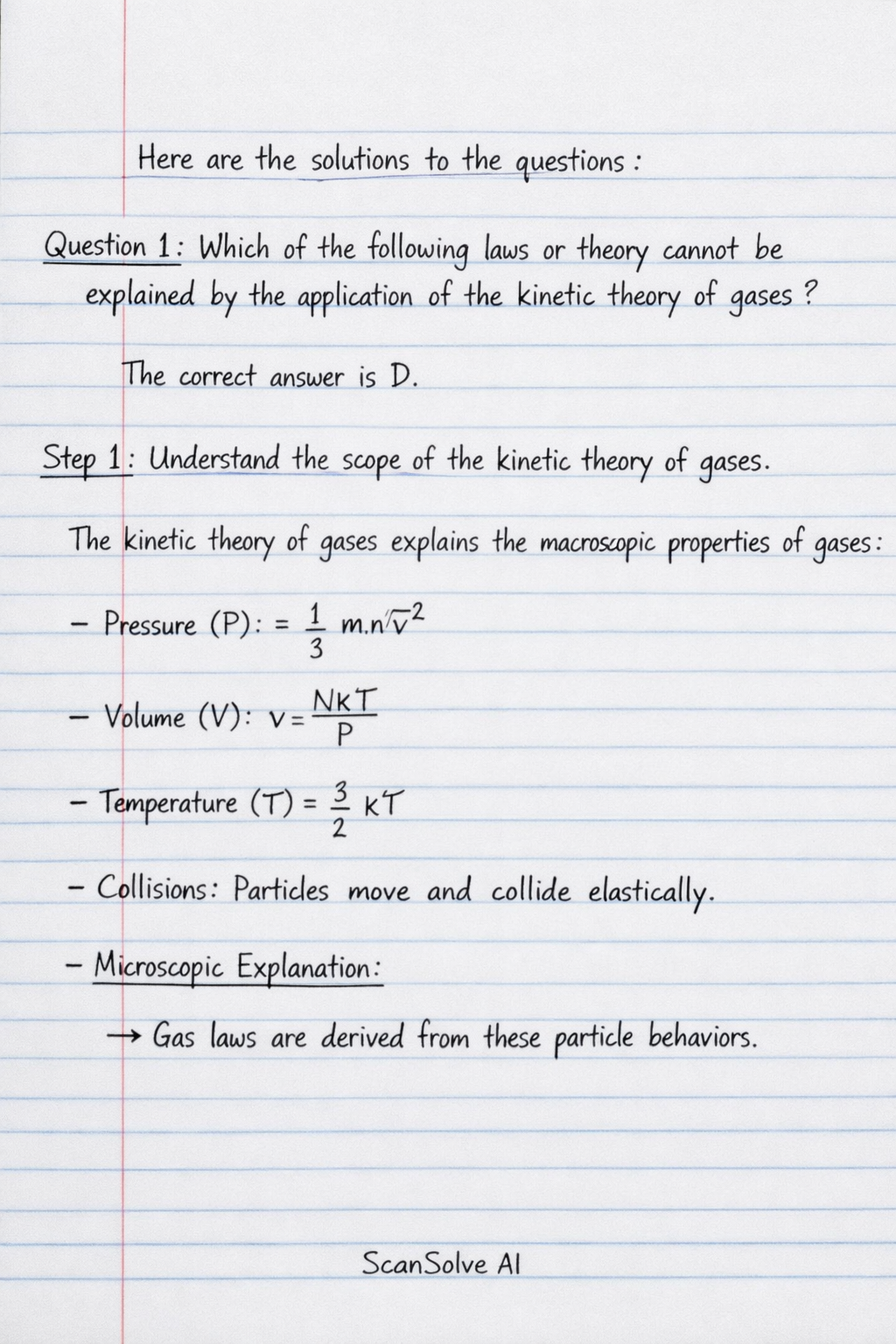
Which of the following laws or theory cannot be explained by the application of the kinetic theory of gases?
ScanSolve AI Answer
Answer
Step-by-step solution
12 stepsHere are the solutions to the questions:
Part 1· 2 steps
Which of the following laws or theory cannot be explained by the application of the kinetic theory of gases?
The correct answer is D.
Understand the scope of the kinetic theory of gases.
The kinetic theory of gases explains the macroscopic properties of gases (like pressure, volume, and temperature) based on the motion and collisions of their constituent particles. It provides a microscopic explanation for gas laws.
Evaluate each option.
- A. Boyle's Law (pressure-volume relationship) is directly explained by the kinetic theory, as decreasing volume increases particle collisions, thus increasing pressure.
- B. Charles' Law (volume-temperature relationship) is explained by the kinetic theory, as increasing temperature increases particle kinetic energy, leading to expansion if pressure is constant.
- C. Gay-Lussac's Law (pressure-temperature relationship) is explained by the kinetic theory, as increasing temperature increases particle kinetic energy, leading to increased pressure if volume is constant.
- D. Dalton's Atomic Theory is a fundamental theory about the composition of matter (atoms are indivisible, elements are made of identical atoms, etc.). It describes the nature of atoms themselves and how they combine, which is a more fundamental concept than the behavior of gases. The kinetic theory of gases assumes the existence of these particles but does not explain Dalton's atomic theory itself.
The final answer is
Part 2· 2 steps
The primary component of natural gas is
The correct answer is A.
Recall the composition of natural gas.
Natural gas is a naturally occurring hydrocarbon gas mixture.
Identify the main component.
The primary component of natural gas is methane (), typically making up 70-90% of its volume. Other alkanes like ethane, propane, and butane are present in smaller quantities.
The final answer is
Part 3· 2 steps
Thermal cracking of alkanes usually
The correct answer is B.
Define thermal cracking.
Thermal cracking is an industrial process that breaks down large, long-chain hydrocarbon molecules (alkanes) into smaller, more useful molecules (smaller alkanes and alkenes) by heating them to high temperatures.
Evaluate the given options.
- A. Thermal cracking is an endothermic process, meaning it requires a significant input of heat energy, not an exothermic one.
- B. The process involves the decomposition of larger molecules into smaller ones.
- C. It produces both smaller alkanes and alkenes, not only small alkanes. Alkenes are a key product of cracking.
- D. It does not require hydrogen; in fact, hydrogen can sometimes be a byproduct, or the process occurs via radical mechanisms without hydrogen consumption.
The final answer is
Part 4· 3 steps
Carbon is deposited in the exhaust pipes of cars because of
The correct answer is C.
Consider the process of fuel combustion in engines.
In internal combustion engines, fuel (petrol) is burned with oxygen. Ideally, this is complete combustion, producing carbon dioxide and water.
Explain carbon deposition.
When there is insufficient oxygen for complete combustion, the fuel undergoes incomplete combustion. This leads to the formation of carbon monoxide () and unburnt carbon particles, commonly known as soot. These carbon particles are then deposited in the exhaust system.
Evaluate the options.
- A. Contamination of petrol with diesel is not the general reason for carbon deposition in petrol cars.
- B. While petrol contains carbon, the presence of carbon itself isn't the cause; it's the incomplete burning of that carbon.
- D. Additives are typically used to improve fuel performance or reduce emissions, not to cause carbon deposition.
The final answer is
Part 5· 3 steps
How many moles of copper would be deposited by passing 1 Faraday of electricity through a solution?
The correct answer is B.
Understand what 1 Faraday of electricity represents.
One Faraday (1 F) of electricity is the charge carried by one mole of electrons ().
Write the half-reaction for the deposition of copper from .
In a solution, copper exists as ions. The reduction of to solid copper () involves gaining electrons:
Use stoichiometry to calculate the moles of copper deposited.
From the half-reaction, 2 moles of electrons are required to deposit 1 mole of copper.
If 1 Faraday (i.e., 1 mole of electrons) is passed:The final answer is
Try one yourself
A new problem that tests the same skill.
Still stuck on this one?
Ask a follow-up, and the answer starts from this question.
More Physics Questions
Handwritten Step-by-Step Solution
Get this as a handwritten image on WhatsApp — like a tutor wrote it for you.
Try on WhatsApp