We read your photo as:

Which of the following quantities is dimensionless? A) Velocity gradient B) Pressure gradient C) Displacement gradient D) Force

Physics

ScanSolve AI Answer

Answer

C

Step-by-step solution

3 steps

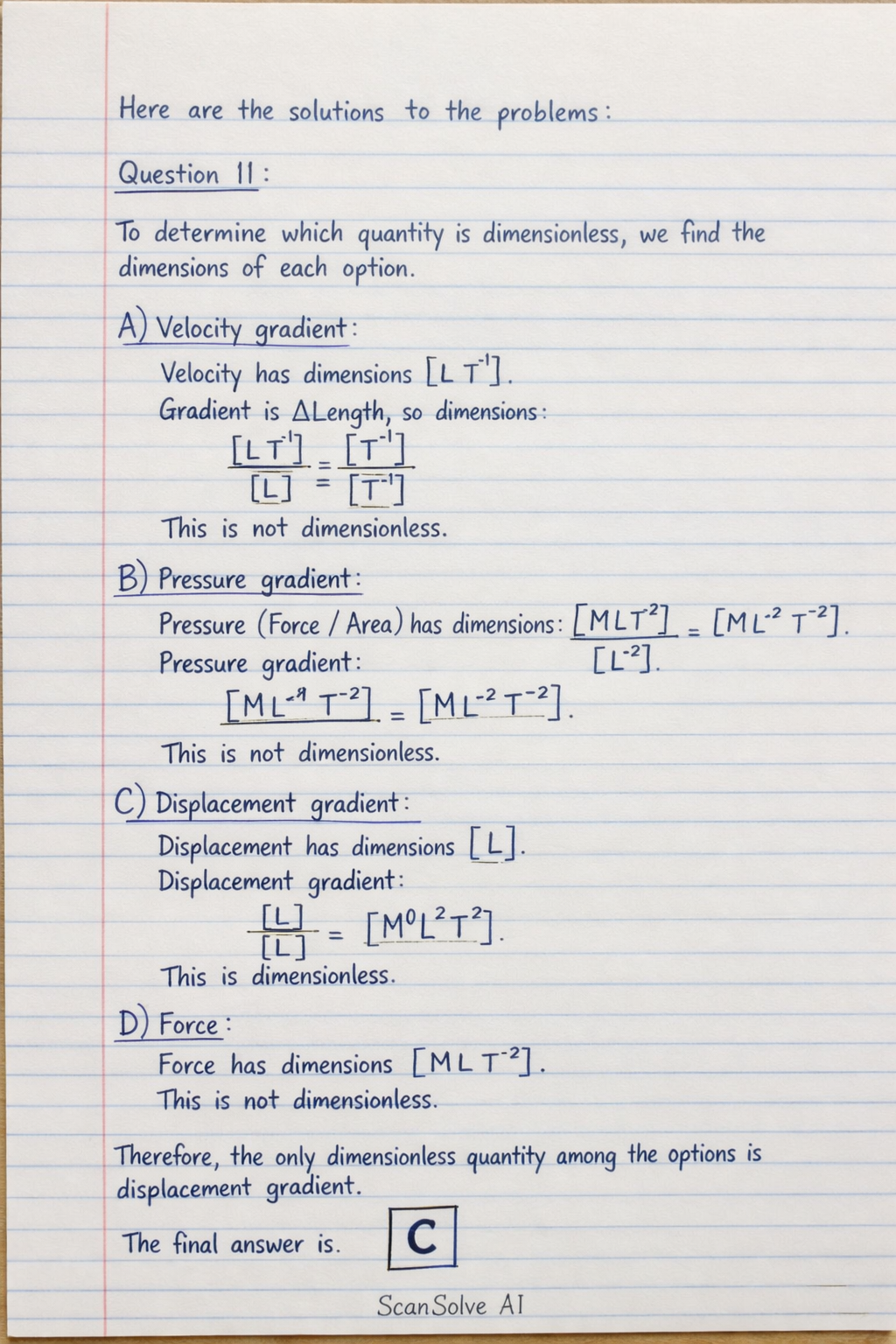
Here are the solutions to the problems:

Part 11

To determine which quantity is dimensionless, we find the dimensions of each option.

  • A) Velocity gradient: Velocity has dimensions [LT−1][L T^{-1}]. Gradient implies division by length, so its dimensions are [LT−1][L]=[T−1]\frac{[L T^{-1}]}{[L]} = [T^{-1}]. This is not dimensionless.
  • B) Pressure gradient: Pressure (Force/Area) has dimensions [MLT−2][L2]=[ML−1T−2]\frac{[M L T^{-2}]}{[L^2]} = [M L^{-1} T^{-2}]. Pressure gradient has dimensions [ML−1T−2][L]=[ML−2T−2]\frac{[M L^{-1} T^{-2}]}{[L]} = [M L^{-2} T^{-2}]. This is not dimensionless.
  • C) Displacement gradient: Displacement has dimensions [L][L]. Displacement gradient has dimensions [L][L]=[M0L0T0]\frac{[L]}{[L]} = [M^0 L^0 T^0]. This is dimensionless.
  • D) Force: Force has dimensions [MLT−2][M L T^{-2}]. This is not dimensionless.

Therefore, the only dimensionless quantity among the options is displacement gradient.

The final answer is C\boxed{\text{C}}

Part 12· 3 steps

  1. Determine the dimensions of Energy (Joule).

    Energy (Work) = Force ×\times Displacement
    Force = mass ×\times acceleration = [M]×[LT−2]=[MLT−2][M] \times [L T^{-2}] = [M L T^{-2}]
    Energy = [MLT−2]×[L]=[ML2T−2][M L T^{-2}] \times [L] = [M L^2 T^{-2}]

  2. Set up the conversion between the old (SI) system and the new system.

    Let n1n_1 be the numerical value in the old system and u1u_1 be the unit in the old system.
    Let n2n_2 be the numerical value in the new system and u2u_2 be the unit in the new system.
    We have n1u1=n2u2n_1 u_1 = n_2 u_2.
    Here, n1=1n_1 = 1 (for 1 Joule).
    The unit in the old system is u1=(1 kg)(1 m)2(1 s)−2u_1 = (1 \text{ kg}) (1 \text{ m})^2 (1 \text{ s})^{-2}.
    The unit in the new system is u2=(α kg)(β m)2(γ s)−2u_2 = (\alpha \text{ kg}) (\beta \text{ m})^2 (\gamma \text{ s})^{-2}.

  3. Calculate n2n_2.

    n2=n1u1u2=1×[M1L12T1−2][M2L22T2−2]n_2 = n_1 \frac{u_1}{u_2} = 1 \times \frac{[M_1 L_1^2 T_1^{-2}]}{[M_2 L_2^2 T_2^{-2}]} n2=(M1M2)(L1L2)2(T1T2)−2n_2 = \left(\frac{M_1}{M_2}\right) \left(\frac{L_1}{L_2}\right)^2 \left(\frac{T_1}{T_2}\right)^{-2}

    Substitute the given values:
    M1=1 kgM_1 = 1 \text{ kg}, M2=α kgM_2 = \alpha \text{ kg}
    L1=1 mL_1 = 1 \text{ m}, L2=β mL_2 = \beta \text{ m}
    T1=1 sT_1 = 1 \text{ s}, T2=γ sT_2 = \gamma \text{ s}

    n2=(1 kgα kg)(1 mβ m)2(1 sγ s)−2n_2 = \left(\frac{1 \text{ kg}}{\alpha \text{ kg}}\right) \left(\frac{1 \text{ m}}{\beta \text{ m}}\right)^2 \left(\frac{1 \text{ s}}{\gamma \text{ s}}\right)^{-2} n2=(1α)(1β)2(1γ)−2n_2 = \left(\frac{1}{\alpha}\right) \left(\frac{1}{\beta}\right)^2 \left(\frac{1}{\gamma}\right)^{-2} n2=1α×1β2×γ2n_2 = \frac{1}{\alpha} \times \frac{1}{\beta^2} \times \gamma^2 n2=γ2αβ2n_2 = \frac{\gamma^2}{\alpha \beta^2}

    So, 1 Joule is equivalent to γ2αβ2\frac{\gamma^2}{\alpha \beta^2} in the new system of units.

    The final answer is A\boxed{\text{A}}

Was this helpful?

Try one yourself

A new problem that tests the same skill.

Still stuck on this one?

Ask a follow-up, and the answer starts from this question.

Got a different question?Ask your own question
Handwritten step-by-step solution preview

Handwritten Step-by-Step Solution

Get this as a handwritten image on WhatsApp — like a tutor wrote it for you.

Try on WhatsApp