
We read your photo as:
Which of the following statements about work and fundamental forces is correct? (Multiple choice questions with provided answers and explanations)
ScanSolve AI Answer
Answer
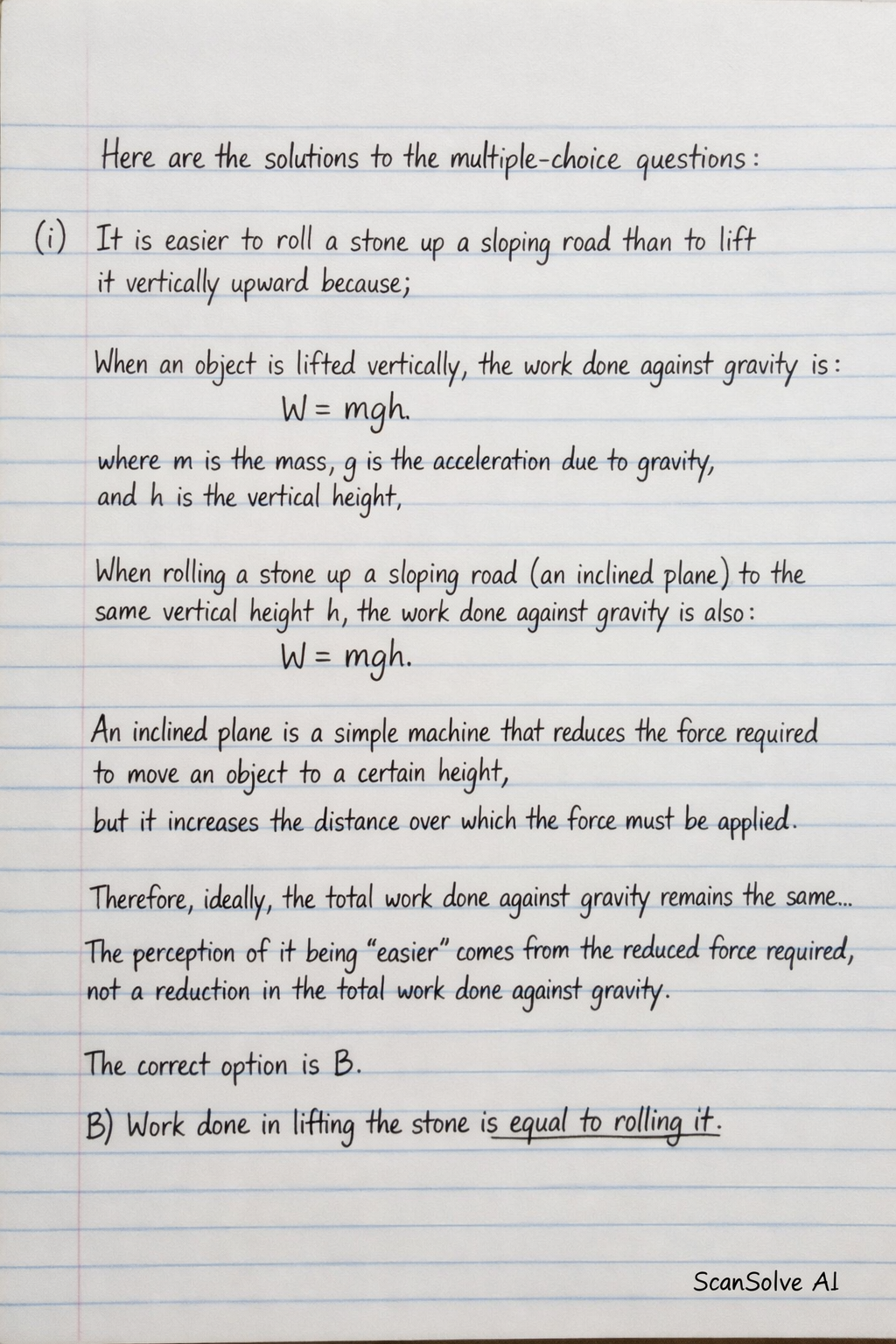
Here are the solutions to the multiple-choice questions:
(i) It is easier to roll a stone up a sloping road than to lift it vertically upward because;
When an object is lifted vertically, the work done against gravity is , where is the mass, is the acceleration due to gravity, and is the vertical height. When rolling a stone up a sloping road (an inclined plane) to the same vertical height , the work done against gravity is also . An inclined plane is a simple machine that reduces the force required to move an object to a certain height, but it increases the distance over which the force must be applied. Therefore, ideally, the total work done against gravity remains the same. The perception of it being "easier" comes from the reduced force required, not a reduction in the total work done against gravity.
The correct option is B.
B) Work done in lifting the stone is equal to rolling it
(ii) is an example of fundamental forces?
Fundamental forces are the basic interactions that govern all phenomena in the universe. There are four known fundamental forces: gravitational, electromagnetic, strong nuclear, and weak nuclear.
Let's examine the options:
- A. Frictional force: This is a macroscopic force resulting from electromagnetic interactions between surfaces. It is not fundamental.
- B. Torsional force: This is a mechanical force related to twisting, not a fundamental force.
- C. Gravitational force: This is one of the four fundamental forces.
- D. Stetetring force: This is not a recognized fundamental force.
- E. Compressional force: This is a mechanical force, not a fundamental force.
The correct option is C.
C) Gravitational force
Try one yourself
A new problem that tests the same skill.
Still stuck on this one?
Ask a follow-up, and the answer starts from this question.
More Physics Questions
Handwritten Step-by-Step Solution
Get this as a handwritten image on WhatsApp — like a tutor wrote it for you.
Try on WhatsApp