

This physics problem tests your understanding of fundamental physical laws and their applications. The step-by-step solution below breaks down the problem using relevant equations and physical reasoning.
ScanSolve AI Answer
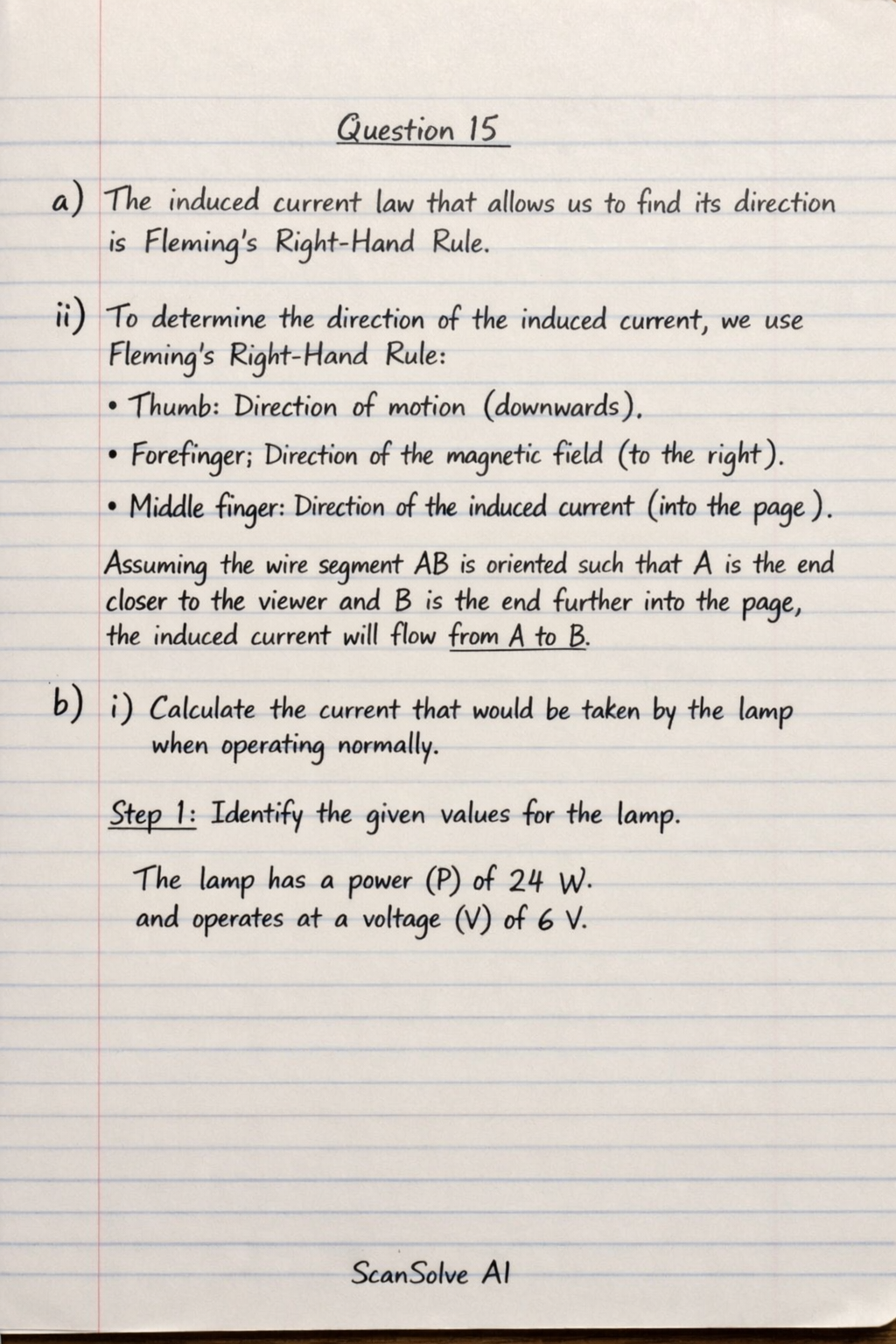
here are the solutions to the physics questions: Question 15 a) i) The induced current law that allows us to find its direction is Fleming's Right-Hand Rule. ii) To determine the direction of the induced current, we use Fleming's Right-Hand Rule: • Thumb: Direction of motion (downwards). • Forefinger: Direction of the magnetic field (to the right). • Middle finger: Direction of the induced current (into the page). Assuming the wire segment AB is oriented such that A is the end closer to the viewer and B is the end further into the page, the induced current will flow from A to B. b) i) Calculate the current that would be taken by the lamp when operating normally. Step 1: Identify the given values for the lamp. The lamp has a power (P) of 24 W and operates at a voltage (V) of 6 V. Step 2: Use the power formula to calculate the current. The formula relating power, voltage, and current is P = VI. Rearranging for current (I): I = (P)/(V) I = 24 W6 V I = 4 A The current taken by the lamp is 4 A. ii) Calculate the turns ratio of the transformer that would be used. Step 1: Identify the given voltages for the transformer. The primary voltage (V_p) is 240 V. The secondary voltage (V_s) is 6 V (the lamp's operating voltage). Step 2: Use the transformer turns ratio formula. For an ideal transformer, the ratio of primary to secondary turns (N_p/N_s) is equal to the ratio of primary to secondary voltages (V_p/V_s): (N_p)/(N_s) = (V_p)/(V_s) (N_p)/(N_s) = 240 V6 V (N_p)/(N_s) = 40 The turns ratio of the transformer is 40:1. Drop the next question!