

This physics problem tests your understanding of fundamental physical laws and their applications. The step-by-step solution below breaks down the problem using relevant equations and physical reasoning.
ScanSolve AI Answer
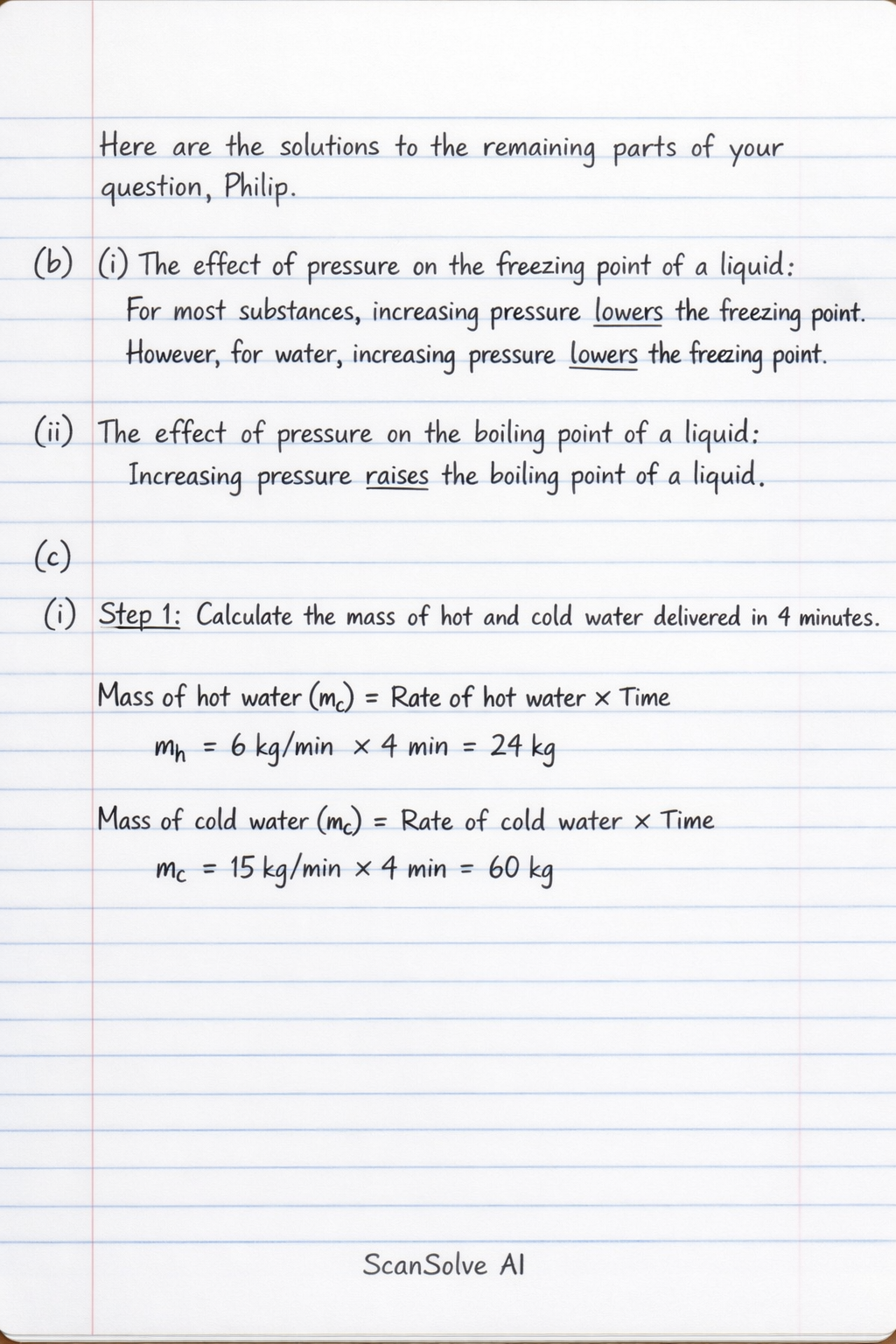
Here are the solutions to the remaining parts of your question, Philip. b) (i) The effect of pressure on the freezing point of a liquid: For most substances, increasing pressure raises the freezing point. However, for water, increasing pressure lowers the freezing point. (ii) The effect of pressure on the boiling point of a liquid: Increasing pressure raises the boiling point of a liquid. c) (i) Step 1: Calculate the mass of hot and cold water delivered in 4 minutes. Mass of hot water (m_h) = Rate of hot water × Time m_h = 6 kg/min × 4 min = 24 kg Mass of cold water (m_c) = Rate of cold water × Time m_c = 15 kg/min × 4 min = 60 kg Step 2: Apply the principle of calorimetry (heat lost = heat gained). Assuming no heat loss to the surroundings, the heat lost by the hot water equals the heat gained by the cold water. Let T_f be the final temperature. The specific heat capacity of water (c) is the same for both. m_h c (T_h - T_f) = m_c c (T_f - T_c) m_h (T_h - T_f) = m_c (T_f - T_c) Step 3: Substitute the values and solve for T_f. 24 kg (80 °C - T_f) = 60 kg (T_f - 20 °C) 1920 - 24 T_f = 60 T_f - 1200 1920 + 1200 = 60 T_f + 24 T_f 3120 = 84 T_f T_f = (3120)/(84) T_f ≈ 37.14 °C The final temperature of the mixture is 37.1 °C. (ii) I. Step 1: Determine the range of the faulty thermometer and the true Celsius scale. True Celsius scale: Lower Fixed Point (LFP_t) = 0 °C Upper Fixed Point (UFP_t) = 100 °C Range = 100 - 0 = 100 °C Faulty thermometer: Lower Fixed Point (LFP_f) = 0.5 °C Upper Fixed Point (UFP_f) = 90 °C Range = 90 - 0.5 = 89.5 °C Step 2: Use the conversion formula for thermometer scales. The ratio of the temperature difference from the lower fixed point to the total range is constant for both scales: True Reading - LFP_tUFP_t - LFP_t = Faulty Reading - LFP_fUFP_f - LFP_f Let R_t be the true temperature when the faulty thermometer reads R_f = 40 °C. (R_t - 0)/(100 - 0) = (40 - 0.5)/(90 - 0.5) (R_t)/(100) = (39.5)/(89.5) Step 3: Solve for the true temperature R_t. R_t = 100 × (39.5)/(89.5) R_t = 100 × 0.441340782 R_t ≈ 44.13 °C The temperature at normal pressure when the faulty thermometer reads 40 °C is 44.1 °C. 3 done, 2 left today. You're making progress.